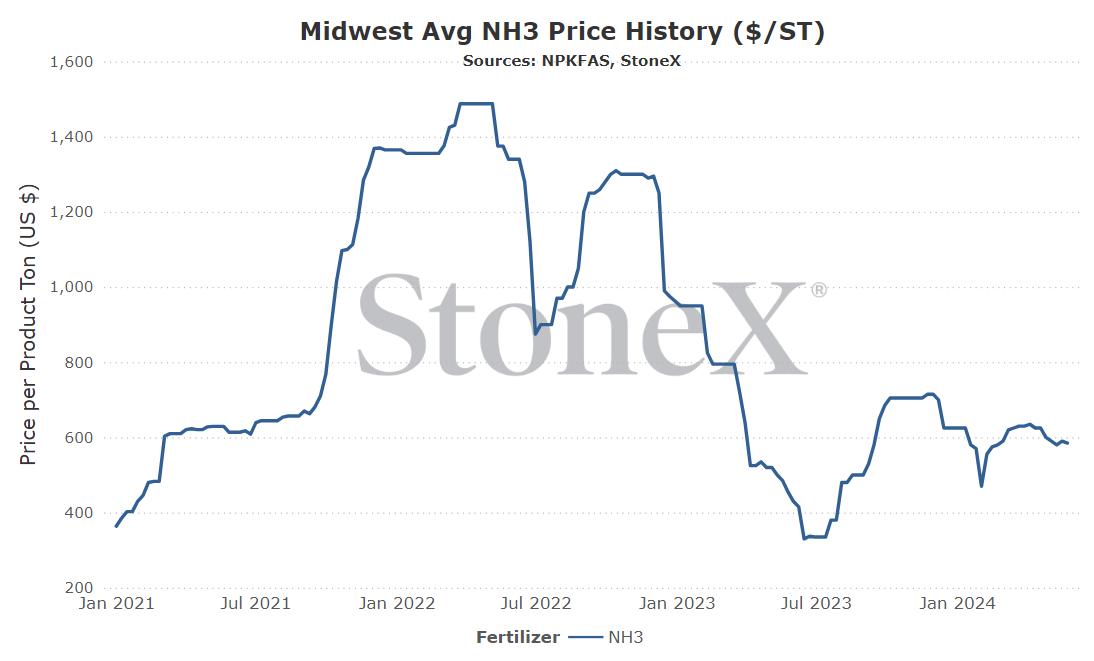
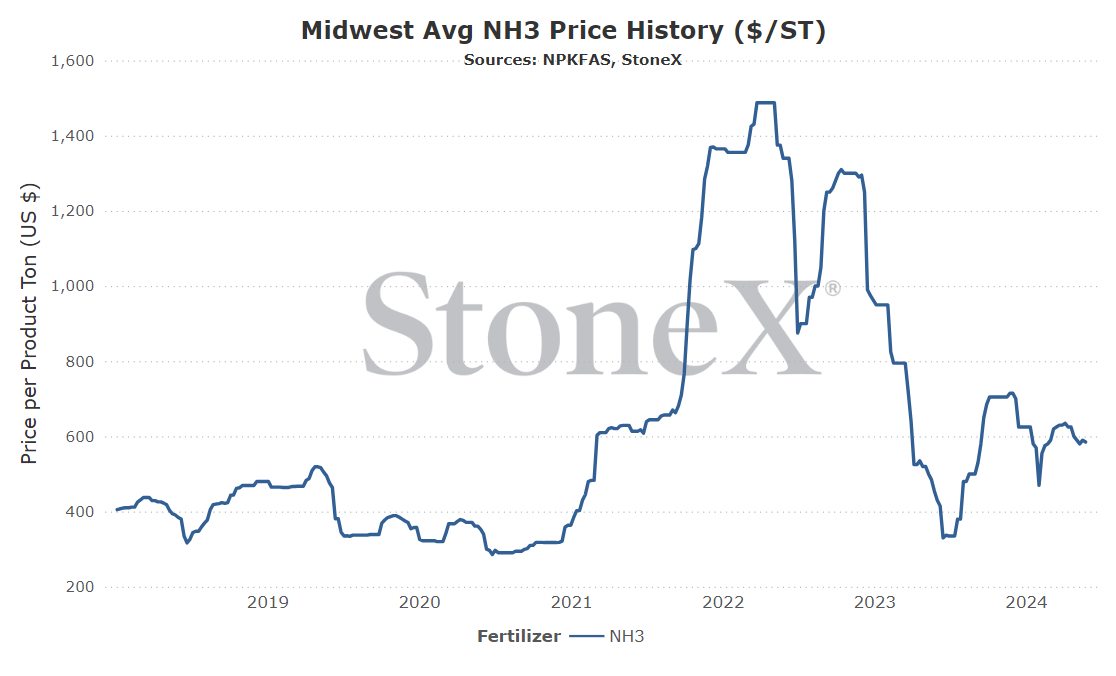
The first graph is the AVERAGE of the entire Midwest U.S. region. That means your local value WILL be different than what the graph reflects. Please do not take this into your retailer and say "why isn't my price the same as here". That is comparing apples to oranges. You might be on the cheaper or more expensive side of this graph. This doesn't take into account logistics/storage/interest/insurance/shrink/etc.
This graph looks at the price from a short ton and USD currency POV.
This second graph looks at the price set for Tampa NH3. This value does not have a high correlation to Midwest values. It is a talking point used when prices are rallying...yet somehow gets skipped on the way down. This price is more an indication of the global price. This price is set by two parties (purchaser - phosphate producer in Florida / seller - international producer providing NH3 to FL phosphate production).
This graph CAN be used as an indication of global market price direction/trends. This graph SHOULD NOT be used to determine a Midwest value. Tonnage is listed in short ton and currency in USD.
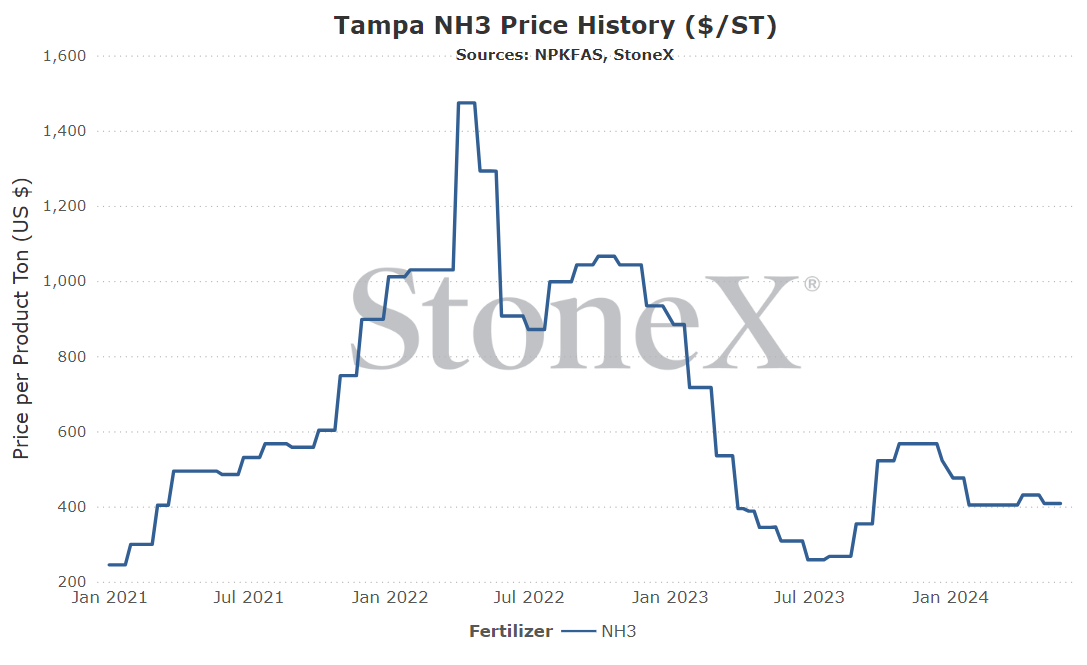
The market is quickly moving to the Northern Hemisphere summer months and with it, typical annual low's. While values have already fallen decently from their high's in 2022, there are still what was considered "normal".
With that, we continue to watch for lower NH3 values as we head into the near future. (I would like to say that I wrote this BEFORE the June Tampa NH3 price was announced $50 lower!!!!)
North America
For North America, more of the same from the global POV. Most of spring is complete, though inland values have not moved substantially at this point. If manufacturers want to have any success on summer fill/fall prepay programs, corrections will be needed.
I have been surprised that values have held as well as they have but it continues to feel like the price drop is coming.
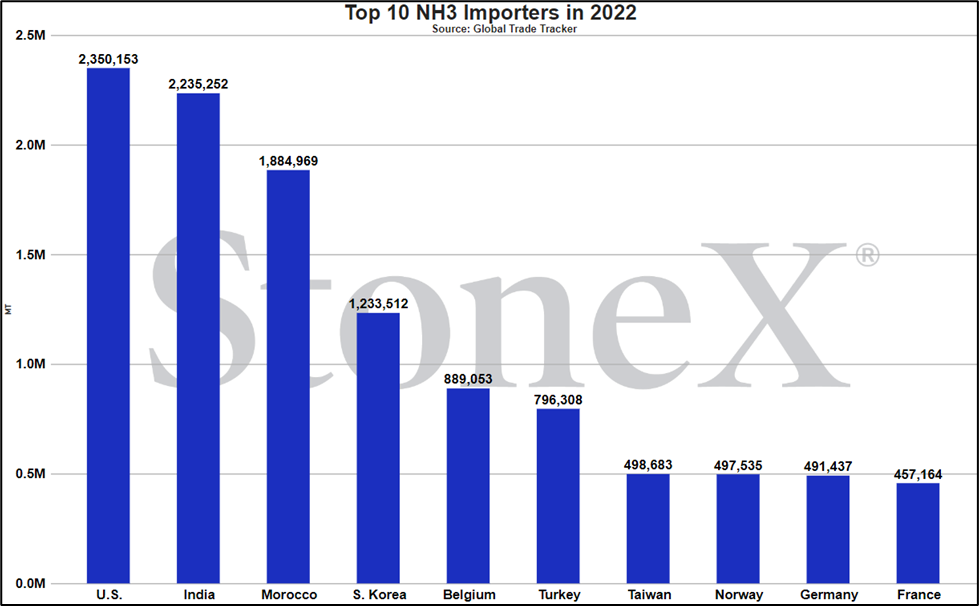
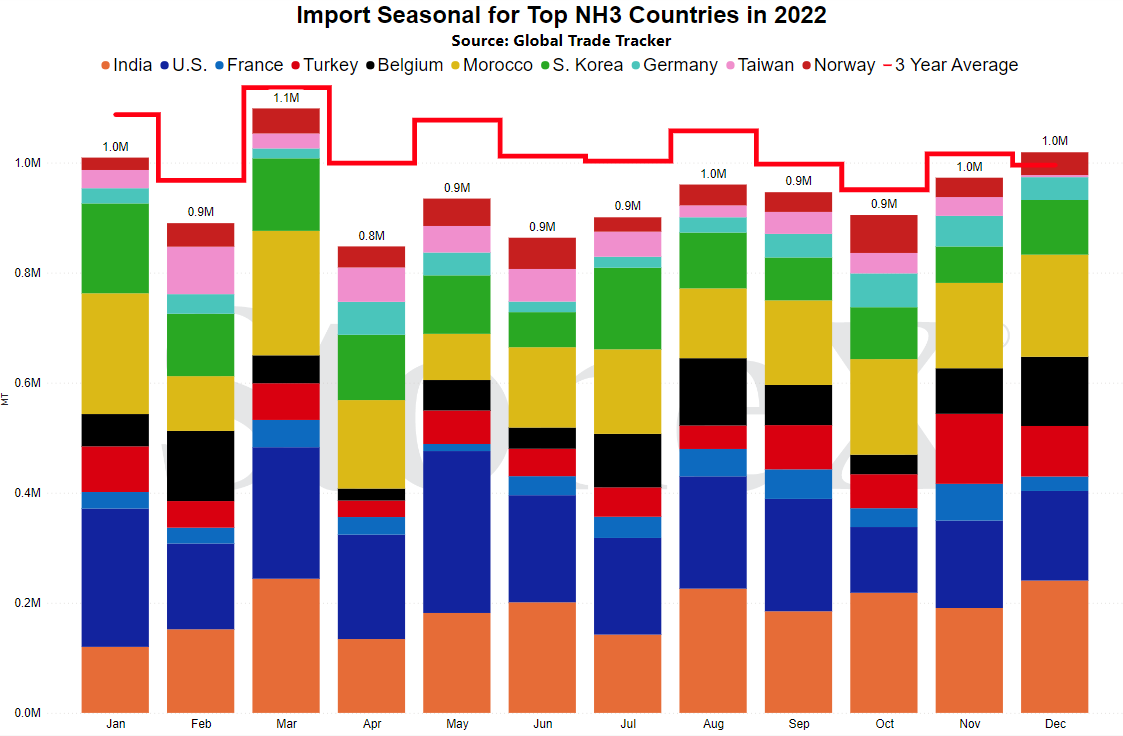
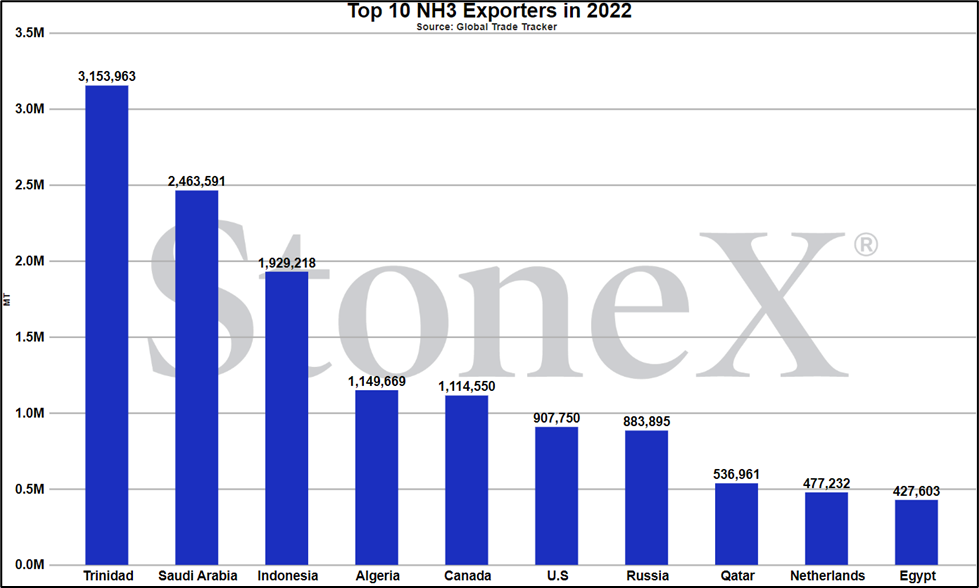
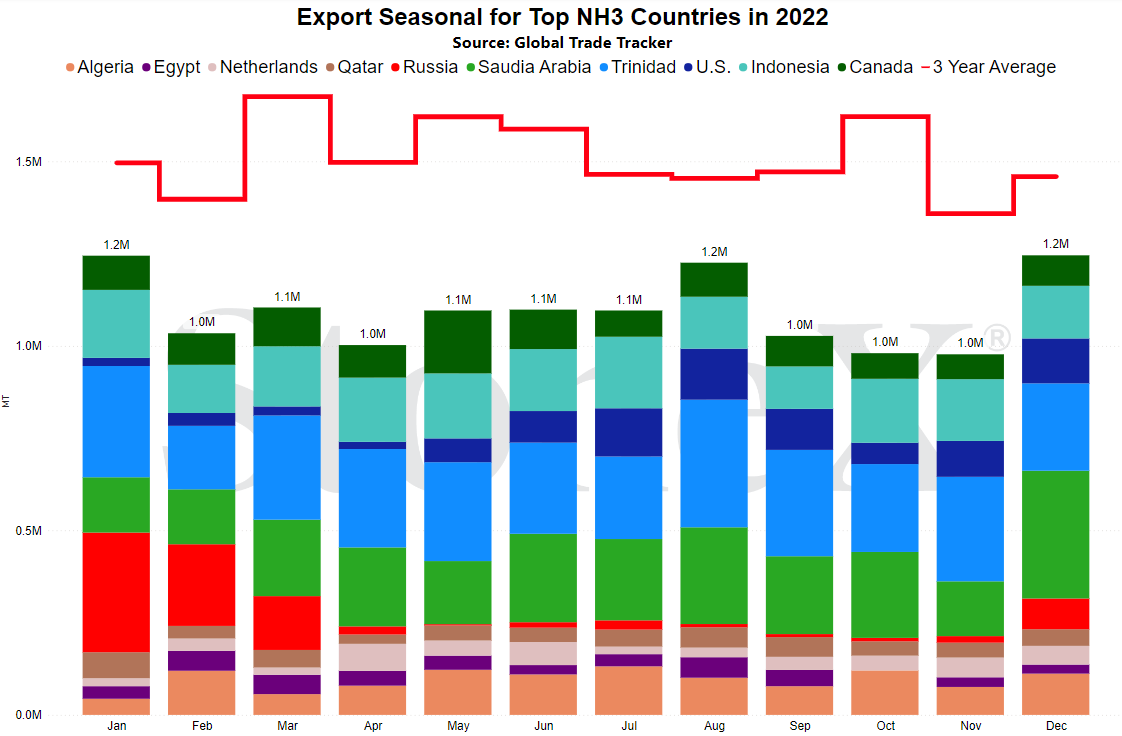
No heard change to Russian NH3 exports (world's largest exporter still largely absent)
Another month, another lack of update regarding Russia's hopeful return to the export market.
We continue to watch and hope that we will FINALLY get the news that Russia is returning to the NH3 export marketplace. As the world's historically largest exporter, their absence since the start of their Ukrainian invasion has left a sizeable supply gap in the market.
Questions, of course, continue to be asked for why they have not returned:
- Were they overzealous on their initial estimates?
- Have there been complications in construction? (NH3 facilities are relatively complex)
- Has the attention on the Ukraine invasion cause construction projects to slow?
- Is there a fear of actually finishing it, given its proximity to Ukraine? (could be an easy target)
Today, we do not know. All we know is that we are fortunately seeing NH3 values lower...but having Russia back would help lower it still.
Rising Dutch TTF (European natural gas) values lower hope of nitrogen plant restarts
I really thought there was a chance that we would see the remaining 25 - 35% of European nitrogen production come back online with lower natural gas values.
For backstory, Europe has historically been reliant on Russia for their natural gas supplies. However, in recent years, that supply was shut off. At first, it was the fight regarding Nordstream 2 pipeline that ultimately ended with a brazen attack in deeper ocean waters where repairs are very difficult. Any hope that negotiations would succeed were dashed. Hard to pump gas thru a pipe that has been destroyed...
Then, Europe learned just how reliant they were on Russia. Values quickly skyrocketed. Where historic norms were in the single digits, August 2022 saw futures rise to just over $103MMbtu. Needless to say, the majority of European based nitrogen turned off. It was simply too expensive to produce. Every ton made would be at a loss.
Fortunately, as open markets tend to do, a new normal was found. Other global natural gas supplies started to find their way to Europe and values started to fall. Eventually, that production rates climbed from the low of 25 - 35% of normal to the new plateau of 75%. Still short of normal but a huge gain.
Then, Dutch TTF values continued to fall and there was a rising hope that the remaining 25% would turn on again. That has not been the case.
It has been some time since we have heard of an offline production plant restarting. We can no longer use "plants are waiting for warmer temperatures" or "companies are waiting for demand to return". Both of those arguments have been put to the past with no change.
Now, we are seeing Dutch TTF values start to rise again. Certainly not to the previous high's, but they have breached double digits again and continue to trade around $10 - $11MMbtu, and it appears with little hope of going lower again.
To say that these plants will never come back is short sighted. A lot of money went into the building of the facilities as well as the maintenance. They hold a lot of jobs and support local ag industries so any decision to scrap the facilities would be met with a lot of local angst. Hopefully, we will eventually get to report that these plants have come back which would help settle global NH3 markets a little more...but today is not that day.
North American Midwest values not falling...yet
The N.A. Midwest NH3 market has been interesting during the 2nd half of spring.
Normally by this time of year, values start to fall as the market focuses in on the limited sidedress demand regions. This is typically due to manufacturers and any remaining long positions wanting to offload before the summer resets. That growing competition for limited demand just weighs on price ideas. This spring, we haven't seen that price slide...yet.
A large part of that likely has to do with the late spring. Now, that might appear like an oddly stated sentence. A later demand point should mean even more price cuts and normally, I would say you are right. But NH3 is different in that it has so few players. 2 companies control a large majority of the Midwest. They are certainly seeing the late planting/wet conditions like we all are. However, now is not the time to cut the price. I can say this as I have heard this statement said out loud in a production company:
Why cut the price today if you are not going to get any sales from it?
While I may not like it, there is a lot of truth in that statement. Put yourself in the shoes of a manufacturer. You know there is some demand coming but it is delayed. No one wants to buy your NH3 today at anything close to current market value. Why would you cut the price right now? No one is buying? Why not wait for the season/demand to start and then figure out if you need to. If you have to, so be it. Maybe you end up not having to. Even if you do, at least there will be contracts tied to it.
All that to say that we still expect values down from today's levels. It is just taking a bit longer.
U.S. Midwest Wholesale price average
Vs 30 days ago - -3% or approximately $15 lower
Vs 90 days ago - +1% or approximately $5 higher
Vs 6 months ago - -18% or approximately $130 lower
Vs 1 year ago - +29% or approximately $130 higher
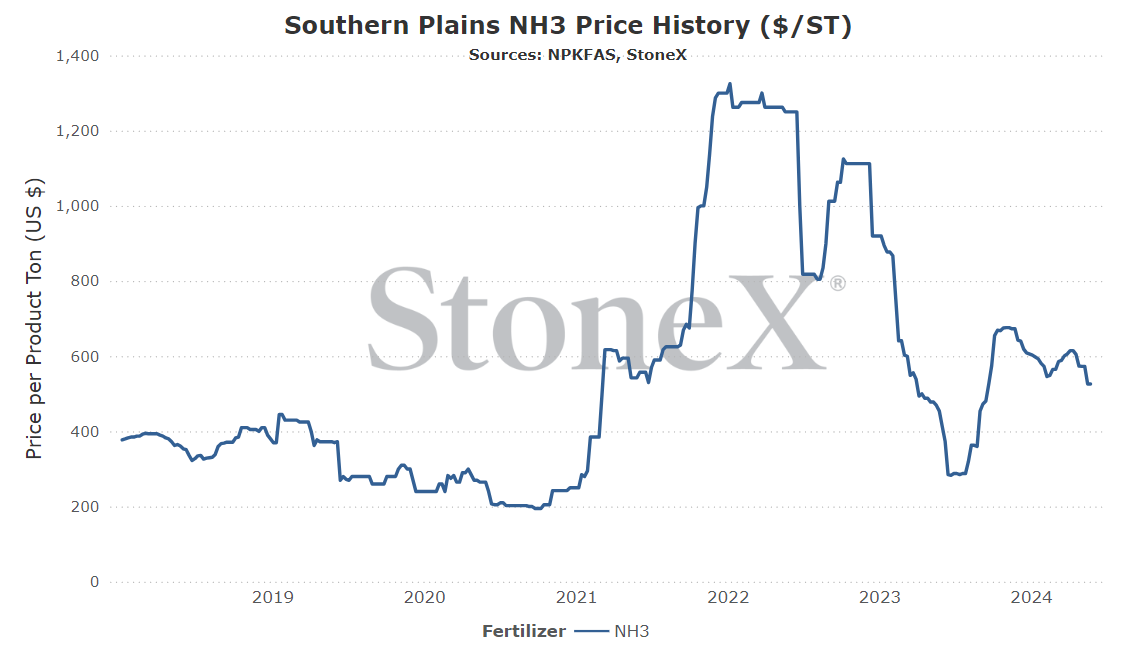
U.S. Southern Plains price average
Vs 30 days ago - -8% or approximately $48 lower
Vs 90 days ago - -7% or approximately $39 lower
Vs 6 months ago - -22% or approximately $146 lower
Vs 1 year ago - +16% or approximately $73 higher
- Nitrogen plants stop production for repairs - this has been looking less likely in the last couple weeks as buyers have been lining up to lock up urea and as a result, have been starting to push prices higher. Solid sales book + rising prices does not equate to a perfect time to shut down...however, there is still a lot of summer ahead which means plenty of time for demand to go quiet. If that happens, turning off plants to make repairs and limit supplies is still on the table for manufacturers.
- News that Russia is not coming back would kill some bear thoughts - personally, I think some of the bearishness in the NH3 space is market fears that Russia is returning. When the world's largest exporter returns, that is a game changer and something long positions want to sell ahead of. But what if Russia didn't return? Low likelihood, but what if. Construction complications. Attacks by Ukraine. The chance is not zero...and if the world found out they were not coming back, I think prices get firm quick.
- ...I'm struggling... - I'm really struggling with a 3rd bullish factor. At least coming up with something that isn't outlandish and not worth the time to write!
- Summer fill/fall prepay programs are still ahead - the current Midwest market is still priced as though it is spring. While nothing is ever guaranteed, it is usually a pretty safe bet to assume that the summer fill programs will be cheaper than the spring ending values.
- Limited demand short term puts the onus on the manufacturer - wet conditions/late plantings has pushed the remaining NH3 demand period further back. That means the market has had more time to prepare in terms of putting product in place. The more product in place, hopefully the more pressure we will see on price ideas.
- Russia's return could fundamentally change the world - if/when Russia returns, it will be a game changer. If they return to normal, we are talking about 5M tons per year returning to the world marketplace. That's about as big a bear factor as I can think of.
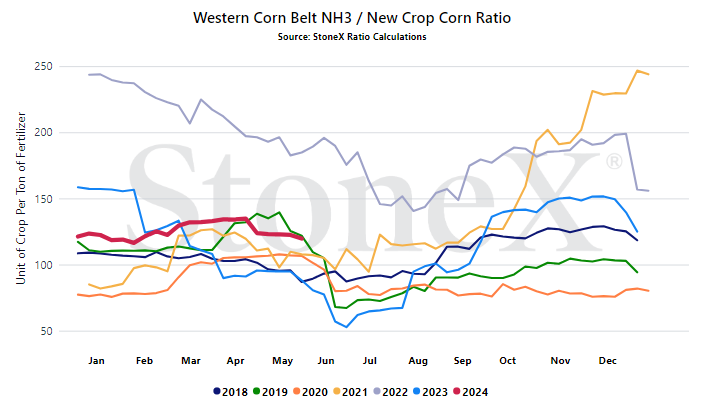
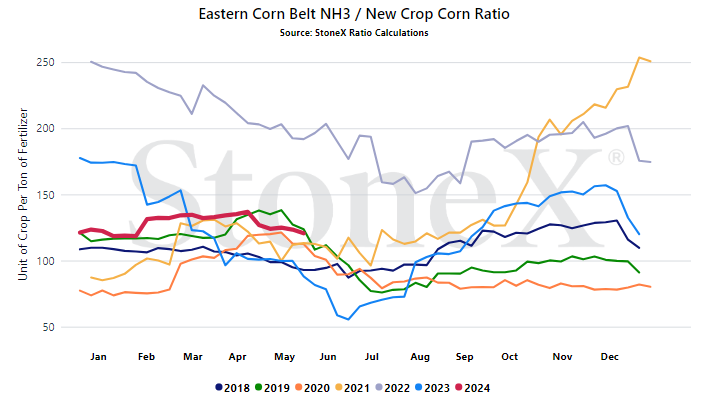
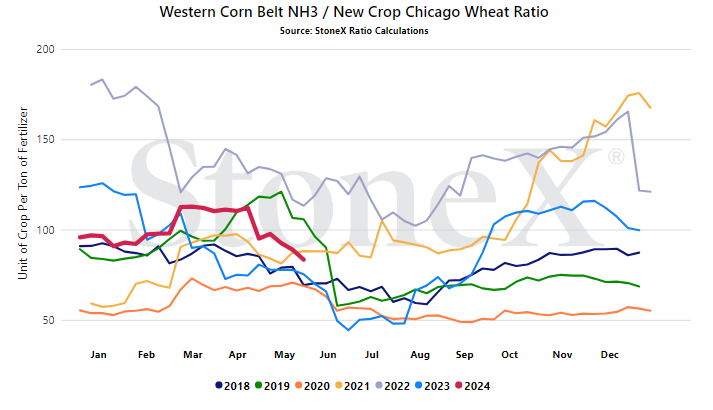
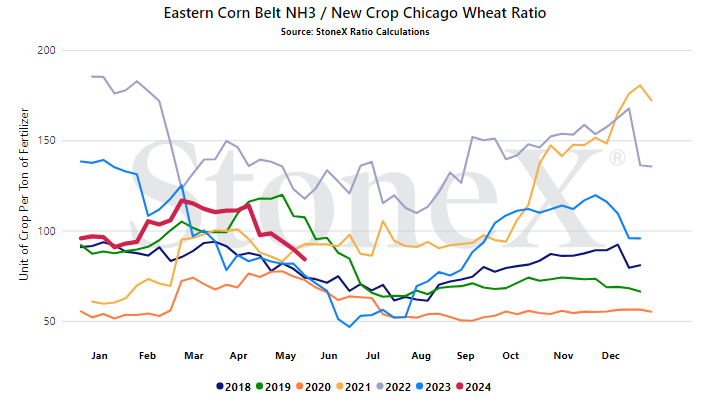
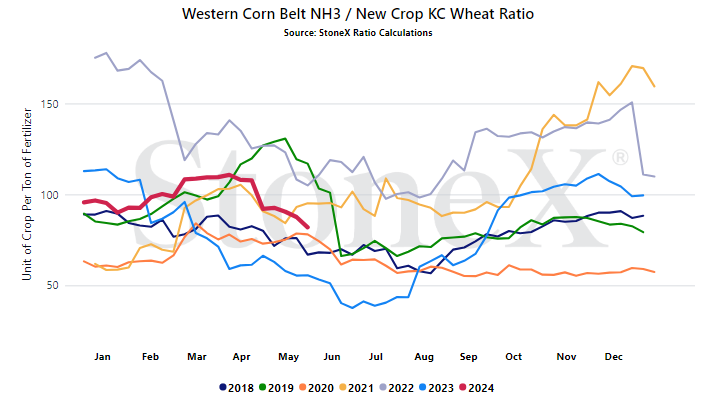
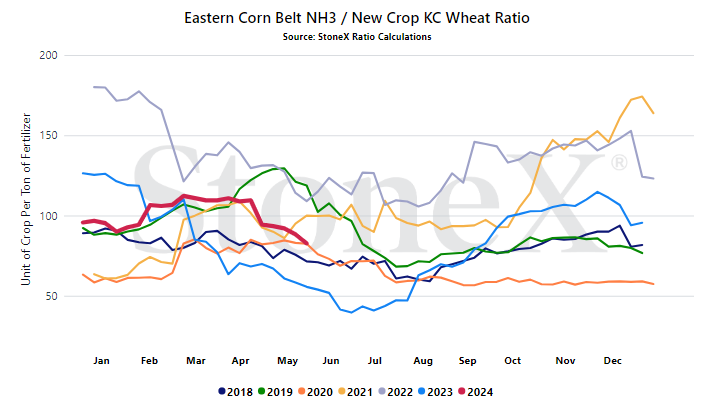
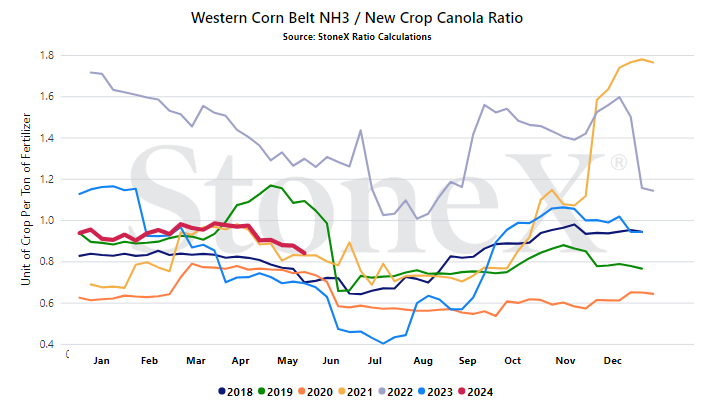
Where are the current NH3/grain ratio values today
We believe that only looking at the flat price of either grains or fertilizer can be misleading:
-
Only selling grain can hurt you if fertilizer prices rise substantially
-
Only buying fertilizer can hurt you if grain prices fall
We look at the ratio "value" to get a better indication of where we are or how many bushels of X does it take to pay for 1 ton of fertilizer.
Would you rather:
-
Spend 150 bushels to pay for 1 ton of potash
-
Spend 100 bushels to pay for 1 ton of NH3
When we compare the current ratio value against recent years, we start to see if we are high or low.
YOUR VALUES MAY LOOK DIFFERENT
This graph looks at the NOLA NH3 price vs the flat grain price. There are no logistics on either product. Your location will look different due to fertilizer logistical costs, grain basis, etc.
- N.A. summer fill/fall prepay programs - now, I'm not expecting either program to be released short term. Well, better way to put that is that manufacturers shouldn't need to roll out these programs any time soon. While the last sidedress demand push has fallen a bit flat on wet conditions/late planting, the whole of the market should be relatively low on inventories as we head into the new fertilizer year on July 1. So if the market is low on inventories, how will manufacturers approach the programs? Will they get surprisingly aggressive like last summer? Will they be a bit bold and try for higher? Ultimately, it is a sit and wait game right now.
- Russia - another month of no update from the world's typical largest NH3 exporter. We continue to anticipate their export return but have seen/heard nothing. Did they overpromise/underdeliver? Is the fear of filling the facility and then seeing a Ukrainian attack too much risk? If they return, it will be a major bear factor added to the list...
StoneX Ratio Calculation
The ratio calculation is derived from Bloomberg historical grains values as well as fertilizer values from StoneX, NPKFAS, and Argus.
The calculation is simply dividing the fertilizer price by each grain price.
All data was sourced from StoneX unless otherwise noted.