Global
This comes down to 2 scenarios for me:
1. If global manufacturers do not change their production rates, I think we see prices lower in the coming weeks/months.
2. If global manufacturers do start to scale back production to fight lower prices, we may not see much of a price reset this summer.
Unfortunately, that is the reality of the potash market today. We still continue to see the global market as oversupplied but we also see manufacturers tired of seeing nitrogen and phosphate markets being high priced while potash does little to nothing. They want their fat margins.
It would take more than one or two production curtailments to make prices rise, but weirder things have been happening.
North America
Barring a major change in global manufacturing rates, I am hoping to see values lower in the coming months. Buyers do not appear in a hurry to buy potash like they are for phosphate. This could cause manufacturers to lower price ideas in an attempt to bring that demand forward.
Now, will that happen? Maybe not. Again, as mentioned above, potash manufacturers are tired of seeing phosphate and nitrogen producers absolutely slaying it with high prices/margins. They are likely tired of potash not doing much of anything and may be ready to take action.
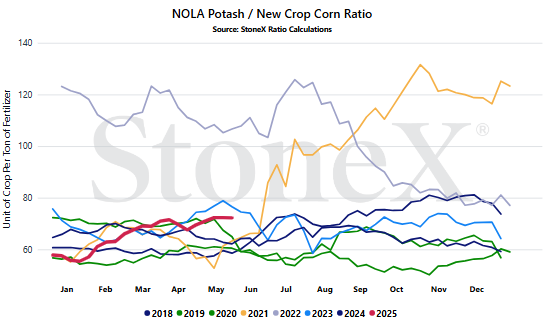
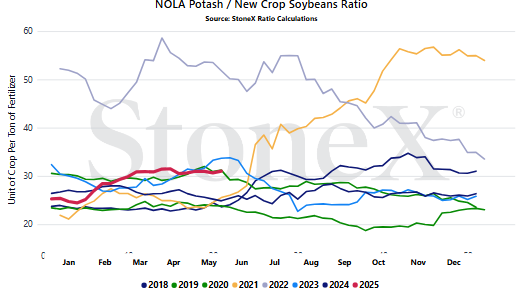
The fundamentals of today's market tells me prices need to be lower. It is on the higher side of normal vs corn. Interest costs are very real. Retailers will be more cautious on position taking. Farmers are struggling with low grain prices/high input prices and so are not going to be in a spending mood.
Again, barring a major production shift, prices should be lower.

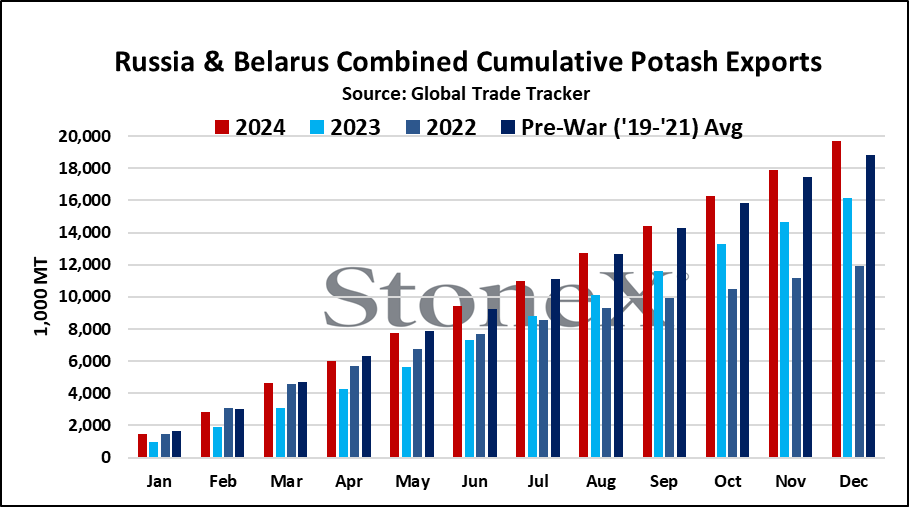
Russia/Belarus potash exports rates above pre-invasion levels
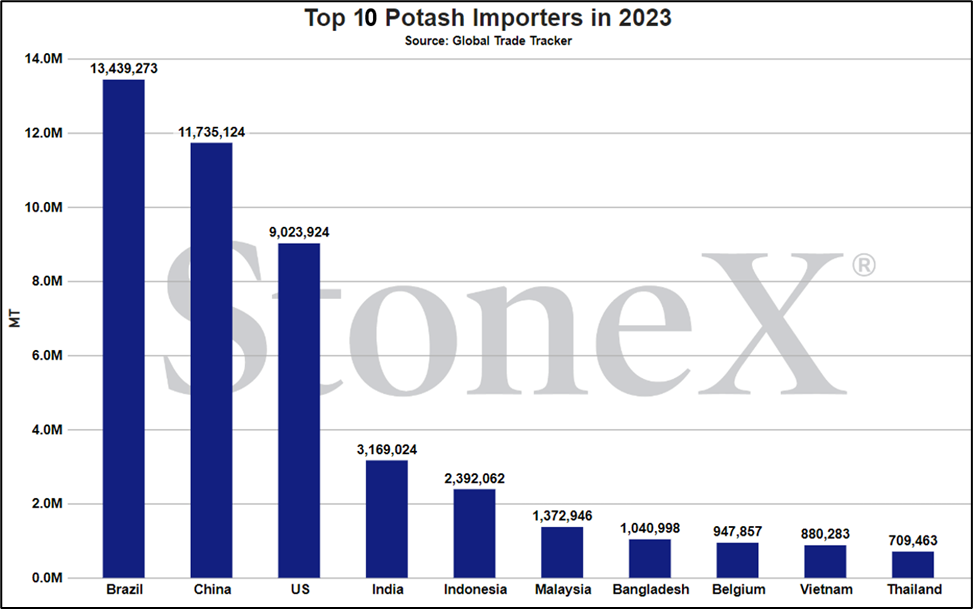
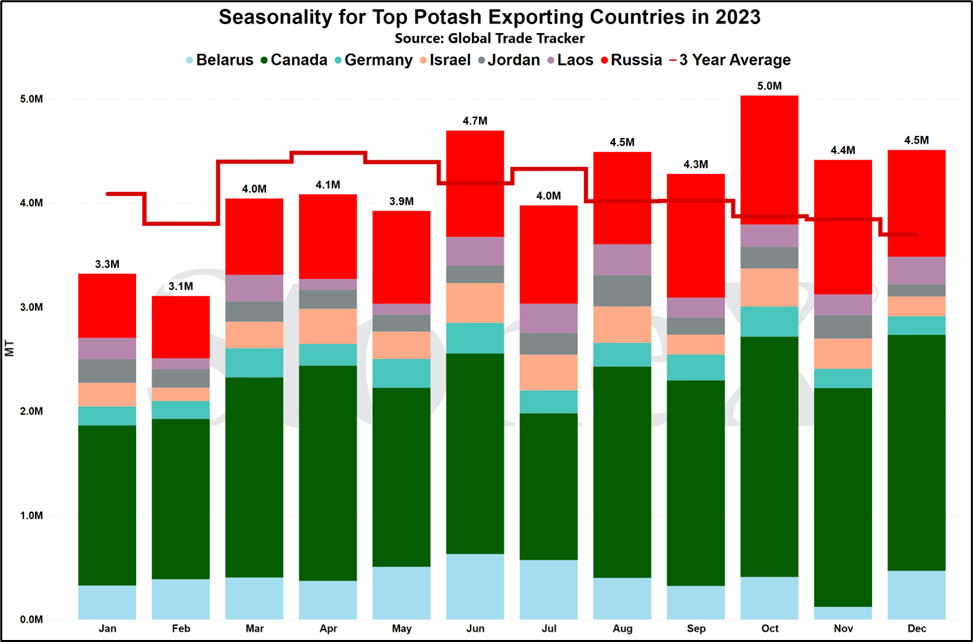
Back in late 2021/early 2022, global fertilizer markets were scared. Russia was taking steps to invade Ukraine and international parties started to fear the loss of Russian fertilizers. Russia is a large exporter of all major fertilizers. For potash, they were the 2nd largest exporter in 2023 with over 11M tons. This pales in comparison to the world's largest in Canada who exported nearly 23M in the same year, but Russia was still an important part of the global S&D. As Russia marched into Ukraine, it appeared a very real possibility that the world would stop doing business with Russian companies.
To be fair, Russian and Belarusian potash exports combined did take a hit, but this was skewed more by a lack of Belarusian tonnages. When Lithuania closed its borders to Belarus, they were left with few options to ship their potash to the world. However, they never gave up on finding new export routes.
Today, Russian and Belarusian potash exports are now higher than they were prior to the invasion. Belarus has developed new routes, largely by Russian and Chinese avenues, to ship their product around the world. Russia has also been working to boost their own production and those new flows are being seen.
This is a good thing for global buyers. More supplies should mean lower prices, assuming it outpaces demand growth. This, coupled with continued production gains in Canada/Russia/Laos/etc., should continue to keep the global potash market well supplied!
What does this mean for farmers?
This is a very good thing for farmers.
Russia and Belarus having their export flows fall was a large part of why global values skyrocketed in late '21/early '22. Now that they have returned, it continues to help keep potash values in line with grain market values. Better yet, as more exports and production continue to appear, it further increases supplies and should help to correct values even lower...assuming manufacturers do not take action by curtailing production.
EU farmers may suffer due to attempts to block Russian fertilizers
Recent weeks have seen EU members pushing further penalties in an attempt to block Russian fertilizers. Their approach is justified. They support Ukraine in their fight against Russia's invasion. If Ukraine were to fall, who is to say that Russia may not start to target other nations next. Better to support Ukraine than to have that fight on your own soil. In that review, they have correctly noticed that Europe continues to buy a lot of Russian produced fertilizer which is helping to fund Russia's war effort. It makes perfect sense to want to cut that supply chain and penalize Russia.
Unfortunately, like most things, the cost of this move will be worn by EU farmers.
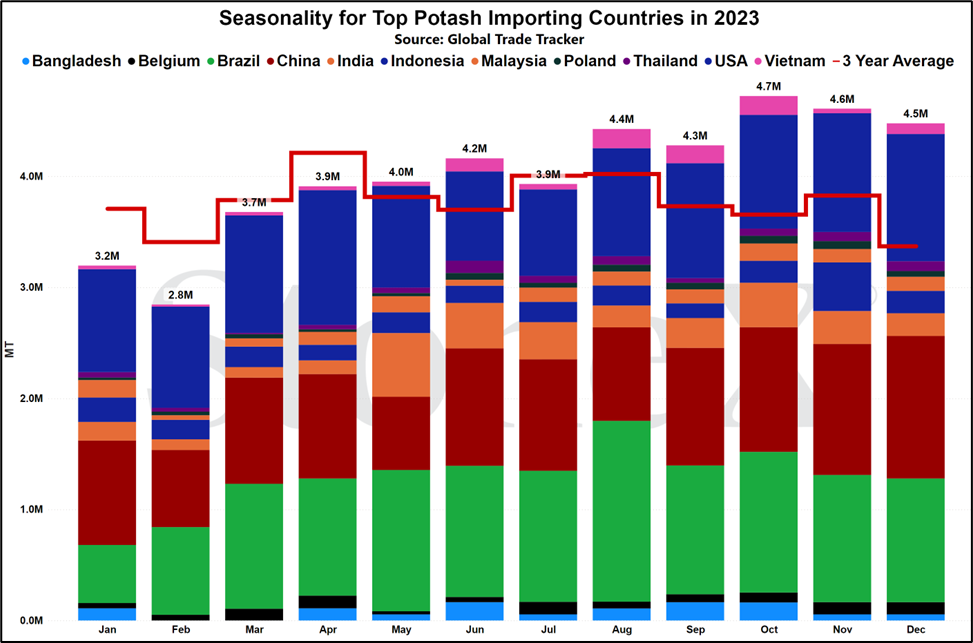
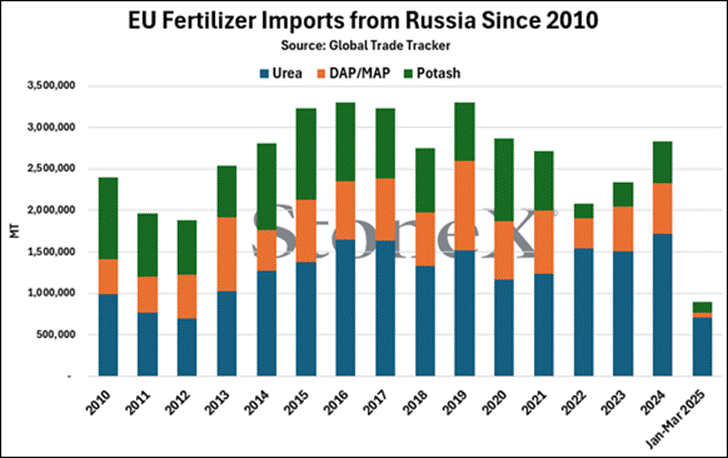
As the graph below shows, there is a solid chunk of potash that originates from Russia. This occurs because this is a natural and relatively cheap trade flow. What this chart does not show is Belarusian potash flows which could also be considered for blockades by the EU if it sees fit.
Regardless, if the EU presses ahead with blocking Russian fertilizers/potash, EU farmers will be forced to look elsewhere. That creates more competition in the marketplace and it likely bears a higher logistical cost. The importers are not going to eat that added cost, they will pass it along. The retailer does not have the margins available to eat the added cost...you know what they say rolls downhill...
This is still a story in progress but all signs are pointing to these blockades becoming reality. If/when they do, EU farmers need to watch out.
What does this mean for farmers?
For EU based farmers, this likely means higher prices. If policies are approved that block Russian potash flows, that means losing a very efficient trade route. Someone somewhere around the world may benefit from the situation as Russia looks to other export options, but EU farmers will have to bear the burden of higher logistical costs.
Manufacturers attempting to push values higher out of spring, ahead of summer fill
My view for the last month or two was that potash prices rising to start and into application season of 2025 was justified. The fall run across North America was solid, which led to lower ending inventories that needed refilled. The fall run was late and saw farmers/retailers working until nearly Christmas. Normal winter fill is December/January/February. By running through most of December, a 3rd of the fill period was lost. Then there was the growing demand due to rising corn acre expectations. It was a trio of factors that made price increases make sense.
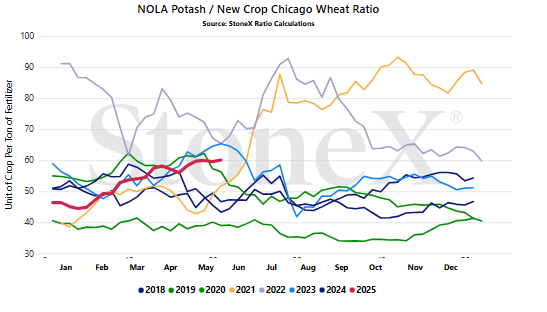
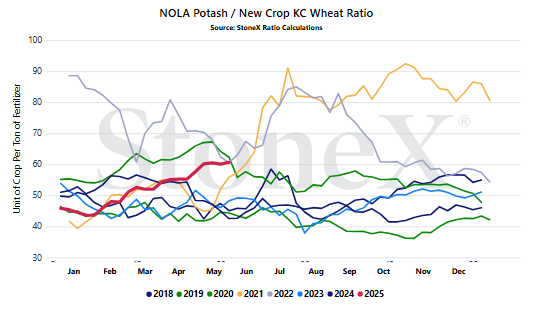
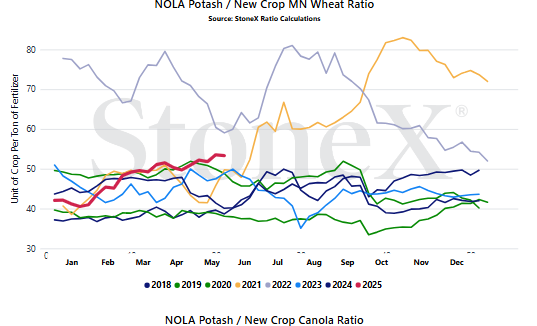
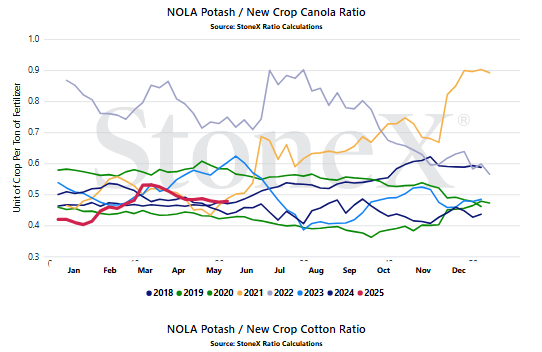
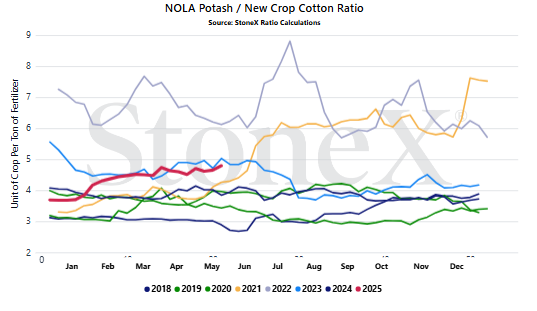
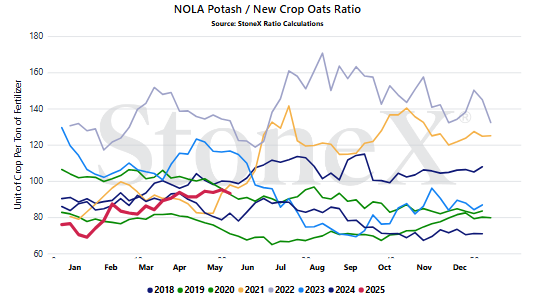
However, once spring applications started to wrap up, values started to look on the high side. The summer fill period is very long so plenty of opportunity to refill the coffers. Farmers were not in a good financial spot due to low grain prices. Retailers are nervous position takers due to knowing how hard their farmers are hurting. Then there was the current potash price vs grain values (see the charts below). They are not overly out of line like phosphate values are, but they are certainly on the high side which should be another reason for farmers and retailers to say "no thanks" until something better comes along.
But that doesn't mean manufacturers will not try to keep prices high/push them higher.
That is what we have been seeing. Over the last couple weeks, some manufacturers have posted price increases for their potash. Some see it as an attempt to actually push the price higher. No doubt there is some jealously over the margins being made by the phosphate and nitrogen sectors. If they are making that much margin, why can't potash? Maybe there is some truth to this view. Maybe it is made up by a confused and nervous market. Personally, I see it as an attempt to keep values from falling.
If nothing happens, then nothing happens. What I mean is that if the market price does not move, then there is little reason for buyers to step forward. The market becomes very quiet and when that happens values tend to fall. However, if a company poses a price increase, it catches the attention of the market. Then the sales technique can become "yeah, the price moved up $20/ton, but if you lock in your tons right now I can get you that old price but I need to know now". That creates a sense of urgency on the buyers part and if the manufacturer is lucky, they gather some sales.
My overall POV is still that there is a lot of summer ahead of us and that global supplies are sufficient. To get buyers to step forward in a big way, I still think that prices need to fall approximately $25 - $50 from where they reside today.
Whether or not that happens remains to be seen...
What does this mean for farmers?
The success/failure of these price increase attempts will determine the market for much of the summer. Look at phosphate as an example. That market was successful in selling a layer of fill to farmers. That gives manufacturers a solid sales book to start summer. That removes a lot of pressure to make sales. Even if the market turns bearish, they can hold out for better days.
If these price increase sales attempts are successful and the market buys in, then a solid sales book is created that supports price ideas. However, if buyers largely say no, manufacturers should continue to make product. Eventually, they need to move tons and to force that to happen, values may need to fall.
StoneX Q2/Q3 (summer fill) price expectations
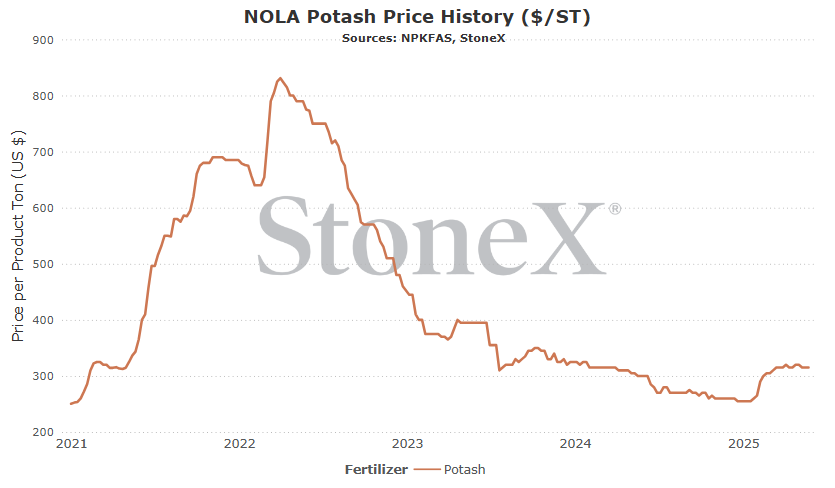
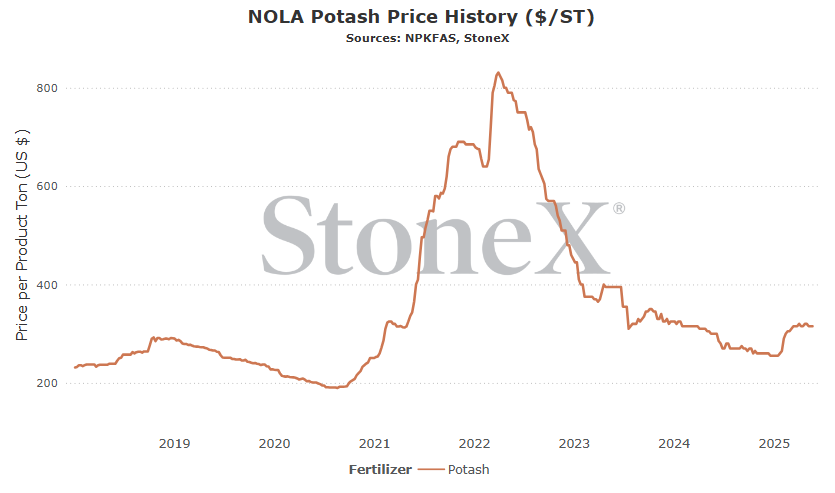
Today, my expectation for summer fill price resets is that values will fall back in line with where they were last summer (NOLA potash price of approximately $275).
I know many of you will read that and think "WTF. This year is significantly worse than last year. Have you seen grain prices? Have you seen our input costs?".
Yes, yes I have.
When I look ahead like this, I try to look at the fundamentals of the market rather than the emotion of it. There is nothing wrong with the emotion of the market. There are plenty of times when that wins out over fundamentals but for this exercise, I feel it best to let the numbers do the talking:
- A $25 - $50 reset from today's levels would make sense vs grain values. It wouldn't be the best ratio values ever seen, but they would likely be attractive enough to incentivize buyers.
- Demand should remain large. As we look at 2026 corn acres (yes, far too early but we have to start this early to build our fertilizer year 2026 views), there is a very real chance that we will be seeing similarly high corn acres. If that is right, then potash demand is going to remain very high.
- Manufacturers are fighting harder today than the last couple years to keep prices level/higher. This is hard to write out to explain but from my vantage point, the manufacturing side is doing more work to keep the price where it is or higher. That doesn't mean the market cannot go lower, but it will have a fight on its hands.
- Global conflicts/tariff fights/etc. lead to uncertainty - the world isn't in a good place today. That leads to fear/uncertainty/etc. and the natural human response is that prices be higher as it bakes in these factors.
- A $25 - $50 reset puts us back where we were last summer and that worked out. It might not have been the greatest values of all time, but the market bought into it and survived the year.
This does not mean that values will reset. This is only my personal POV based on the things I am seeing. I will say the biggest danger to this POV is that global production remains untouched. With manufacturers fighting back, we could see production curtailments. It certainly wouldn't be the first time in history that has happened.
NOLA/New Orleans Louisiana
Vs 30 days ago - -2% or approximately $5 lower
Vs 90 days ago - 3% or approximately $10 higher
Vs 6 months ago - 21% or approximately $55 higher
Vs 1 year ago - 5% or $15 higher
U.S. Midwest Average (average of several points across the Midwest)
Vs 30 days ago - 2% or approximately $9 higher
Vs 90 days ago - 6% or approximately $23 higher
Vs 6 months ago - 17% or approximately $54 higher
Vs 1 year ago - 0% or approximately $1 higher
- Manufacturers curtail production to fight lower prices – this is still my biggest worry point as we proceed into late Q2/Q3. We continue to see the global potash market as better supplied than any other major fertilizer in the world...with more production coming. However, potash manufacturers are likely a bit jealous of nitrogen and phosphate margins and wonder "why not us". If this happens, we could see manufacturers start to curtail their production rates. That helps to lower global supplies and raise global price ideas. It isn't easy to do as it would take a lot of mines/companies/countries to fall in line, but it is something we are watching.
- Farmers/retailers "buy-in" to higher priced fill programs - when I look at potash prices today, I think they are higher priced when compared against grain values. That "should" have buyers waiting in hopes that something better will pop up in the coming months. But what if it doesn't scare buyers off? Spring UAN was a tough situation. We have already seen a layer of summer fill phosphate be done. The market is already in a bit of a "buy mode". If they continue on that path, they might go ahead and start locking up potash fills which will help set a price floor...with a path higher.
- U.S. places tariffs on Russia, adding a hurdle to the 2nd largest importer – fortunately for the U.S., we have Canada to our north who is the largest global exporter in the world. For context, they are larger than countries 2 thru 5 (Russia/Belarus/Israel/Germany) combined. That does not mean that 100% of potash imported into the U.S. comes from Canada. Russia is the 2nd largest provider of tons (still a distant 2nd to Canada). Trump and Putin are not seeing eye to eye and I would not be surprised to see penalties against Russia in the coming weeks. If those penalties include blocking Russian goods that include potash, the U.S. loses its 2nd largest provider...and will set the stage for prices to rally a bit.
- Global buyers reject higher prices due to belief of plentiful supplies – there is nothing about 2025 that has been considered normal. However, when the stress of spring season finally goes away and the market has a chance to breath, it will be able to view potash from a fresh set of eyes. What I mean by that is it will be able to clearly see that current potash prices are high when looked at vs grain values. Farmers are already struggling in 2025 with little hope of improvement for 2026. They will not be in a spending mood. If they perceive potash as too high priced, they may largely reject summer fill programs. If manufacturers are unable to find sales, that creates a lot of pressure.
- Big demand globally finally starts to slow down to 3-year average levels - the last couple years have seen some of the world's largest potash buyers buying well ahead of their typical flows. This can certainly continue, but what if they do not? Potash values have largely been level priced during this large demand cycle. If that demand falls off, wouldn't that mean that prices are set to fall as well?
- Grain values fall further – listen, I do not like this bear factor because it devastates the farmer even more than they already are. However, it is still a watch point. Potash already appears high priced compared against grain values. If growing conditions remain really good, as they have been, we could start to see grain values fall which would make potash look even worse. It can only handle so much stress before being forced to correct lower to find demand.
Where are the current potash/grain ratio values today
We believe that only looking at the flat price of either grains or fertilizer can be misleading:
-
Only selling grain can hurt you if fertilizer prices rise substantially
-
Only buying fertilizer can hurt you if grain prices fall
We look at the ratio "value" to get a better indication of where we are or how many bushels of X does it take to pay for 1 ton of fertilizer.
Would you rather:
-
Spend 120 bushels to pay for 1 ton of potash
-
Spend 60 bushels to pay for 1 ton of potash
When we compare the current ratio value against recent years, we start to see if we are high or low.
YOUR VALUES MAY LOOK DIFFERENT
This graph looks at the NOLA potash price vs the flat grain price. There are no logistics on either product. Your location will look different due to fertilizer logistical costs, grain basis, etc.
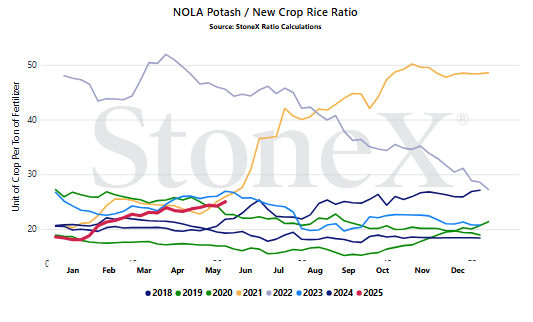
- Biggest focal point for me this month is how global manufacturers will approach production rates - to a certain extent, I want to believe that potash manufacturers are a bit jealous of nitrogen and phosphate manufacturers. Those markets are seeing massive profits. However, potash values have remained relatively mute in comparison which has seen profits kept in check. The natural tendency of the market is for prices to fall in the summer. Ultimately, if enough make the decision that prices need to be higher, they can make the decision to curtail production. With it being a manmade problem, it can be resolved relatively quickly...but it can still happen.
- Buyers approach to potash - from my perspective, if potash values were to fall $25 - $50st USD from where they are now, it would be an attractive price that buyers should jump on. That would cause manufacturers to build a sales book which would help them start to raise prices. However, if manufacturers work to keep the price high, buyers very well may drag their feet either from the perspective that they cannot afford it or feel slighted at the move and want to punish them. Regardless, how buyers approach the coming weeks prices/programs will go a long way in setting the market. If the market doesn't buy, it puts pressure on the seller. If the market does buy, it helps rally price ideas.
- Russia relations with the world - for a moment, it looked like there was a chance at peace between Russia and Ukraine. Since then, that has largely fallen apart as Putin refuses to meet. Now the question needs to be "will there be more penalties on Russia goods?". From a U.S. perspective, Russia has been the 2nd largest supplier of potash. If President Trump decides to impose penalties on Russia, that supply line could be cut and values rise. This would be true for any country in the world who gets product from Russia.
StoneX Ratio Calculation
The ratio calculation is derived from Bloomberg historical grains values as well as fertilizer values from StoneX, NPKFAS, and Argus.
The calculation is simply dividing the fertilizer price by each grain price.
All data was sourced from StoneX unless otherwise noted.