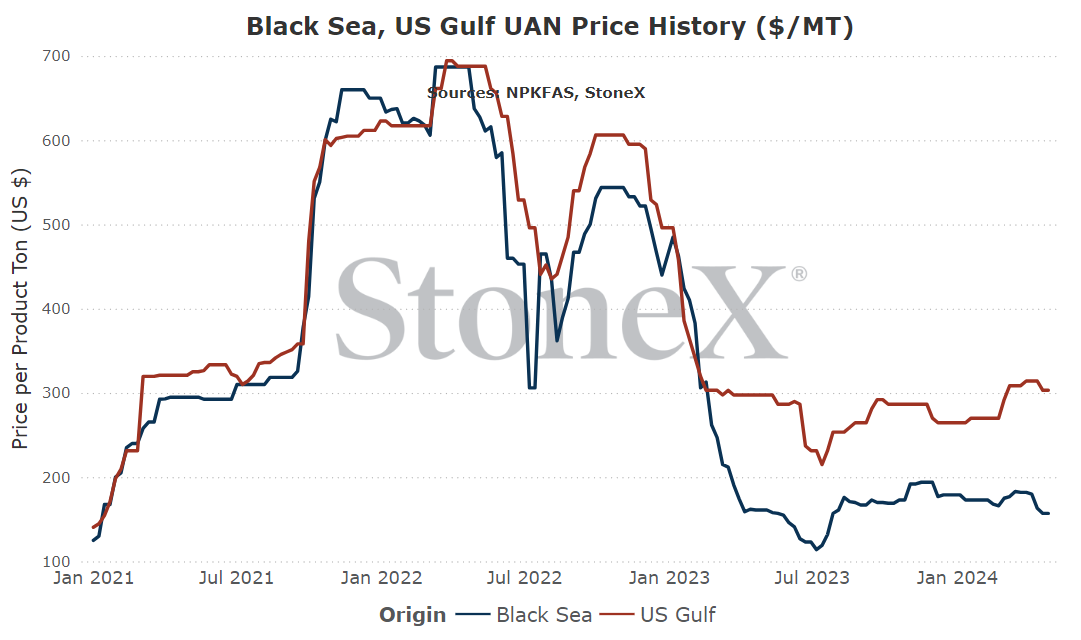
The intention of the below graphs are not to use to say "my price should be X based on this graph". These prices are derived from an FOB price point average. The intent is to show major global price movement trends. Your values will likely have significant basis difference (similar to your local grain price being different than the traded market price).
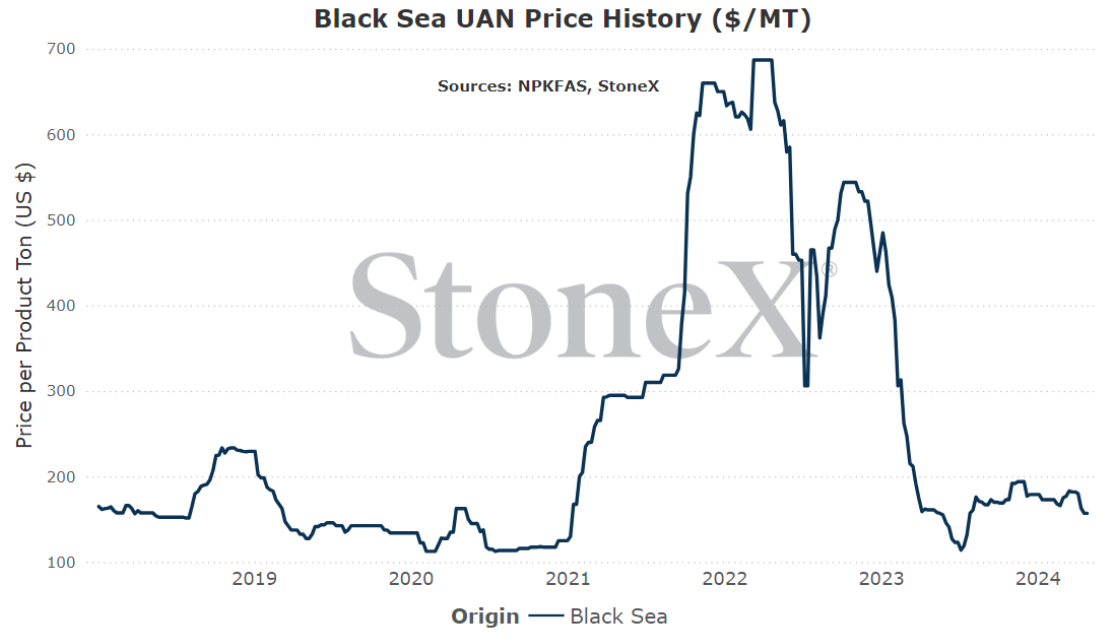
This graph is labeled as MT in USD currency.
- Fert year 2024 inventories started low
- Larger than expected production outages this winter
- Imports have nearly matched exports
Basically, inventories are very tight as many have reported struggles in finding resupply starting late March.
Eventually, we should see UAN values across N.A. start to fall...but we are not expecting that to happen in the short term. With inventories being as tight as they are, manufacturers remain in control of price negotiations and I haven't met a manufacturers that likes lower prices.
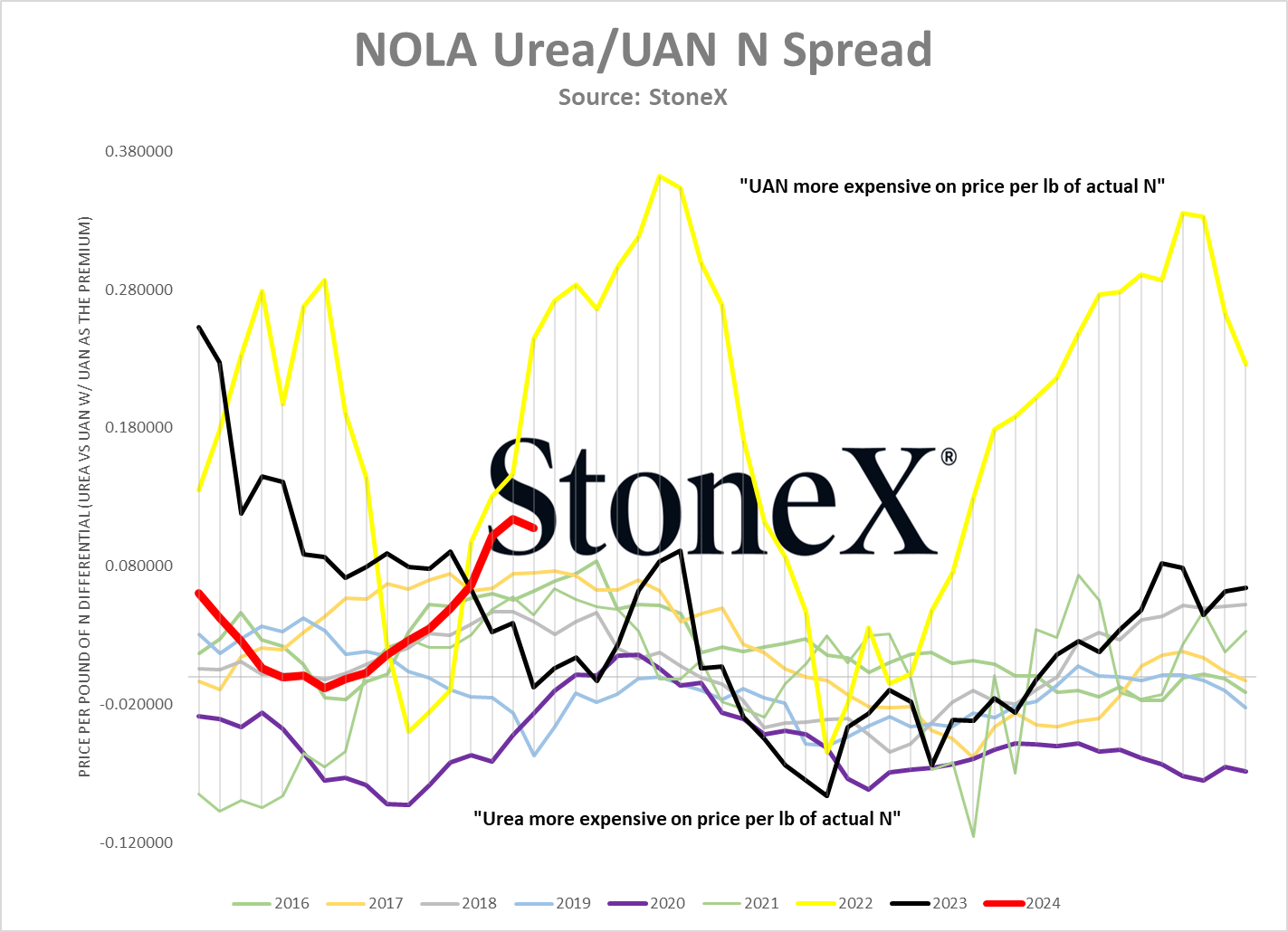
N.A. UAN moves to hefty premium vs urea on tight inventories
A story that we have been tracking for much of fertilizer year 2024 was how tightly supplied the N.A. UAN marketplace was going to be. After starting the year (July 1, 2023) very low on inventories due to a large spring that emptied the system, it felt as though things would remain snug.
...I believe we underestimated how tight it would be as other factors came to play...
First, while we anticipated some production issues, we did not expect how severe they would be. Some plant repairs that were expected ended up taking longer than previously believed. Then, while winter seemed short, we did see the period of excessively low temps that ultimately slowed/stopped production. While it is hard to put an exact value on how many produced tons were lost (companies are very skittish about sharing that intel), some have theorized it could be over 1M tons. Honestly, I struggle to poke holes in that value.
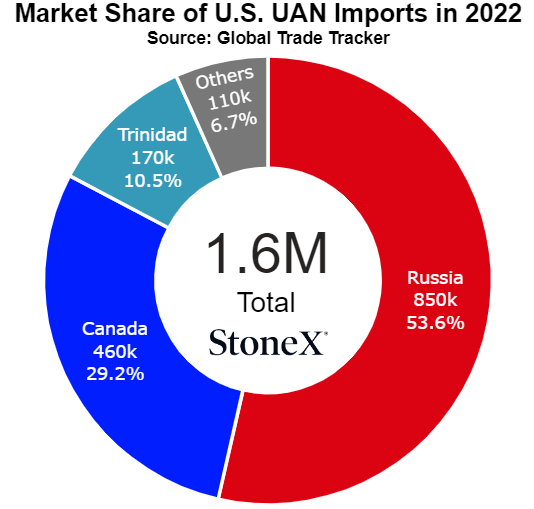
Next, we just haven't gained much in terms of the import/export balance. We have seen very good imports flowing in from Russia. That should have helped to boost supplies and lower price ideas. Unfortunately, production problems persist in Europe so for almost every ton imported from Russia, the same amount of tons flow out to Europe. There has been a bit of gain, but not hugely significant.
Now, we are hearing from multiple folks in the industry that it is tough to find resupply. Not tough as in "I do not want to pay that price" but more "they are telling me it will be weeks before I could pull a load".
Because of this, UAN values have been much more steadfast than what we have seen on the urea market...and rightfully so. If inventories are as tight as being described, the S&D of the N.A. market is out of balance. At this point on the calendar, little can be done about supply. It is what it is. That means the pressure must be placed on the demand side. How do you lower demand? You put the price at high enough level that demand goes elsewhere.
That is why we are starting to see such a disparity between urea and UAN today.
- NOLA urea @ $295 = $0.32/lb of actual N
- NOLA UAN @ $275 = $0.43/lb of actual N
So today, NOLA UAN is approximately 11-cents premium to urea. Glancing at the chart below, that is very high...but again, not unexpected.
Last, remember the difference between a place like NOLA and your local marketplace. These spreads can and will look different based on where you farm.
Summer expectations
There is still a lot of spring left to do but I thought we were getting close enough that I wanted to take a first stab at what I expect to see this summer.
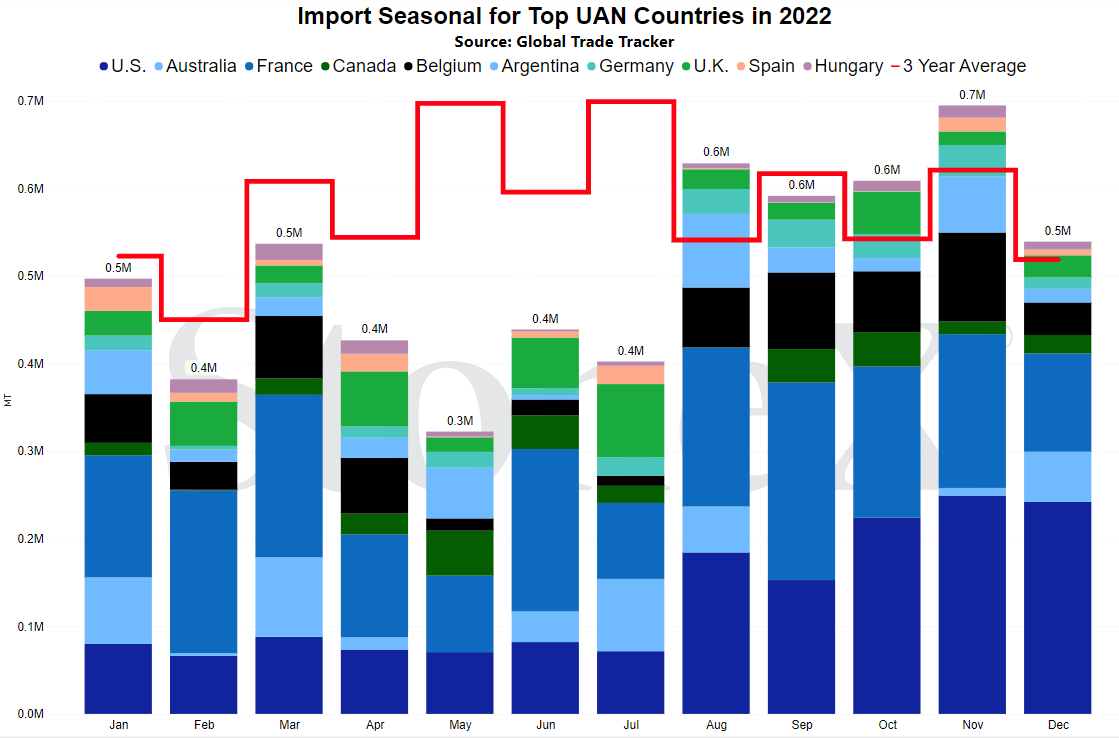
First, globally speaking, I do not expect a lot of change from Europe. As you likely know, European production has been running at approximately 75% of normal. That means they have been a much bigger importer of UAN than what they would historically do. This, combined with no end in sight for the Russian invasion of Ukraine, likely means that N.A. manufacturers will have ample opportunity to send product that direction. That means a loss of supplies.
Second, I expect that we will end this spring very low on inventories once again. Given just how tight supplies are today, and there is still a lot of spring to go, I just struggle to see where we are going to make up any ground. A market that is tightly supplied/low ending inventories in tanks, usually means manufacturers have more success in negotiations.
Last, even with inventories tight, urea values will still go a long ways in determining UAN fill programs. The outlook for urea is that summer resets should be a bit lower than last summer's, not likely to be huge.
All of that said, do not be surprised to see the first round of values discussed until later and likely somewhat close to last summer's values. Manufacturers are going to hold more cards if things stay tight as expected and they like higher prices/margins. Can't say that I blame them. However, it is not likely that it will be allowed for UAN to get far out of sync from other N sources.
In the end, I still think it more prudent to consider the value between buying UAN and selling grains as that is how we can be more confident in securing value.
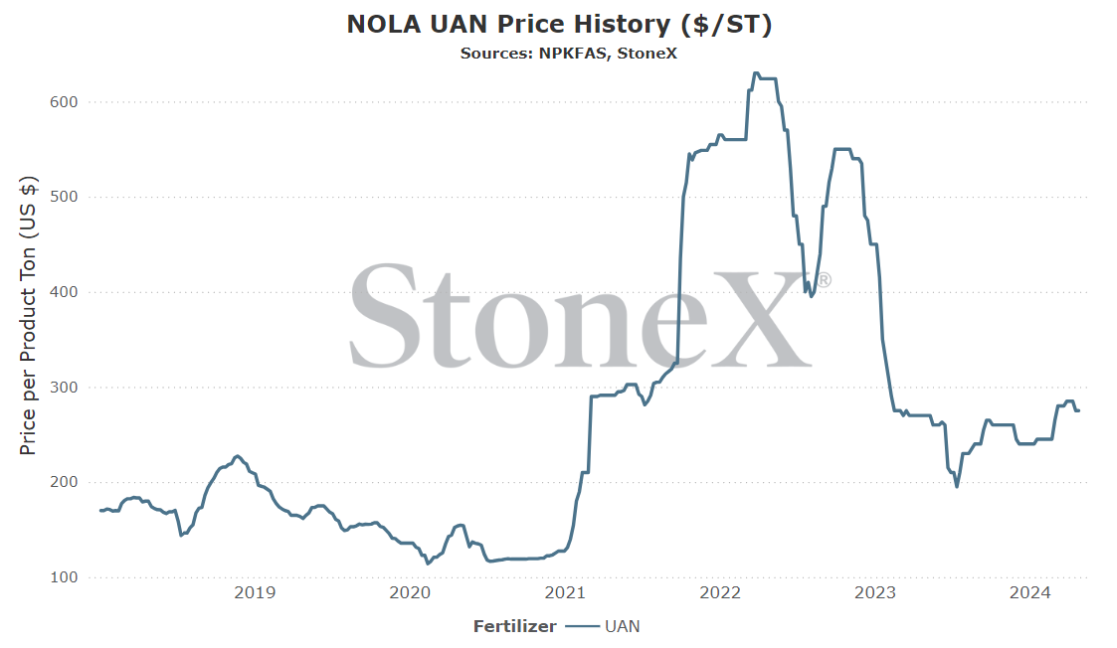
NOLA/New Orleans, Louisiana
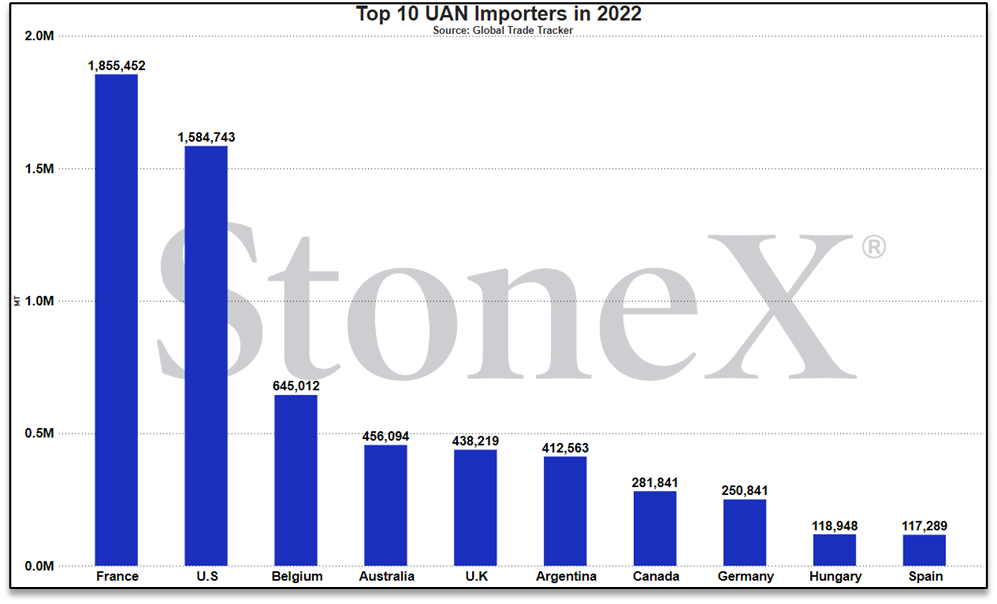
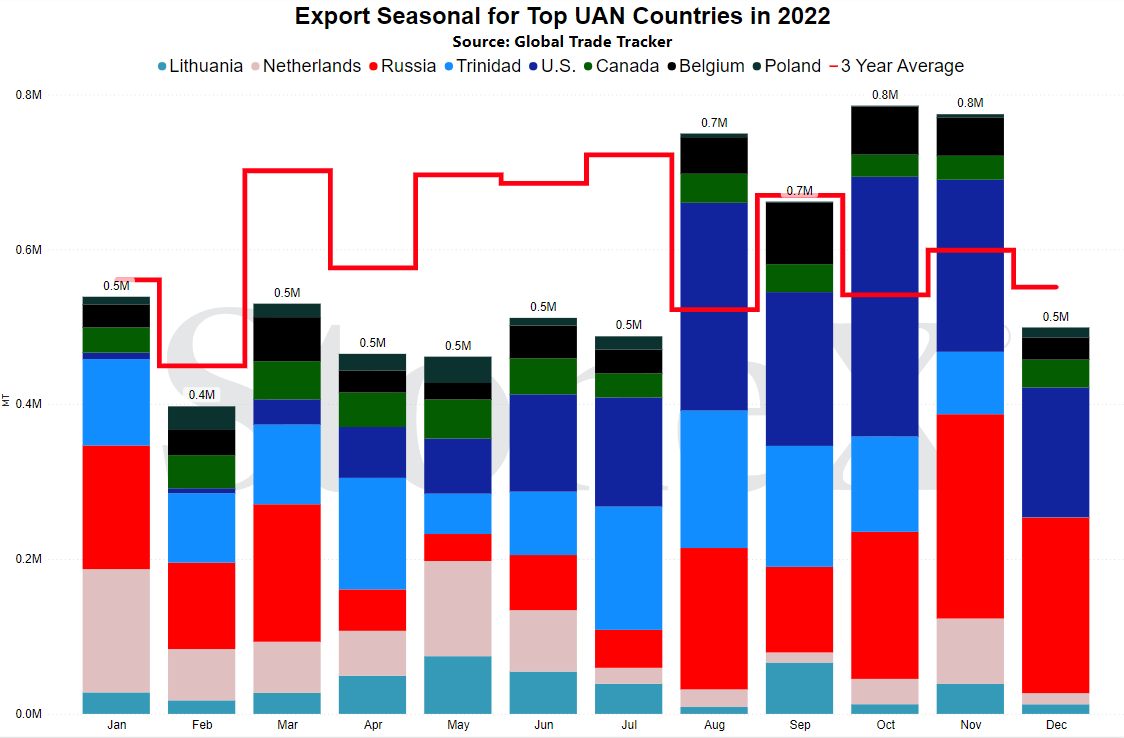
Number 2 global importer in 2022
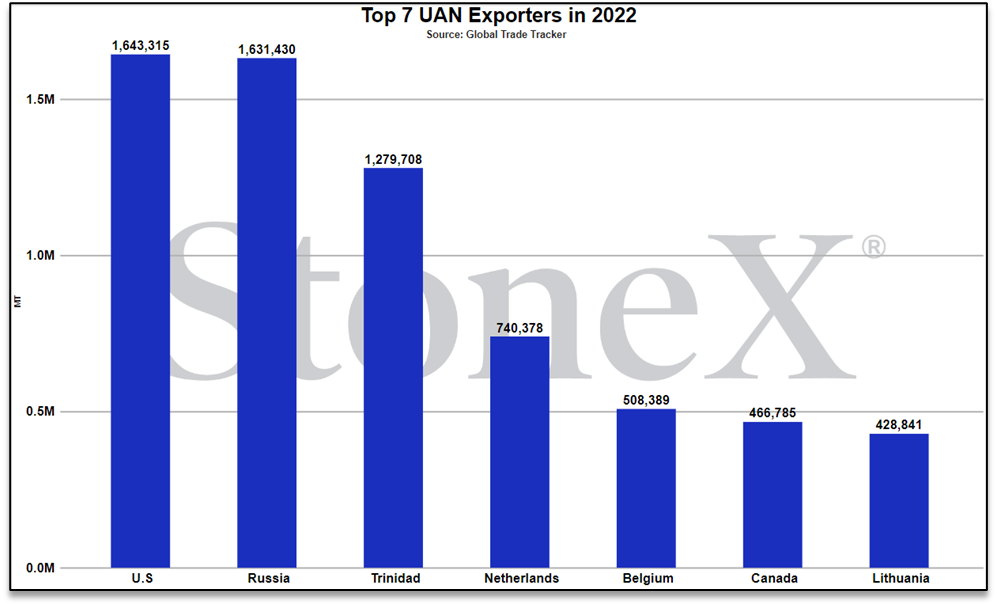
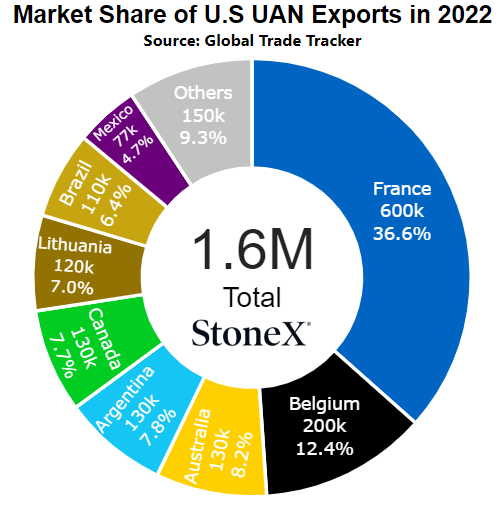
Number 1 global exporter in 2022
Price Comparisons
Vs 30 days ago - -4% or approximately $10 lower
Vs 90 days ago - +12% or approximately $30 higher
Vs 6 months ago - +6% or approximately $15 higher
Vs 1 year ago - +2% or approximately $5 higher
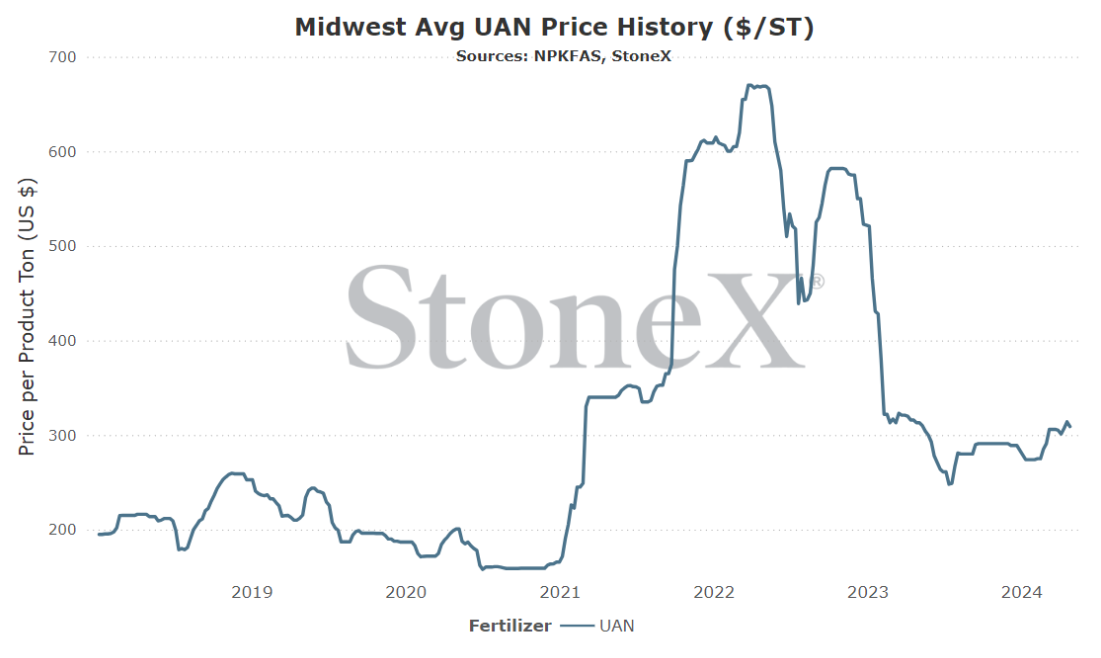
U.S. Midwest Average
Vs 30 days ago - +2% or approximately $5 higher
Vs 90 days ago - +13% or approximately $35 higher
Vs 6 months ago - +6% or approximately $18 higher
Vs 1 year ago - -1% or approximately $4 lower
Black Sea (Russia)
Number 2 global exporter in 2022
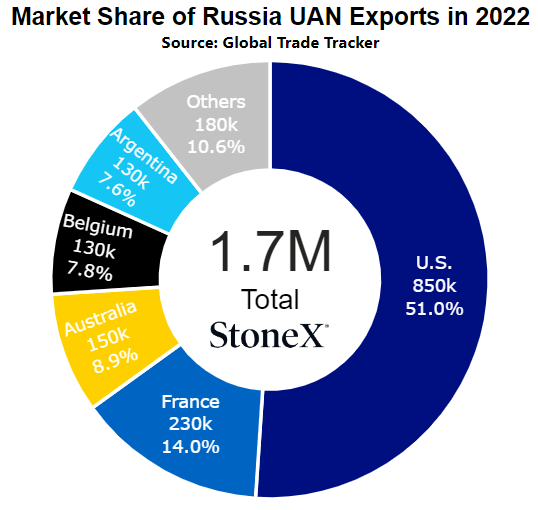
Price comparisons
Vs 30 days ago - -14% or approximately $25 lower
Vs 90 days ago - -9% or approximately $16 lower
Vs 6 months ago - -9% or approximately $16 lower
Vs 1 year ago - -2% or approximately $4 lower
- European production remains offline – from my vantage point, Europe continues to be the linchpin in global UAN markets. Their production remaining at approximately 75% of normal means a large block of tons are not being produced. That makes them a larger global buyer which boost all global price ideas. There is still a chance they get back to 100%, but I wouldn't bet on it based on what is seen today.
- Spring just in time inventories fail to keep up with demand – this is more for N.A. Inventories are snug. Just the way this spring is set up. Chances are this does not improve significantly until the majority of spring is complete. If inventories cannot keep up with demand, prices should remain steady at best and rally at worst.
- If U.S. seeks sanctions on Russian fertilizer – this is a bit of a stretch. A U.S. based UAN manufacturer tried this and failed a couple years back. However, that is not to say they could not try again. Heck, given how D.C. tends to work, I wouldn't put it out of possible that they might push for it to punish the Ukrainian invasion. If this were to happen, again a very low probability, inventories would go from tight to tighter.
- Urea values continue to fall, painting UAN in a premium light – as detailed above, UAN is moving to a large premium vs urea. Last year, we heard that N.A. manufacturers were not going to allow UAN to get "overpriced vs urea" and miss demand. That was a lesson sorely learned spring '23. With urea values continuing to fall, it makes us wonder if UAN price corrections are coming to keep it in line with urea. It is doubtful given the time of year (hard to make switches today) but is something that needs to be watched. This will certainly come into play this summer.
- If fears of summer resets beat current tight inventories – at some point, the UAN market will start to fear carrying product into the summer reset period more than it wants to enjoy taking current premium sales. Tight inventories means this is less likely to happen short term, but eventually it should start to fall. As always, it is all about timing.
- Offline European restarts start to be announced – this is another "low probability" situation...but that probably is not 0. If we start to see the remaining offline European production restart, this would be a game changer. Not only would it mean that Europe would become largely self sufficient again, but it would also push tons back into markets like North America. Those tons being pushed back would then have to compete with Russian imports. More supply, unchanged demand, lower price ideas in theory.
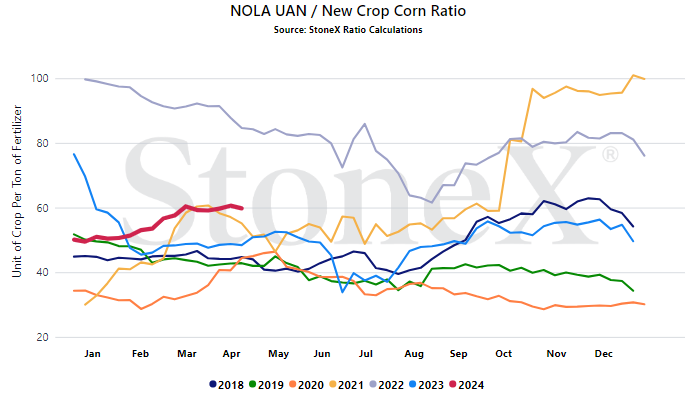
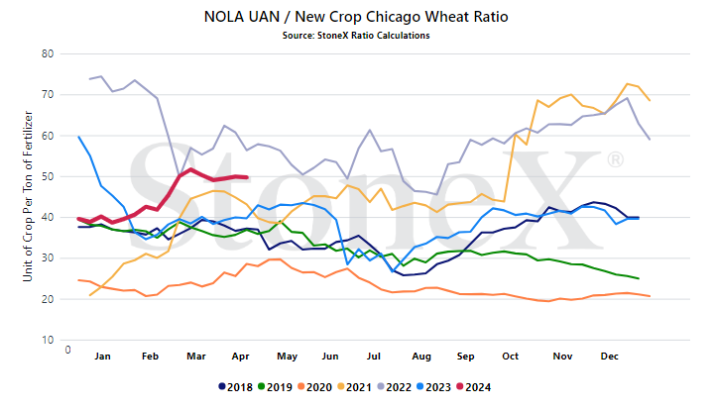
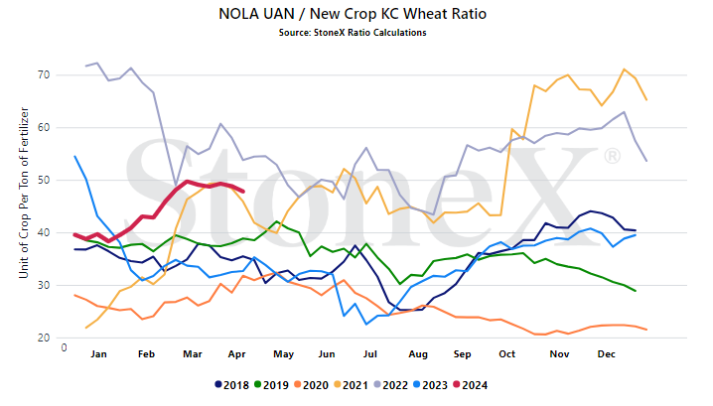
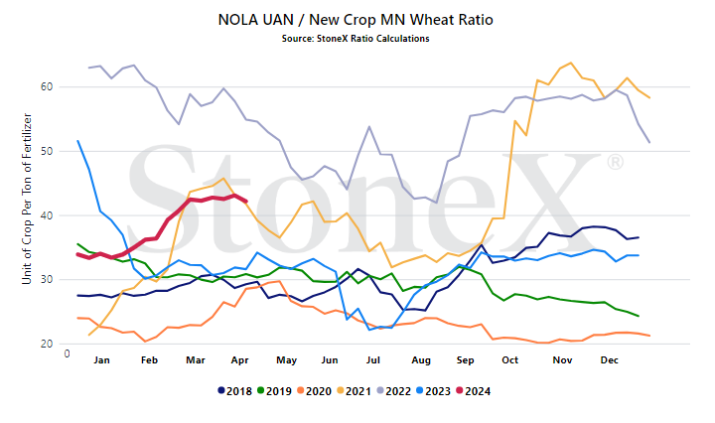
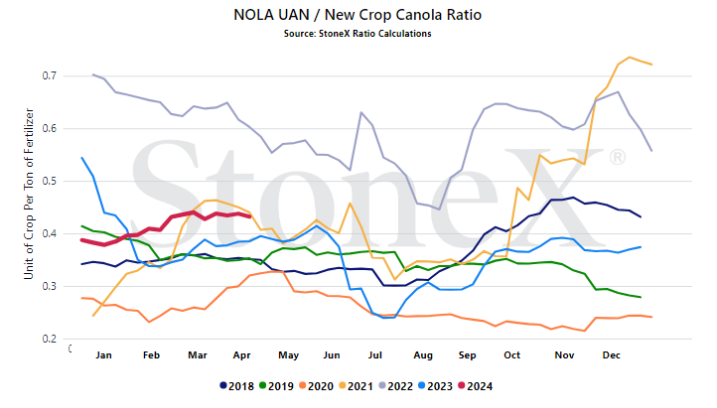
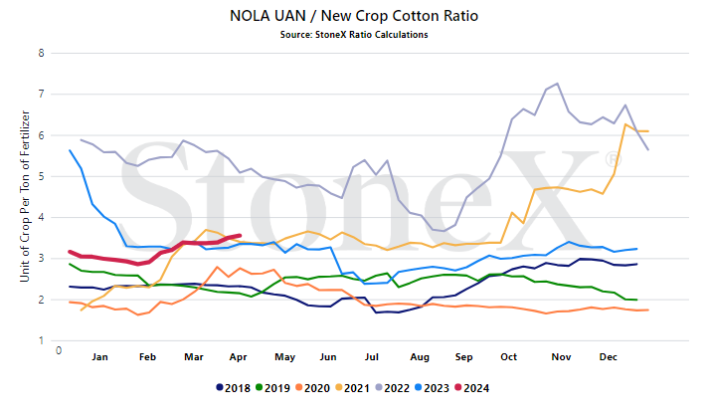
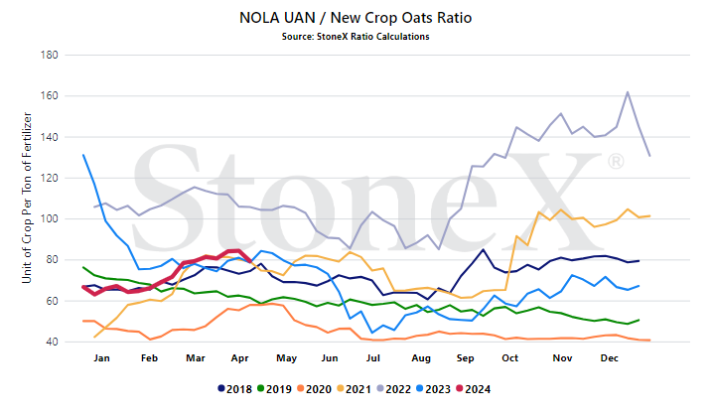
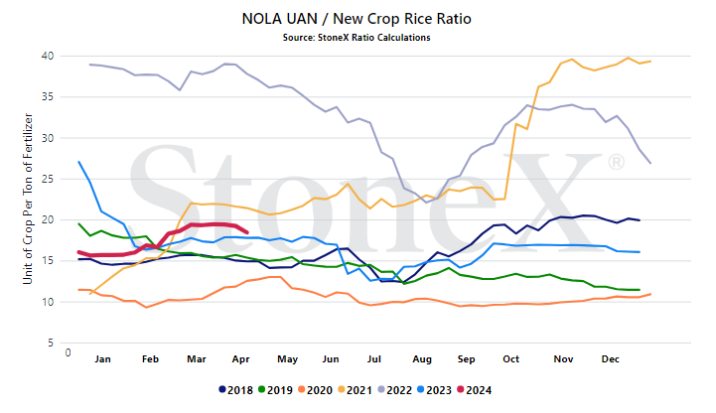
We believe that only looking at the flat price of either grains or fertilizer can be misleading:
-
Only selling grain can hurt you if fertilizer prices rise substantially
-
Only buying fertilizer can hurt you if grain prices fall
We look at the ratio "value" to get a better indication of where we are or how many bushels of X does it take to pay for 1 ton of fertilizer.
Would you rather:
-
Spend 100 bushels to pay for 1 ton of UAN
-
Spend 60 bushels to pay for 1 ton of UAN
When we compare the current ratio value against recent years, we start to see if we are high or low.
YOUR VALUES MAY LOOK DIFFERENT
This graph looks at the NOLA UAN price vs the flat grain price. There are no logistics on either product. Your location will look different due to fertilizer logistical costs, grain basis, etc.
- European production rates - unfortunately, it does not appear that rates will change anytime soon. The perfect scenario has already come and gone as Dutch TTF values fell and global nitrogen values rose. Dutch values remain in the single digit region but global nitrogen prices are back under pressure and the outlook isn't overly positive. There is always the chance that restarts begin, but it doesn't look likely today.
- Tight N.A. inventories vs falling urea values - if inventories across N.A. were not so tight, we would be singing a very bearish tune today. Unfortunately, that is not reality. It seems as though the market is going to continue to be price supported on tight inventory levels for most of spring. This is certainly something I would be happy to be wrong on for June...
StoneX Ratio Calculation
The ratio calculation is derived from Bloomberg historical grains values as well as fertilizer values from StoneX, NPKFAS, and Argus.
The calculation is simply dividing the fertilizer price by each grain price.
All data was sourced from StoneX unless otherwise noted.