LME Seminar October 2021
12th October 2021
The Great Metal Debate: nickel displaces copper
One of the sessions at the LME Seminar this week was the Great Metal Debate. Chaired by Mark Burton of Bloomberg, this featured five respected experts looking at the fundamentals for each of the main metals in the LME suite; Aluminium, copper, lead, nickel, tin and zinc. To start with the audience was polled as to which of these we believed had the most upside potential for 2020. At the end of the session we were asked again.
This was the outcome: -
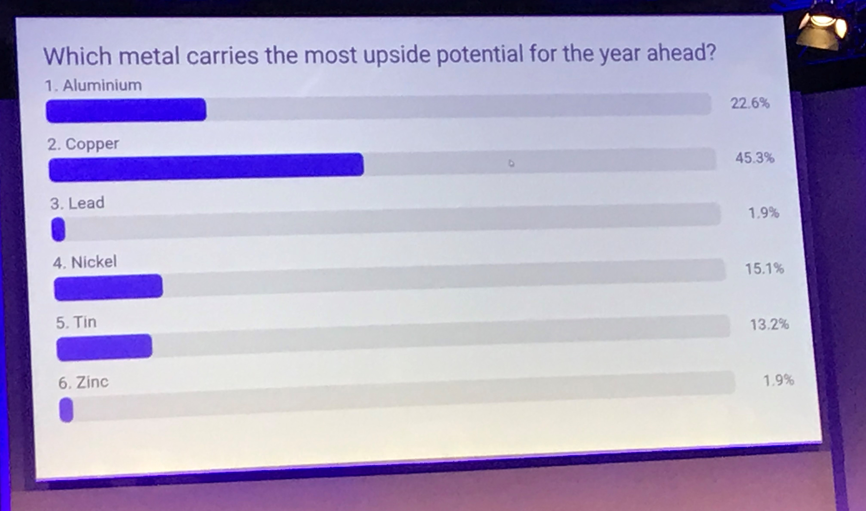
Before
Copper was the clear winner with over 45.3% of the vote
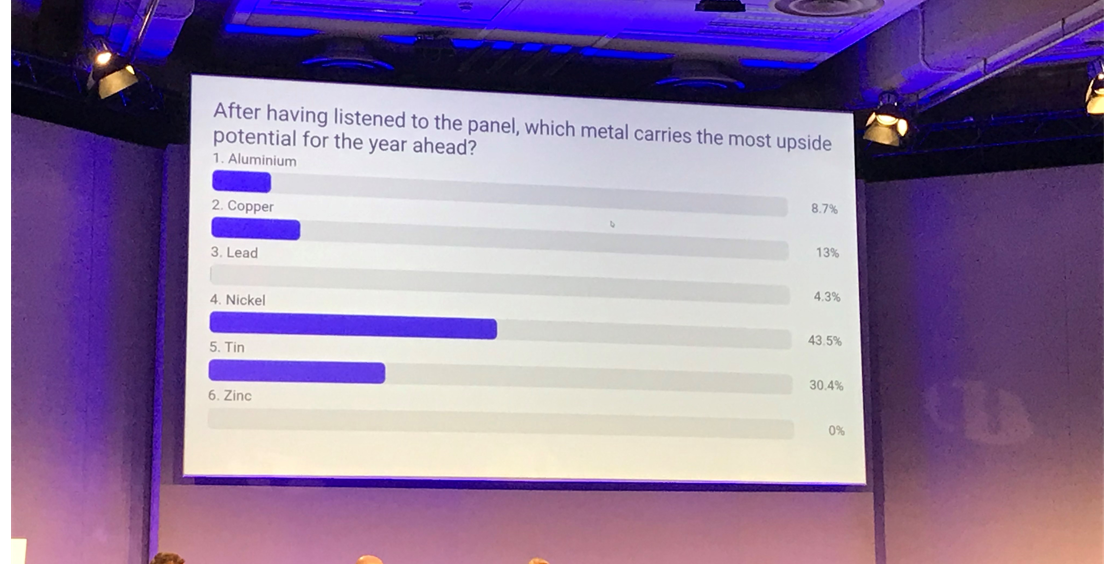
After
Massive swing with nickel commanding 43.5% of the vote, up from 15.1% while copper slipped to 13.0%.
What follows is a summary of the key points made by the analysts in question.
Nickel
The nickel market analysis came from Jessica Fung, the Head Strategist of Pala Investments. She kicked off by saying that nickel is a very simple story – it’s all about demand. Having clearly made the point that Covid is another example of an exogenous shock that neutralises the concept of the “old normal” and reversion thereto, her argument was that Covid is driving the global economy towards sustainability. This gives nickel the potential for a bright future.
At present only 3% of nickel demand is taken up by batteries. By 2025 this sector is likely to account for 10% of nickel demand and by 2030 it could be as much as 30%.
To put this another way, by the end of the decade the nickel market needs to be 60% bigger than it is today.
At Pala investments they take the view that a super-cycle can be defined as one in which one specific demand driver is responsible for taking prices up by anything from 100% to 300%. The argument here is that the shift towards sustainability fits into this definition.
While this analysis concentrated very much on the demand side of the metals equation, comments from other analysts about under-investment in the mining sector can be broadly applicable across the full spectrum. Certainly the audience fully bought into the expectation of substantial higher prices for the longer term, and by interpolation for next year also.
In the panel discussion she also noted the supply-side switch from nickel pig iron to matte for battery usage. The transition to change NPI into nickel sulphate form is now being achieved and should enable the market to meet the sustainability demand. Current price; $19,185
Tin
Tin came in second in the end-of-session vote, despite its stellar performance so far this year, raising its share of the vote from 13.2% to 30.4%.
Here, too, Tom Mulqueen, the Head of Research for Amalgamated Metal Trading, referred to a bright future. Noting that the price has scaled levels three times those of the pandemic lows, the key here is the very low level of inventories (although that also applies to the majority of the metals in the suite). Looking back, he noted that the price action this year has been informed by supply-side issues. These have been dominated by the Malaysia Smelting Corporation, which suffered operational problems due to COVID, along with much of the rest of the non-ferrous industry, but this was then compounded by furnace problems, while force majeure was declared in June under the Government’s Movement Control Order. While the recent demand burst is fading (for now?), due to the economisation of the solder sector, the market is currently vulnerable due to those very low inventory levels – as illustrated by persistent backwardation. This is likely to lead to intense price volatility for the short to medium term.
Looking further out, prospects are strong. The proliferation of the electronics sector, which uses tin in solder, will drive demand growth, as will the use of tin in solar cells as part of the global decarbonisation programme. Add to that the fact that the solder “economisation” is more or less complete – subject of course to technological changes and the expectation for the unleashing of pent-up demand due to supply chain issues (again, this affects everything, more or less) and he argued that tin should be bet ween $25,000 and $30,000 per tonne by end-2022 with an upwards trend thereafter. Current price; $36,390
Copper
Copper was overtaken by nickel and tin. This was not just because of the compelling bull cases that were argued for the latter metals, but also because Vanessa Davidson, the Director of Base Metals Research & Strategy for CRU, argued that growth demand rates would halve next year from roughly 5% in 2021 and that inventories, (also very low on exchange at ~one week’s demand) would start to rebuild. She is bearish from now on, looking for a surplus of roughly 150,00t this year and ~100,000t next, with an average of $8,700 for 2022. Current price; $9,523
That said she pointed to the low level of Board approvals for fresh mining operations, and particularly some concerns in the Chilean and Peruvian mining industries that, implicitly, may lead to uncertainty over some projects. For the longer term, therefore, this could well point to further deficits and upward re-ratings in copper prices, especially with the decarbonisation of the economy. CRU estimates that by 2030, Electric Vehicles (EVs) could account for 30% of light-duty vehicles, against 7% currently. In other worlds, EV demand for copper could rise to as much as 6Mt by 2030, from 1.2Mt now. Meanwhile, producer margins will remain high.
Aluminium
Aluminium came in fourth in the race for supremacy with 8.7%, a big drop from second place with 22.6%. Timothy Weiner, the Vice President for Aluminium Pricing and Risk Management at Harbor Aluminium, believes that we are at or near the peak of the current business cycle, pointing, for example, to the downward trend that is developing in U.S. durable goods consumer spending as the economic recovery transitions towards the services sector; he is also expecting Chinese demand to weaken as the Chinese Government manages its “common prosperity” that will manage slower economic growth for the short term in order to underpin the foundations for the longer term. Despite the pressure that the Chinese primary aluminium sector is experiencing because of its high energy intensity, secondary supply is eating into primary’s market share. He argues that there is plenty of supply while demand is waning, and called the metal down to $2,200/t. Current price; $3,044
Finally we come to the analysis from Duncan Hobbs, the Research Manager at Concord Resource, who had both lead and zinc under his belt. In the opening poll, lead had scored 4.3% and zinc posted zero.
Mr. Hobbs noted that there has been a strong rebound in zinc demand this year, still keeping the market in a surplus but a much narrower one than the market had been expecting this time last year. The strong rebound in demand has been led by the auto sector (despite its issues) and construction – with steel and brass accounting between them for over 70% of zinc demand. In addition, mine supply is growing more slowly than had been expected. Metals price premia and concentrates charges have been mainly positive over this past year, with conc’s charges dropping, reflecting a shortage of concentration, while premia have been rising. He did point out, however, that freight rates form part of price premia so we should expect these to come down when vessels finally start to become available. The fundamental demand-side development here that undermines zinc’s outlook is the development of ZAM, or zinc alloyed with magnesium, when used for galvanised steel this allows for a reduced unit zinc loading for the same level of galvanisation. This market penetration was up to 12% of steel sheet production in 2019, the most recent year for which he had figures.
Lead, meanwhile, has been experiencing very strong demand, with relatively constrained mine supply, while China has been struggling to export its domestic lead surplus, this is partly due to container vessel shortages and also a long-standing high tax treatment of exports. China’s lead metal output has been rising sharply this year, with secondary producers in the vanguard, while ex-China production has been characterised by unplanned outages in the U.K. and Germany, along with the closure of the Clarios secondary refinery in the United States in February. For the medium term, he noted that the growth in China’s e-bike sector is topping out. For the longer term, the growth in EVs will put a lot of pressure on the lead battery sector – EVs do have lead batteries, but they are a lot smaller, he noted – and that this could put a lot of pressure on lead primary demand. It could even turn negative (as we are also largely expecting for palladium and rhodium, but these are not part of this debate).