Morning Ferrous Markets
Market Overview
Global ferrous markets have been significantly influenced by recent economic developments and policy shifts. The US economy has shown signs of continued contraction in the manufacturing sector, as evidenced by the latest ISM Manufacturing PMI. Additionally, the Federal Reserve's monetary policy, including high interest rates, has constrained economic activity and impacted commodity demand. Political developments, such as the recent US presidential debate, have also contributed to market volatility. President Biden's maintenance of tariffs on Chinese goods, alongside potential further rate cuts, has kept the steel industry in focus. Meanwhile, in Europe, the ECB’s recent rate cut to 3.75% has not alleviated investor concerns, as economic conditions remain challenging. China's potential stimulus measures aimed at supporting its real estate sector could provide some relief, particularly for iron ore demand.
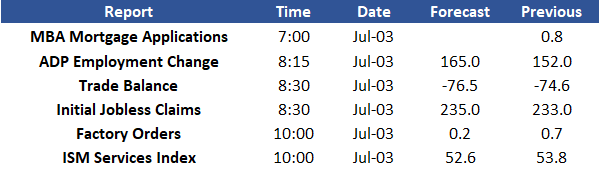
Upcoming Data Releases

North American (US) HRC Steel Market
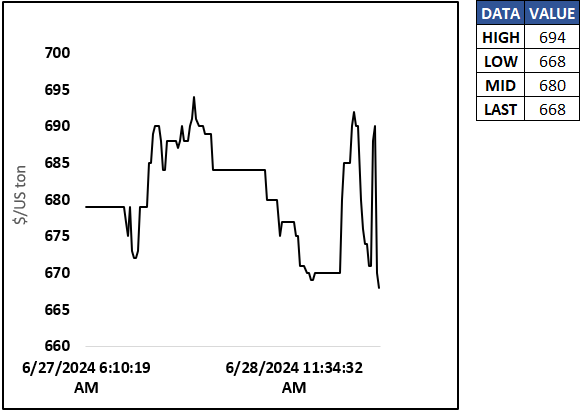
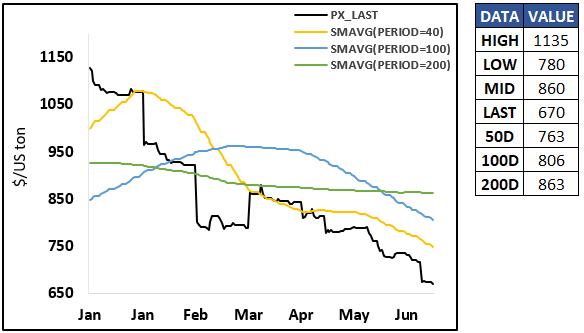
Markets: US HRC steel futures have faced downward pressure due to low demand and high supply. The benchmark hot-rolled coil (HRC) prices reported by Steel Market Update fell to $670/st, with Nucor’s HRC Consumer Spot Price dropping to $680/st. Recent market activity reflects a decrease in lead times, with some mills offering significant discounts to secure orders. A major buyer in Northern Ohio halted scrap deliveries due to excess material and a soft order book, indicating a significant potential price drop for prime scrap. The US manufacturing sector continued to contract in June, impacting steel demand negatively.
Techicals: US HRC Steel futures are currently experiencing a strong bearish trend across all monitored contracts, confirmed by multiple technical indicators including moving averages, RSI, and DMI. Despite this, oversold conditions indicated by RSI suggest the potential for short-term corrections or rebounds. Volume and open interest data highlight significant market activity, particularly in the front-month contracts.Key support levels are observed at 665.59 for HRC1 and 673.24 for HRC2, whereas resistance levels are marked slightly above current prices at 727.84 for HRC1 and 726.64 for HRC4 respectively.
HRC Front Month 3 Day Trend
StoneX & Bloomberg
HRC Front Month 6 Month Price Trend
StoneX & Bloomberg
Chinese Steel & Iron Ore Markets
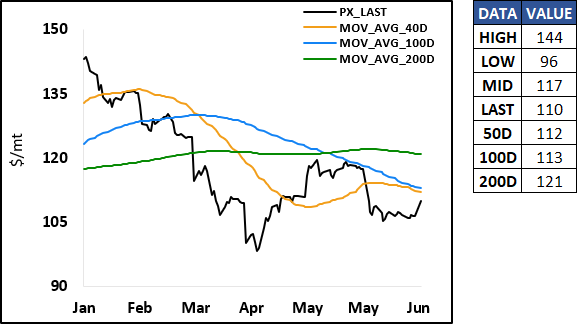
Markets: SGX TSI Iron Ore futures have shown resilience, with prices holding near $110/ton amid investor optimism regarding potential stimulus measures from China. Futures in Singapore remained steady at $109.65/ton, reflecting hopes for increased Chinese demand. However, iron ore remains over 20% lower year-to-date due to abundant seaborne supplies and high port inventories in China. Despite a brief rally, Chinese domestic and export prices for sheet products have fallen, driven by seasonally weak demand and bearish market sentiment. Production remains elevated, but rumors of crude steel production controls persist, affecting market dynamics.
Technicals: SGX TSI Iron Ore futures show a bearish long-term trend, with all contracts below their 200-day moving averages. However, short-term indicators suggest potential recovery, with improving short-term moving averages and MACD indicators. RSI values in the oversold territory indicate a potential rebound. Moderate ADX values suggest possible trend changes. High trading volumes and open interest highlight significant market activity. Key support levels around 102 and resistance levels slightly higher suggest critical points for potential price movements. Overall, while the long-term trend remains bearish, short-term indicators point to possible recovery.
SGX Iron Ore CFR China (62%) Futures
StoneX & Bloomberg
European Steel and Steel Scrap Markets
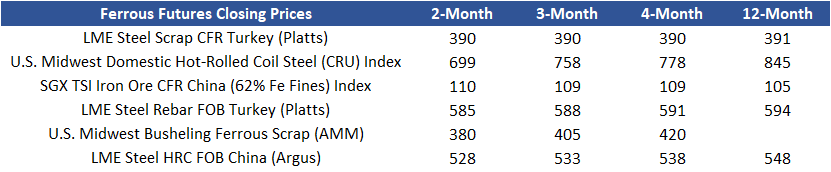
The Turkish steel scrap market faces downward pressure due to new European import caps and tariffs, weak demand, and economic factors. The European Commission's 15% quarterly cap on HRC imports is designed to protect domestic producers but challenges importers, particularly from Asia. Despite these measures, the European steel market remains weak, with German and Italian HRC prices falling to €629/mt and €635/mt, respectively.
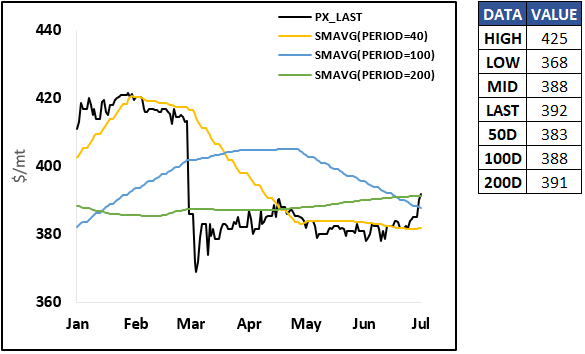
Turkish scrap demand has significantly slowed, with recent HMS 1&2 80:20 transactions ranging from $383-387.5/tonne CFR Turkey from the EU and $389/tonne CFR from the US. Producers have paused purchases after completing July shipments, assessing steel sales before buying August cargoes. This, coupled with cheaper billet offers, is expected to exert further pressure on prices.
In India, competitive domestic scrap and direct reduced iron prices are undercutting imported scrap values. Current offers for containerized shredded scrap are at $410-414/tonne CFR and HMS 1&2 80:20 at $385-390/tonne CFR Nhava Sheva. Weak steel sales and lower steel prices hinder short-term scrap price recovery.
LME Steel Scrap futures exhibit a bearish trend, with all contracts trading below their 200-day moving averages and most below their 20-day and 50-day moving averages. RSI values indicate slight oversold conditions, suggesting limited immediate recovery potential. The death cross in some contracts indicates further bearish momentum. Trading volumes are moderate, with significant open interest pointing to active market participation. Key support levels are around $385, with resistance near $391, indicating critical price points.
Turkish Scrap 1st Month Futures
StoneX & Bloomberg
Current Prices