Morning Ferrous Markets
Market Overview
Global economic conditions are shaping the ferrous markets with significant impacts from macroeconomic data, FX markets, and geopolitical developments. The Federal Reserve's current stance on maintaining the fed funds rate at 5.25-5.5% until a potential cut in September, alongside anticipated gradual rate cuts, is influencing U.S. market dynamics. Globally, real GDP growth is projected at 2.7% for 2024, driven by household income growth and a manufacturing recovery. The ongoing geopolitical tensions, particularly between the U.S. and China, and recent tariffs targeting Chinese steel and aluminum via Mexico, are crucial factors. Additionally, expectations for a modest GDP growth pickup in the U.S. and policy changes in China and Europe will further affect market sentiment.
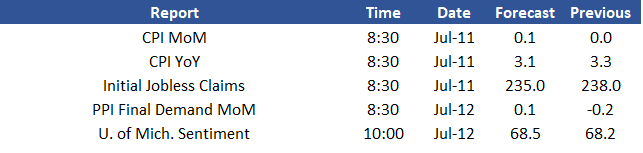
Upcoming Data Releases

North American (US) HRC Steel Market
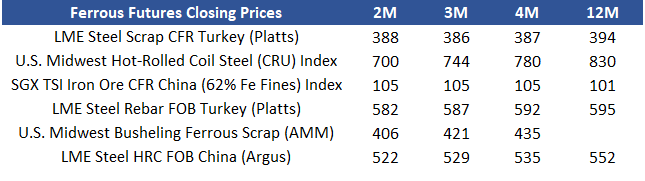
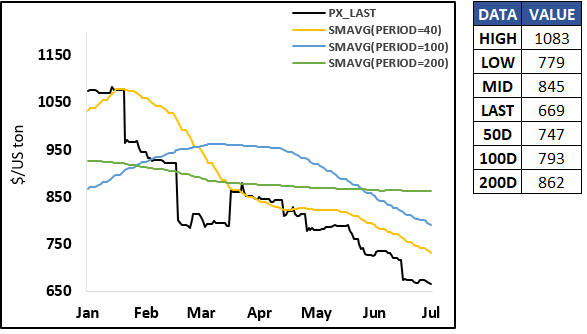
In the U.S. Midwest Domestic HRC Futures market, the 3-month contract (HRC4) slightly increased to 778, and the 4-month contract (HRC5) decreased to 800. The 12-month contract (HRC12) rose to 830. Recent developments include new U.S. tariffs on steel and aluminum shipments from Mexico to curb Chinese transshipment, aiming to protect domestic industries. The RSI values indicate oversold conditions for near-term contracts, suggesting potential for a short-term rebound, driven by policy measures and stable consumption growth. However, US HRC Steel Futures remains 8.6% cheaper than foreign HRC Steel, with a price gap of $56/st below offshore products, widening from last week's -5.6% premium. US HRC Steel Futures for July and August were identified as the most oversold with RSI values of 24.22 and 29.89, respectively. US Scrap prices saw significant increases with the August contract rising by 7.69% to $420/lt, the September contract up 4.68% to $425/lt, and the October contract increasing by 4.51% to $440/lt.
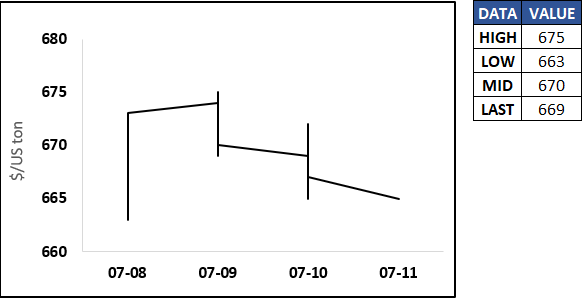
HRC Front Month 3 Day Trend
StoneX & Bloomberg
HRC Front Month 6 Month Price Trend
StoneX & Bloomberg
Chinese Steel & Iron Ore Markets
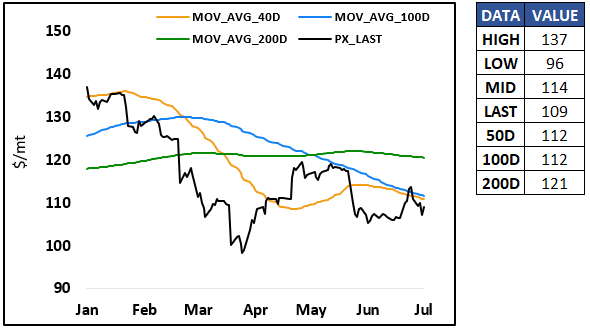
The SGX TSI Iron Ore Futures showed declines across observed contracts, with the 3-month (SCO3) and 4-month (SCO4) both falling to 106, and the 12-month (SCO12) dropping to 101. Despite these declines, iron ore prices rallied by 2.6% to $108.15 a ton, anticipating economic reforms at China's upcoming Third Plenum. However, market volatility persists due to pessimism over China's construction sector and a surge of Chinese steel imports into Vietnam, up 91% year-on-year. The iron ore market experienced a volatile week, with a 3.6% rally on Thursday following a 4.1% slump on Wednesday, yet prices remain down nearly 25% this year. The Chinese government is expected to focus on property policies to revive home sales, although results have been muted, with a projected 20% decline in sales from China’s top developers. The active SGX iron ore contract has recovered to around $109.25/ton, reversing recent dips and staying within $101.80/ton to $114.30/ton. Improved broader Chinese asset sentiment, aided by regulatory shifts and a rise in the CSI 300 index, along with higher steel futures and aluminum and copper prices, further influence the market.
SGX Iron Ore CFR China (62%) Futures
StoneX & Bloomberg
European Steel and Steel Scrap Markets
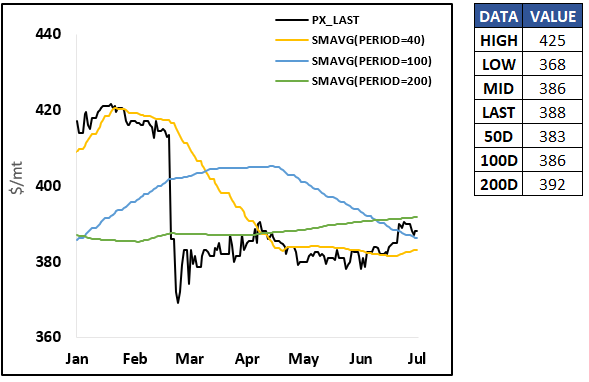
For the European ferrous market, LME Turkish Steel Scrap futures remained relatively stable. The 3-month contract (JBO3) slightly decreased to 387, the 4-month contract (JBO4) remained unchanged at 387, and the 12-month contract (JBO12) marginally declined to 394. In May, Turkey's billet and bloom imports decreased significantly, reflecting market challenges. Jefferies maintains a cautious outlook for the European steel sector, anticipating demand recovery delays until 2025. EU Scrap prices have experienced a mild recovery since early March, but remain at historical lows. Expectations for infrastructure-related demand to increase in late 2024 or 2025.
In Europe, Italian and German hot-rolled coil (HRC) prices have shown slight increases. Italian HRC rose by $5/st to $622/st, making the delivered price to the US approximately $712/st after adding import costs, while US HRC remains $62/st cheaper. Similarly, German HRC increased by $7/st to $619/st, with the delivered price to the US at $709/st, leaving US HRC $59/st cheaper.
Turkish Scrap 1st Month Futures
StoneX & Bloomberg
Current Prices