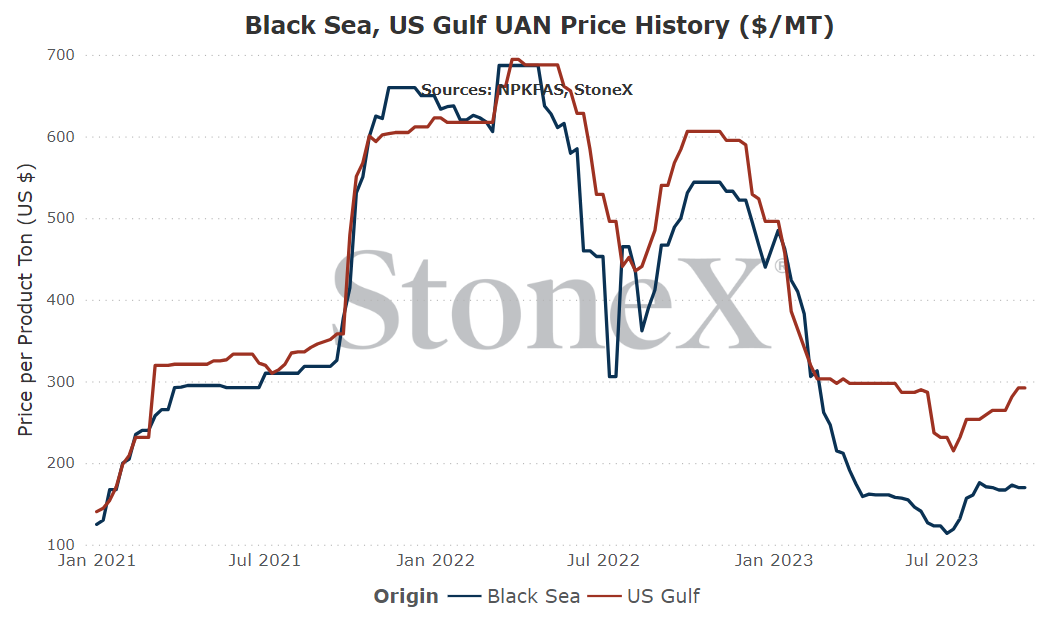
The intention of the below graphs are not to use to say "my price should be X based on this graph". These prices are derived from an FOB price point average. The intent is to show major global price movement trends. Your values will likely have significant basis difference (similar to your local grain price being different than the traded market price).
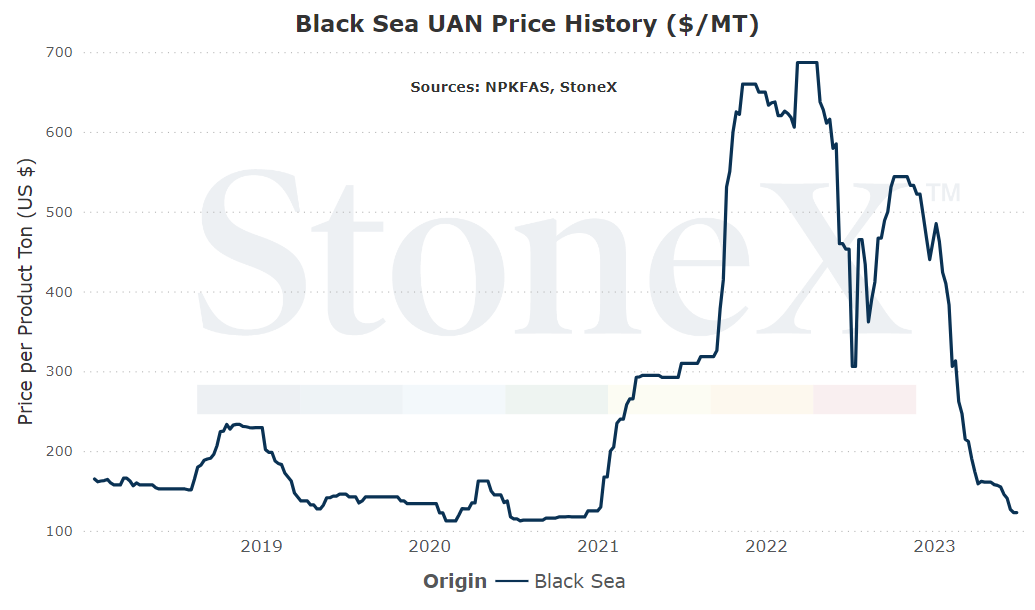
This graph is labeled as MT in USD currency.
Global
For the most part, the global UAN market follows the global urea market higher and lower so that should be the biggest driving factor.
However, UAN continues to struggle with disrupted trade routes...specifically Russia. Where they go/do not go will help determine each's regions price in relation to the world. If Russia is arriving, those values are a bit more depressed. If Russia is diverted, welcome to a premium priced world.
Long story short - UAN markets look supported near term
Australia
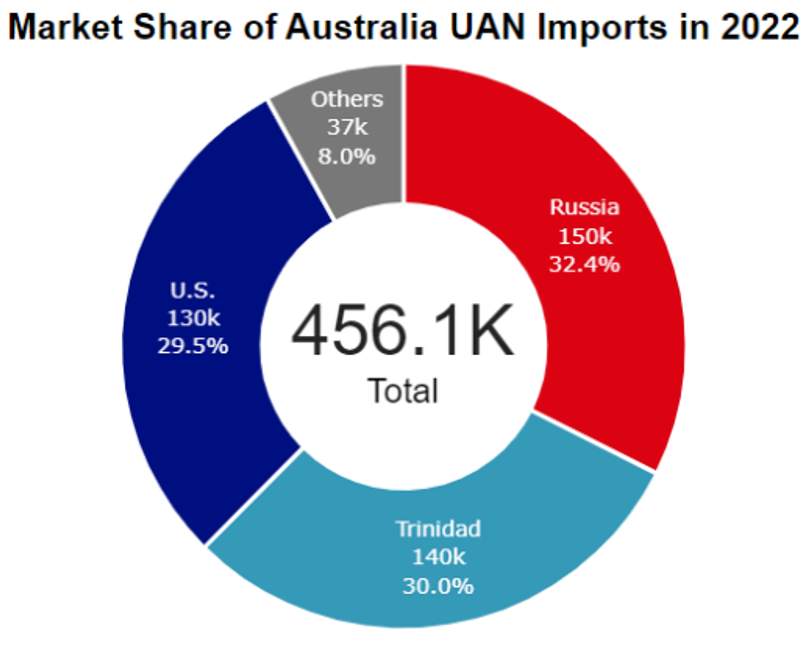
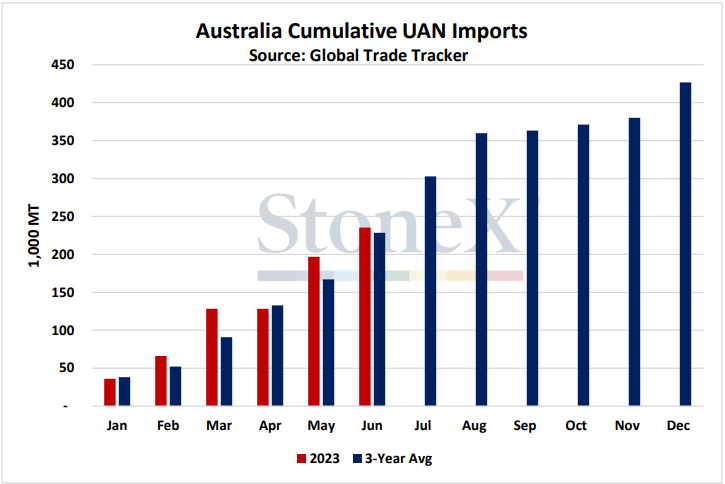
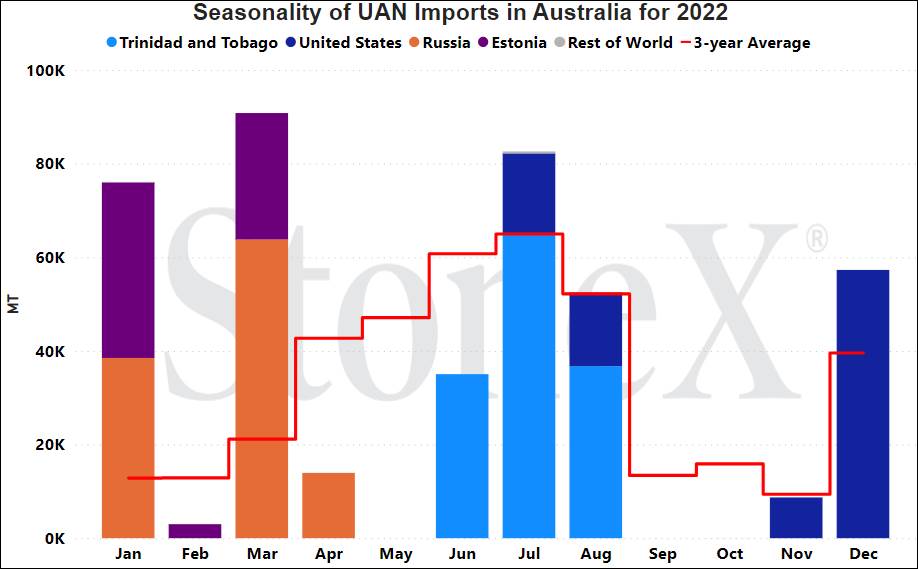
Unfortunately for Australian UAN buyers, the list of places to secure product from is pretty small as duties against Russia remain in place which are effectively blocking the product flow.
Long story short - the current short term global UAN outlook is supported and the addition of only have one major production region (N.A.) available only works to heighten the Aussie price outlook.
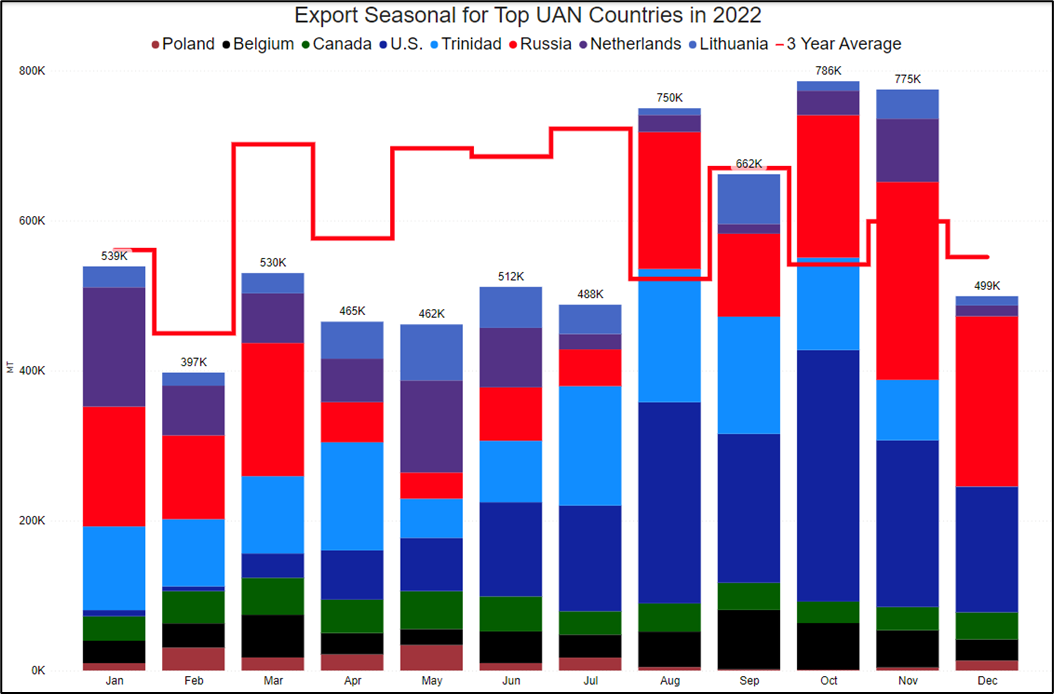
EUROPEAN PRODUCTION RATES IMPROVE...SLIGHTLY
For me, the main focus of the global UAN market has been European production rates.
Check out recent month editions to get a deeper background/explanation of what happened but the short story is:
- Europe accounts for roughly 1 out of every 5 tons of UAN purchased around the world
- European natural gas supplies have historically come from Russia (Nordstream pipeline)
- Europe's refusal to allow Nordstream expansion and Russia's invasion of Ukraine combined to send Dutch TTF (natural gas) values skyward
- With natural gas prices up, the cost to produce nitrogen fertilizer became too great and most plants shut down
- After the world figured out shipments to Europe and demand tailed off, gas values plummeted from their high's, allowing some production to resume
Today, we are in a situation where the majority of European nitrogen production is back online. While Dutch TTF markets are still elevated from historic norms, they have been low enough and global nitrogen values high enough to justify the restart.
In the last month, restart announcements have been mostly quiet with only a plant in Romania making the decision to restart. This restart and the belief that other plants are ramping up production rates have us believing that Europe as a whole is in the 80 - 85% of normal production.
For the UAN market, this means a decent deal. More production running means more tonnage at "home". More tonnage at "home" means less dependence on imports. Regarding imports, these restart moves puts pressure on North America producers who have greatly enjoyed exporting their extremely cheap produced UAN to Europe at sizeable premiums. Now, those tons will be more forced to stay at home and compete.
The situation in Europe is far from over. Russia continues to invade Ukraine and that situation shows few signs of changing near term. European nations continue to largely refuse to do business with Russia. Russia in turn is largely refusing to send any natural gas to Europe due to their support of Ukraine.
That means this will continue to be a story that causes ripples in global supply routes but every restart announcement brings us closer to normal.
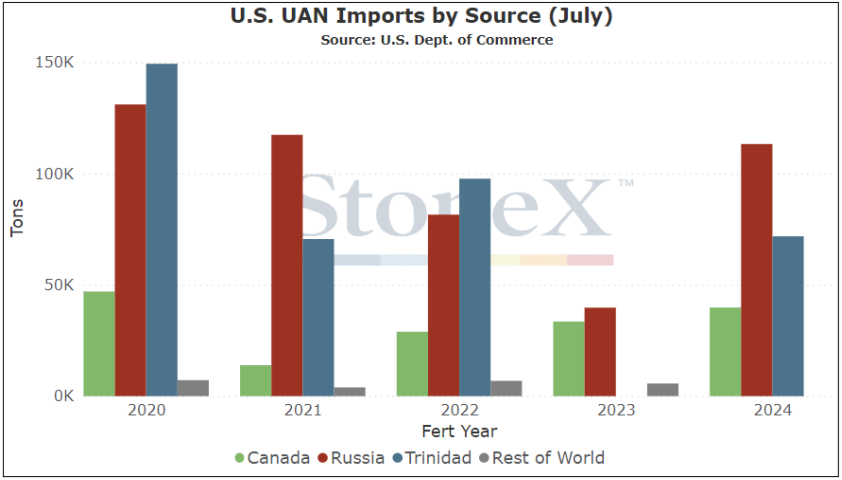
RUSSIAN PRODUCED UAN CONTINUES TO TARGET U.S.
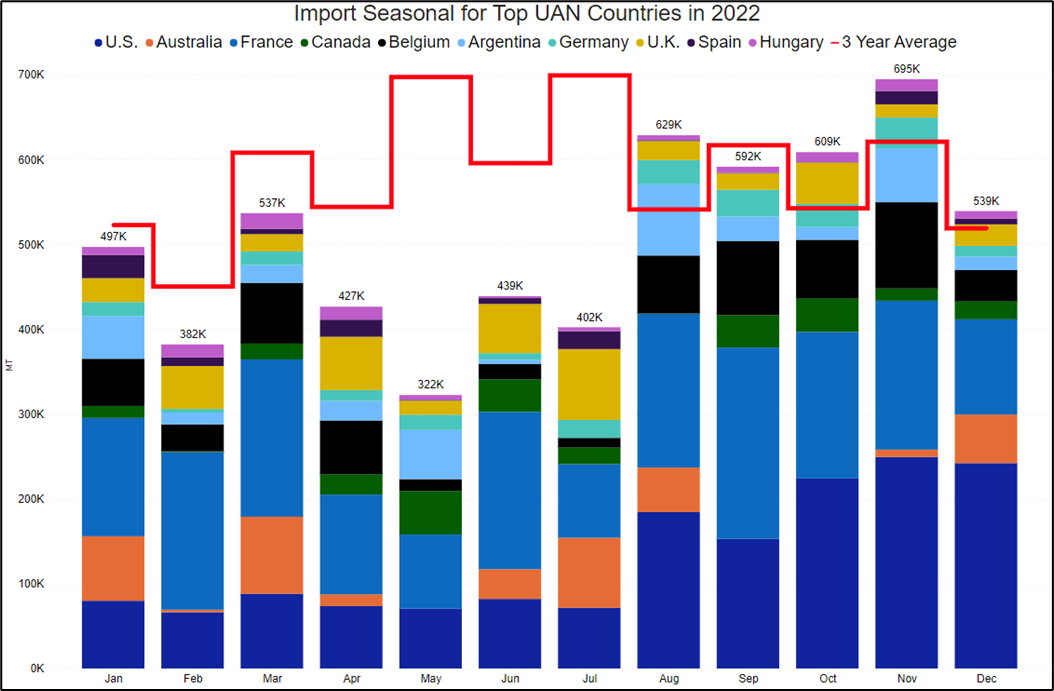
As has been the case since shortly after Russia's invasion of Ukraine, the U.S. has become a popular destination of Russian produced UAN. European nations have largely shunned doing business directly with them. Both Canadian and Australian governments have imposed import duties on all Russian produced fertilizer.
Given how relatively few demand destinations are around the world, it makes sense that U.S. would a popular destination. As the U.S. dives into its 2024 fertilizer year, this trend is growing still which is a good thing for N.A. buyers.
Without these imports, N.A. UAN manufacturers would have more control of a market that is still seeing sizeable exports to Europe. Not only does the influx of Russian UAN help balance the N.A. S&D, it also provides more competition in the market. Without it, N.A. manufacturers would have almost sole control on what the market is.
Looking forward, it does not look like there will be a substantial shift away from this approach. While there have been some improvements on European production, the shifts have been slight. There are no signs that the U.S. is going to block these flows near term. Few, if any, farmers in the U.S./N.A. are asking where their UAN is sourced from.
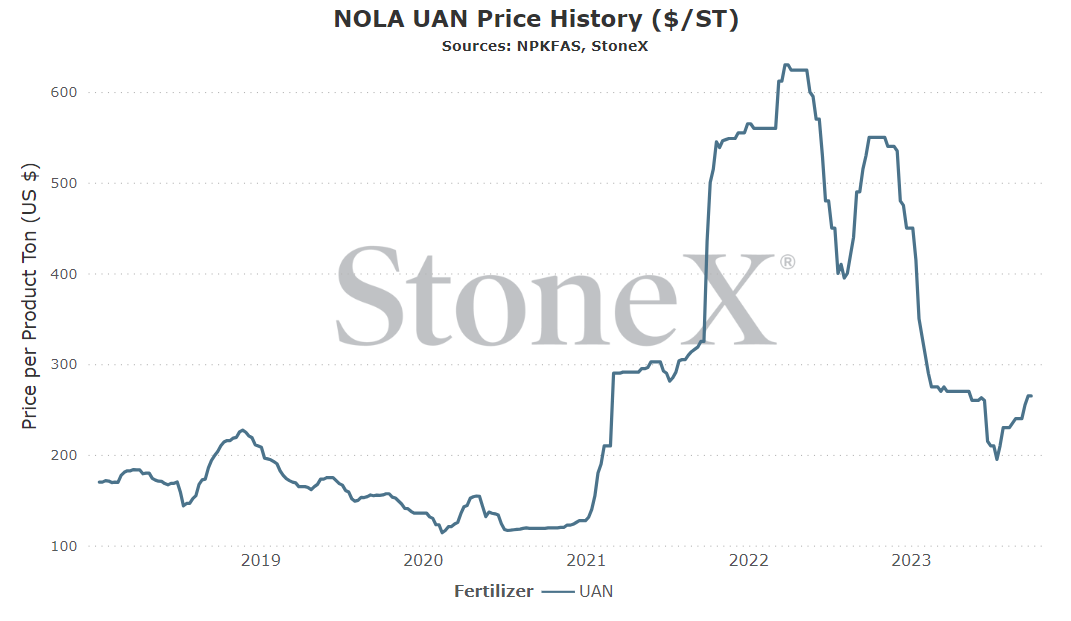
NOLA/New Orleans, Louisiana
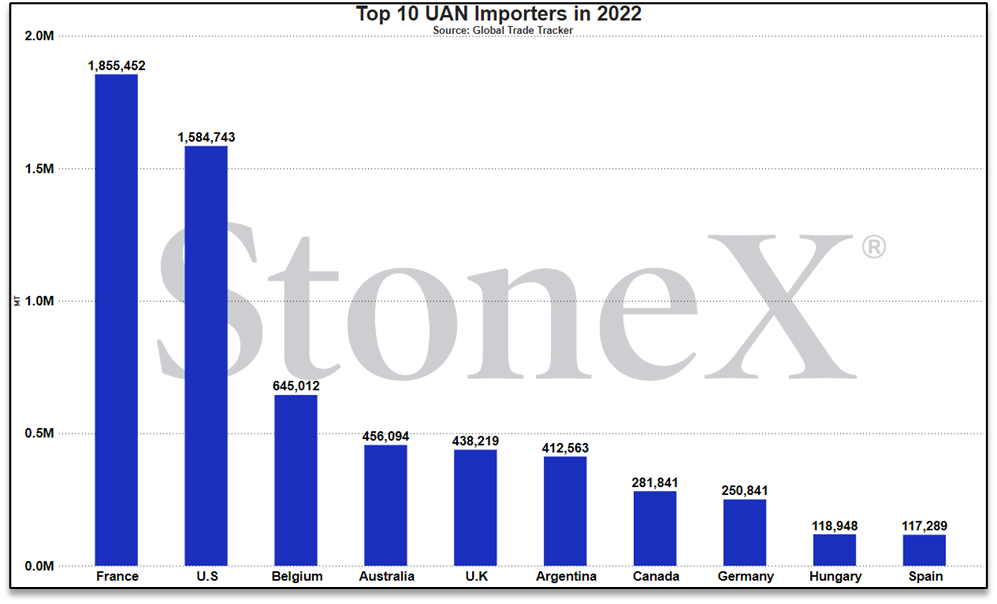
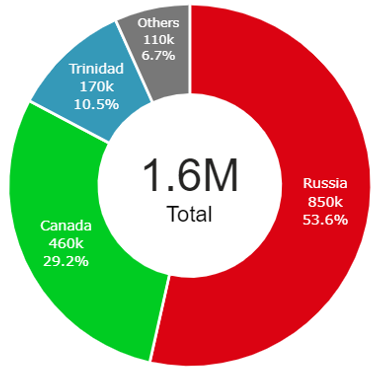
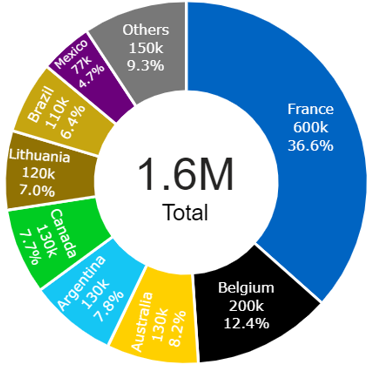
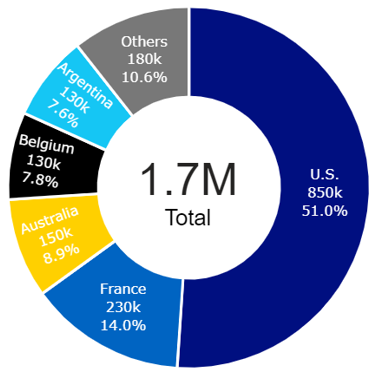
Number 2 global importer in 2022
Price Comparisons
Vs 30 days ago - +10% or approximately $25 higher
Vs 90 days ago - +26% or approximately $55 higher
Vs 6 months ago - -2% or approximately $5 lower
Vs 1 year ago - -52% or approximately $285 lower
Black Sea (Russia)
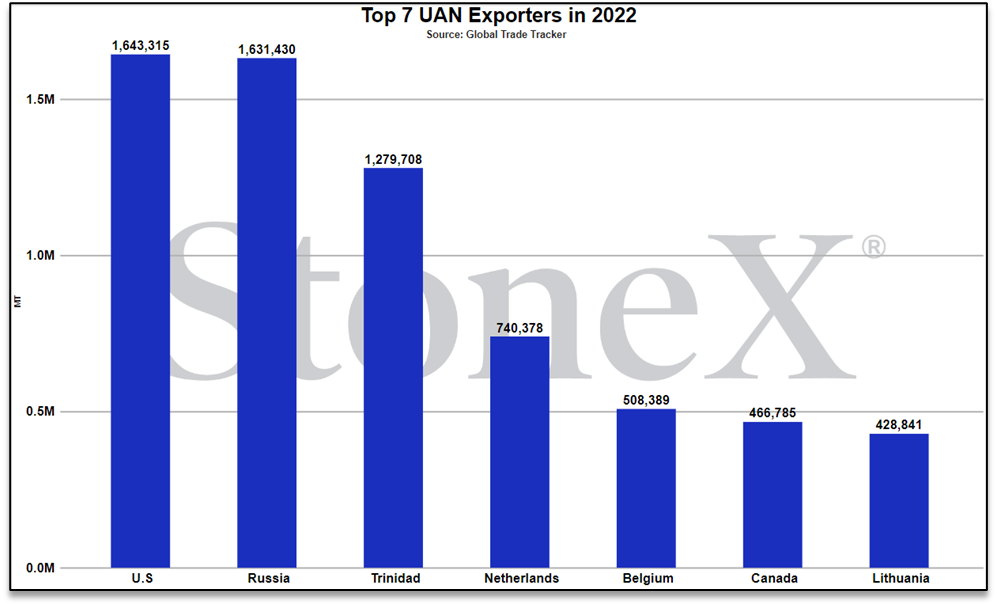
Number 2 global exporter in 2022
Price comparisons
Vs 30 days ago - +1% or approximately $3 higher
Vs 90 days ago - +38% or approximately $47 higher
Vs 6 months ago - -3% or approximately $5 lower
Vs 1 year ago - -68% or approximately $362 lower
- High Dutch TTF natural gas values keep remainder of European production offline – European natural gas values have remained relatively flat of late which means the cost is simply too high for the remaining offline nitrogen plants to restart. If those remaining plants were to restart, it would help global UAN values settle down a bit...unfortunately for buyers, that isn't the case.
- UAN still attractive vs urea – when taking a snapshot of the UAN and urea markets today, UAN is still a bit more attractive than urea for those farmers that can switch between nitrogen products. Now, it is only October so we are not expecting a lot of spring '24 nitrogen decisions to be made but for those that do, that demand should lean slightly to UAN.
- N.A. manufacturers still appear to have a solid sales book on today – in my mind, this is the biggest bull for UAN. N.A. manufacturers have plenty of UAN sold. That means they can comfortably sit back and wait out the market for the next "emergency". When you are well sold, you can fight downward pressure for much longer than when you are not.
- Large N.A. fall NH3 application run could "steal" spring UAN demand – while this factor is far from set in stone, there are enough things pointing to a big fall NH3 run that we need to consider it. If the fall is big, there will be less need for overall nitrogen in the spring. That weighs on the market, whether it wants to admit it or not.
- Continued Russian produced UAN imports to U.S. keeps competition in place – N.A. manufacturers continue to take advantage of the export opportunity to Europe to backfill missing production. However bullish that may make them, they also have to appreciate the fact that Russian produced UAN continues to pour in, creating more competition. As long as these imports continue, it weighs on price ideas.
- Rising global nitrogen values could allow remaining European production to restart – categorize this in the low chance column...but there is a chance!! Only focusing on Dutch TTF values means only considering the input side of the equation. Seem familiar to the ratio approach?!?!! If input costs remain stagnant but global nitrogen values continue to climb, we could well see the remaining offline European nitrogen plants restart.
We believe that only looking at the flat price of either grains or fertilizer can be misleading:
-
Only selling grain can hurt you if fertilizer prices rise substantially
-
Only buying fertilizer can hurt you if grain prices fall
We look at the ratio "value" to get a better indication of where we are or how many bushels of X does it take to pay for 1 ton of fertilizer.
Would you rather:
-
Spend 100 bushels to pay for 1 ton of UAN
-
Spend 60 bushels to pay for 1 ton of UAN
When we compare the current ratio value against recent years, we start to see if we are high or low.
YOUR VALUES WILL LOOK DIFFERENT
This is a work in progress section! We plan on looking at the relationship between Aussie grains and global price points (and hopefully Aussie specific locations, though that data is hard to secure, very protected). Big reason why we are still in the "trial" stage of this newsletter!!!!

- European production rates - big shock, I know!! For those that may be new, European nitrogen production rates have been a big deal to the global N complex for a while now. As important as the higher/lower production rates are for the urea and NH3 markets, it is even more important to the global UAN market as Europe accounts for approximately 20% of global capacity. Today, it does not appear that significant changes are going to be made regarding restart announcements. The cost of natural gas (Dutch TTF) is simply too high for the remainder to restart...for now.
- Global urea price directions - as important as the import/export situation is, the overall direction of nitrogen (specifically for me, urea) continues to have the largest affect on UAN values. As urea has continued to see bullishness globally, it helps set the stage for UAN prices to appreciate. Now, if going forward we start to see urea values fall, UAN is likely to be delayed on dropping as well (shocker, right?) as manufacturers are very well sold and the current S&D remains tight. But as last year taught us, that situation can only hold for so long before something breaks.
- U.S. price ideas - with Russian produced UAN effectively being blocked from shipping directly to Australia, the U.S. has become the major supplier in today's world. That means as the U.S. market goes, so to should Aussie values. Their S&D/price ideas/etc. should mean just as much to Australian farmers as it does to U.S. farmers.
All data was sourced from StoneX unless otherwise noted.
This material should be construed as market commentary, merely observing economic, political and/or market conditions, and not intended to refer to any particular trading strategy, promotional element or quality of service provided by the FCM Division of StoneX Financial Inc. (“SFI”), StoneX Financial (Canada) Inc. (“SFFC”) or StoneX Markets LLC (“SXM”). SFI, SFFC and SXM are not responsible for any redistribution of this material by third parties, or any trading decisions taken by persons not intended to view this material. Information contained herein was obtained from sources believed to be reliable, but is not guaranteed as to its accuracy. Contact designated personnel from SFI, SFFC or SXM for specific trading advice to meet your trading preferences. These materials represent the opinions and viewpoints of the author, and do not necessarily reflect the viewpoints and trading strategies employed by SFI, SFFC or SXM. The FCM Division of StoneX Financial Inc., a subsidiary of StoneX Group Inc., is a member of the National Futures Association (“NFA”) and registered with the U.S. Commodity Futures Trading Commission (“CFTC”) as a futures commission merchant and commodity trading advisor. StoneX Financial (Canada) Inc. is currently registered as a Futures Commission Merchant or equivalent in all provinces of Canada and is a member of the Investment Industry Regulatory Organization of Canada.