China has historically been the leading global exporter...and they continue to be behind on export rates.
India has historically been the leading global importer...and they need to rebuild stockpiles.
That is not a good combination...
As long as China scales back on exports and India plays catch up on stockpiles, it is really hard for me to see global values falling. I do firmly believe that farmers that are seeing global replacement values (i.e. not subsidized by the government) will look to cut back but I am afraid that will not be enough to offset this situation.
This makes me continue to believe that global values stay flat to higher. I would love to be wrong and everyone get a chance to lock in significantly lower values...but I do not see it today.

As expected, India fixes subsidy rate and buying spree ensues
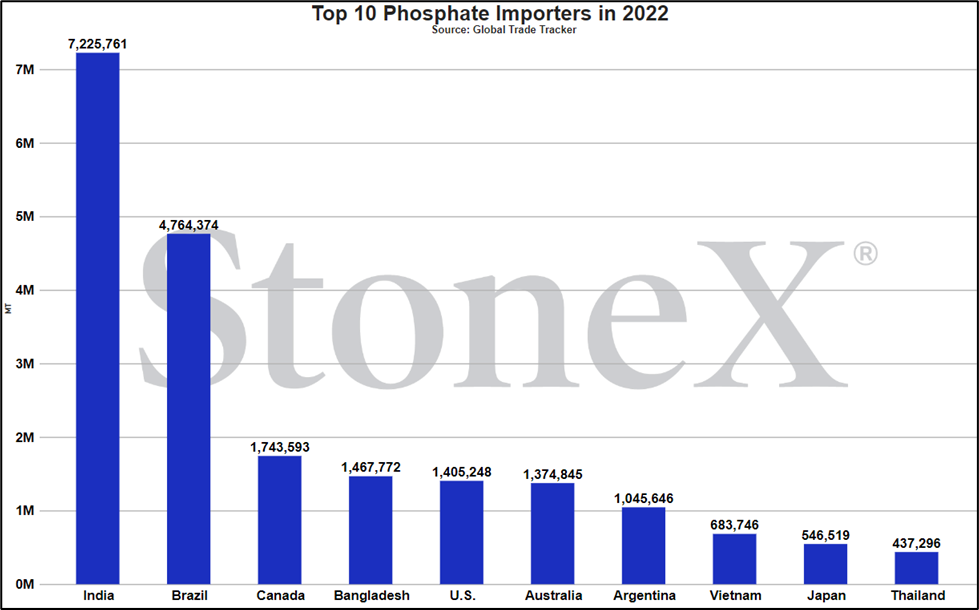
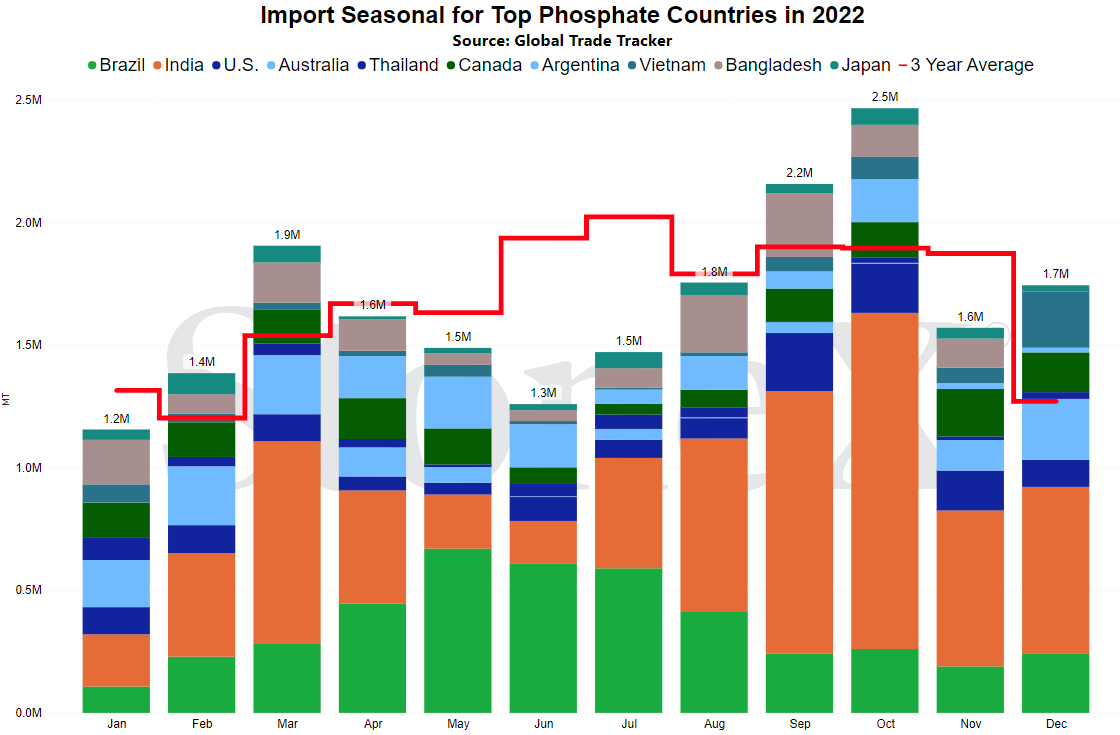
Given India's place as the largest global phosphate buyer (not consumer but buyer), it makes sense that we watch their activities very closely as it can shift global sentiment.
That is what we have spent so much time discussing them the last few months. For a bit of backstory:
Back in later 2021, we saw Indian farmers erupt. Stockpiles of DAP had dwindled down to the low 1M ton range across the country. While that may seem a huge number of tons available, for a country the size of India, it was very low. As a result, upheaval began. Farmers rioted. There were reports of retail locations being ransacked. It was an ugly look. Fortunately, the government was able to start rebuilding stockpiles to comfortable levels and the angst went away.
While India is not yet back to those times, they have been getting closer than they need to and most of it was due to the government not "fixing" their subsidy rate.
For those unaware, Indian farmers do not see global replacement values. Their phosphate values remain steady. Obviously, importing companies are not going to purchase product at a loss so the government steps in with a subsidy rate that helps offset the difference. If you remember earlier this year, global phosphate values were falling on what appeared to be improving Chinese supplies and waning demand. The Indian government started to cut their subsidy rate. No doubt in hopes of influencing global values further down in order to save a little money. This worked for a short time...until Chinese exports started to slow again. That is where the issue began.
The government was slow to increase their subsidy rate, so importers had their hands tied. Imports slowed to a stop/crawl and demand started to reduce the available supplies. Remember how the late 2021 riots started because stockpiles dropped to the low 1M ton range? The lowest forecasted stockpile I have seen was 1.5M. Fortunately, in the last month, the government finally start to take steps to alleviate the issue.
A team was sent to Morocco to secure a block of tons. While they were unsuccessful in lowering price ideas, they were able to lock up 500K of DAP (and a couple hundred thousand ton of TSP). Then, the subsidy rate was improved and buying began.
That brings us to today. Put yourself in the shoes of a global phosphate manufacturer. You continue to see China (world's largest DAP/MAP exporter historically) scaling back on their export flows. That tightens global supplies. At the same time, you see the world's largest buyer low on inventories and backed into a corner. What do you do? Do you keep prices flat or even consider lowering them?
I wouldn't...
What we have seen is that with every reported sale or every couple reported sales, the price they pay goes up a little. Originally, they were paying $630 CFR. Then that value jumped to $637 CFR. Then it jumped to $642 CFR with rumors/reports that traders are buying DAP destined for India at prices near $640. India has been doing a solid job of securing tonnages, but they have a long ways to go. Normally in the summer, they would have approximately 4M tons sitting around...far cry from the 1.5M forecasted.
While I am very glad to see imports resuming to India as it means farmers there have access to product sorely needed to raise their crops. Unfortunately, it means that the price bar continues to rise. How long this buying spree continues is anyone's guess.
What does this mean for farmers?
When the world's largest buyer is low on stockpiles and needs to replenish for fear of another farmer uprising like late 2021, global sellers see it...and get really excited.
Since the Indian subsidy rate was "fixed", they have been a pretty constant buyer...and their values have been rising as well. If their value rises, then manufacturer price ideas rise for other buyers. It isn't as though they will sell India one price and leave everyone else cheap.
Unfortunately, this should trickle down to the farm.
Chinese exports continue to lag, reducing global supplies
On the above story, I talk about how we need to track the world's largest buyer of phosphate as they can influence the global markets. Just as important is the historically largest exporter of DAP/MAP in China.
For a bit of backstory for the new crowd, the last several years have seen a tremendous amount of price volatility. Early 2022 was the worst of it. Grain prices were high, causing demand to front run and support price ideas. Then Russia's invasion of Ukraine sent fear thru global phosphate markets that the world would stop the export flows. Given how important Russia is on the global phosphate state, prices rallied to near record high's.
That is when the Chinese government took notice.
While the world was rallying price ideas, China was seeing its own phosphate price skyrocket. With fears of Russia being removed from the world, a sudden fear emerged in China that exports could explode to backfill the lack of Russia, leaving Chinese farmers with little to no product. That didn't sit well with communist China. We suddenly saw the government step in to protect its farmers. Exports started to be restricted with the strategy being "if we restrict exports, it ensures domestic supplies and helps to lower our farmers price". Unfortunately for the rest of the world, it worked.
Since then, global values have come off their high's and inventories feel much better than they did at the peak...but the Chinese government continues to play a part in restricting exports. Why?
With most things China, we never truly know but I have a working theory.
We have seen reports/rumors/etc. that the Chinese government is taking steps to make themselves much more self sufficient than they have been in the past. This includes wanting to raise more domestic grains which could mean domestic demand is even higher than it has been. On the other side of the theory, the government figured out the power they have as an exporter. By reducing outflows, it forces more tons to stay at home and forces values to stay a discount to the world. That benefits their farmers significantly.
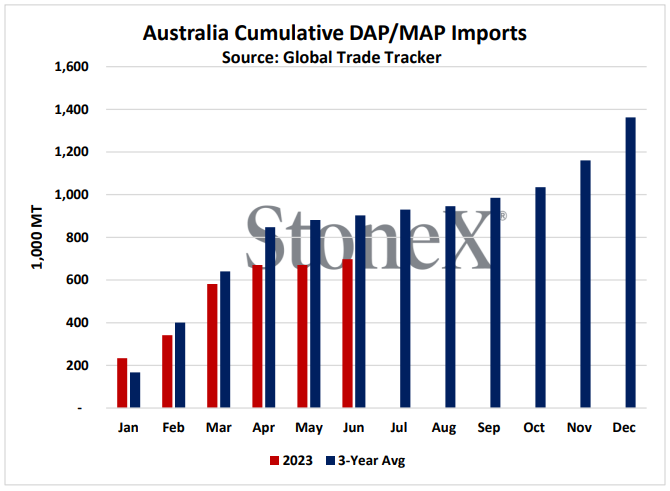
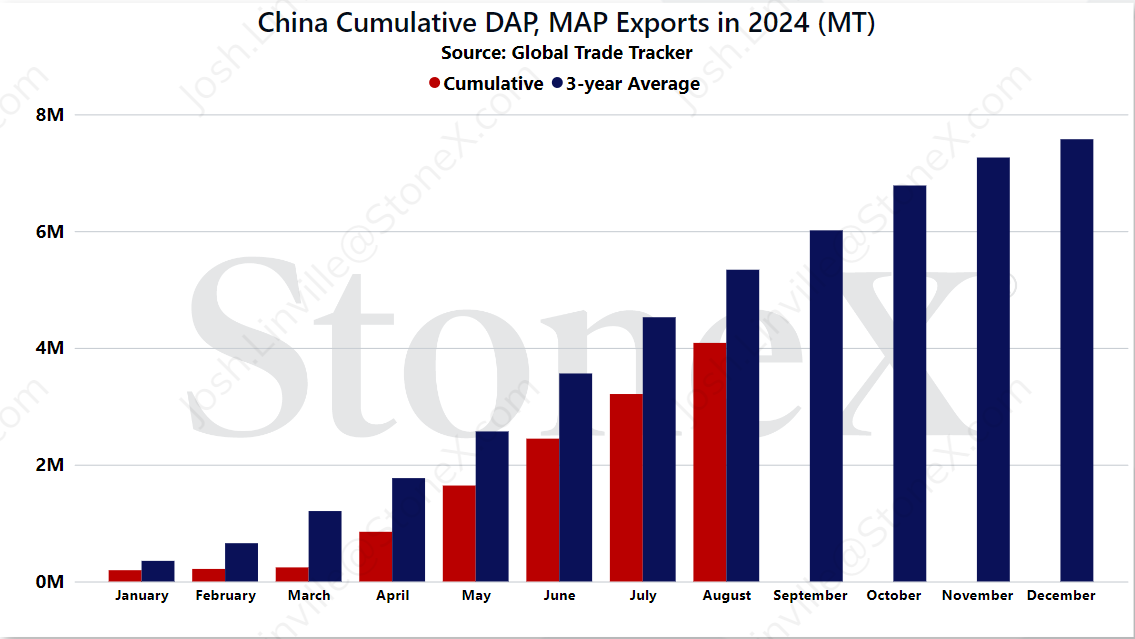
That brings us to today. Thru August, Chinese DAP/MAP exports sit at only 4.1M tons. Their 3-year average thru August would normally put them around 5.3 - 5.4M tons. A 1+M ton shortfall obviously hurts but that is only part of the story. In recent history (prior to the 2022 situation), China would export something closer to 9 - 10M tons for the year so when you look at the graph below, remember that the last dark blue line should be another 1.5 - 2M ton higher than what it shows...
So a very long story short is that the world's largest exporter continues to restrict flows to benefit their own farmers...and the globe continues to pay the price.
What does this mean for farmers?
So the world's largest buyer is having to rebuild stockpiles for fear of angry farmers...and at the same time, the world's historically largest DAP/MAP exporter is falling further behind on flows with fears it gets worse before it gets better.
Well, the outlook can get worse...but not by much.
Again, if this story plays out, this should trickle down to the farm level.
Phosphate remains high priced vs...everything
This is a piece that I wrote for North America, but I wanted to include it here as I thought a lot of the points hold true to farmers around the world. Phosphate prices are historically high around the world and a lot of the grain/phosphate ratio values are high as well.
Yeah...phosphate prices are high.
While most other fertilizer saw their values tumble to a third of the high's set in early 2022, phosphate dipped to half and has been building back since. Farmers, already struggling with poor farm economics due to low grain values, have been singling out phosphate as one of their first cuts if necessary. Now, a lot of that can be put on emotion and there is nothing wrong with that. There are going to be a lot of farmers who are happy if their harvest pays the bills. There could be a lot that are not that fortunate. Farming has gone back to being a rough living so it is easy to be upset/frustrated/etc.
However, as explained in the above pieces, this is not just a one area of the world situation. We are seeing global values remain high with a very tight S&D looking to continue supporting values.
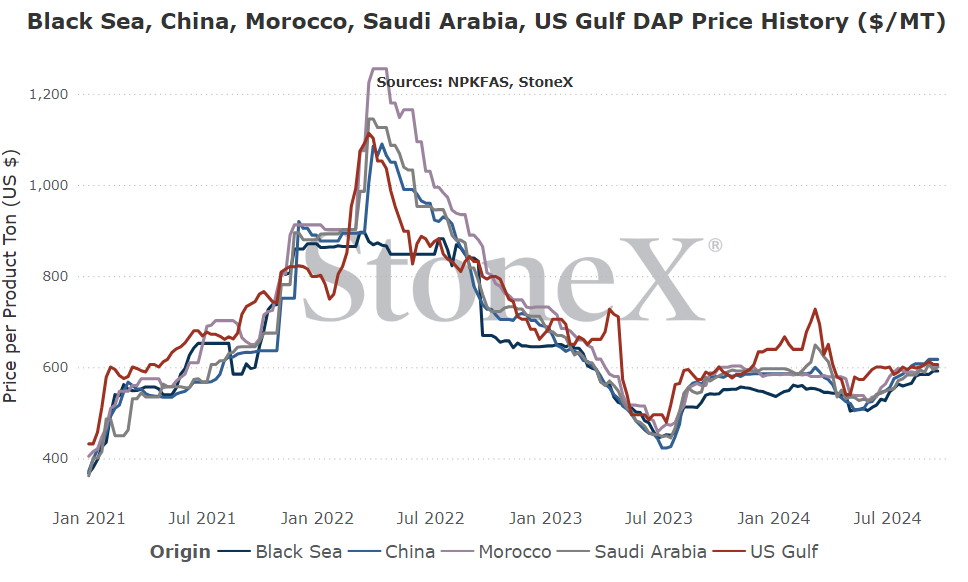
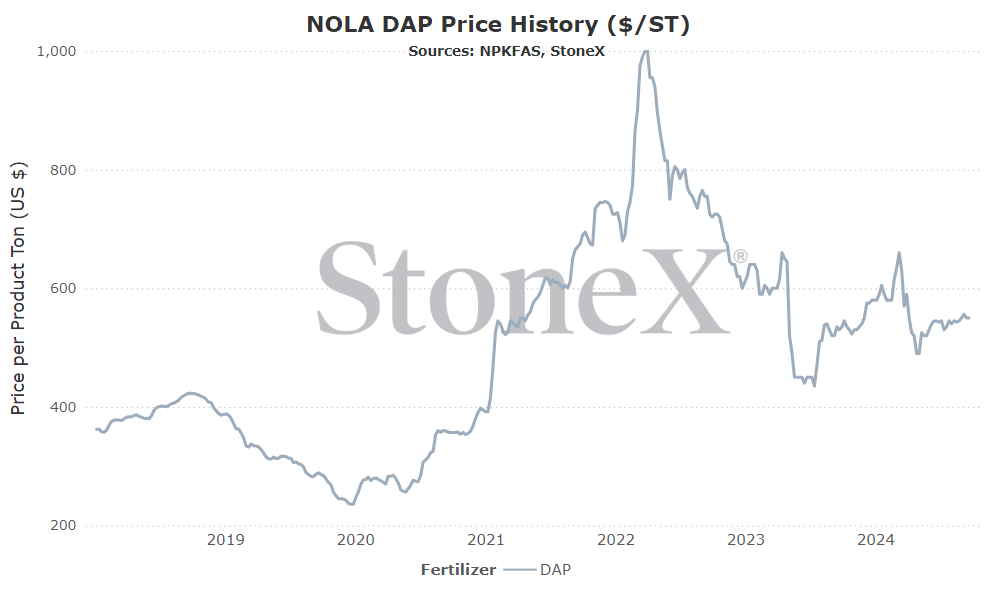
Based on memory, I believe the highest NOLA DAP barge trade that I saw was very near $1,000. Today, it has been in the mid-$550's and with global support looks to climb near term. Historically speaking, it is high.
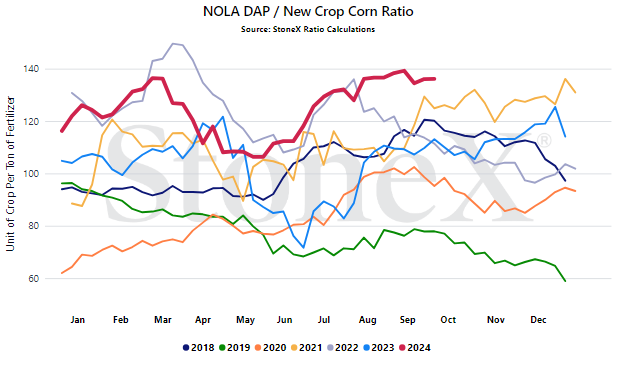
But how does it compare to grain values? At the end of the day, if grain values are high then the value between the two must be decent. Therein lies the problem. Grain prices suck. December 2024 corn currently sits at $4.13/bushel. With NOLA DAP in the mid-$550's, that puts the ratio in the 134 - 135 range. A quick glance at the historical DAP/Corn ratio chart below shows that this is easily on the highest end of values. What that means is that you are paying significantly more bushels to pay for the exact same ton of DAP. I'll save you the MAP chart...it's worse.
By a lot of the POV's that I use, each one says that phosphate is overpriced today...but that does not mean it is coming down. Ultimately, the world still has several issues and prices have been holding on. Given what is happening in China/India, I'm afraid they can get worse.
Now for my soapbox time:
Make rational phosphate decisions.
Notice I didn't tell you what to do or not to do? Just make rational decisions.
It is very easy today to make angry decisions. Those rarely work. However possible, try to set those emotions to the side when making your farm marketing decisions. Can you reduce/cut your phosphate application rate without hurting overall yield potential? OK, then that might be the way to go. Can you wait until spring in hopes a clearer picture emerges? I'm not sure it will but if you can, that might be the way to go.
My job IS NOT to tell anyone what to do. I simply ask that whatever you ultimately decide to do, you do that from a grounded place. It is already hard enough out there this year. No need to make it harder.

Price comparisons
Vs 30 days ago - 1% or approximately $5 higher
Vs 90 days ago - 1% or approximately $5 higher
Vs 6 months ago - -7% or approximately $40 lower
Vs 1 year ago - 4% or approximately $20 higher
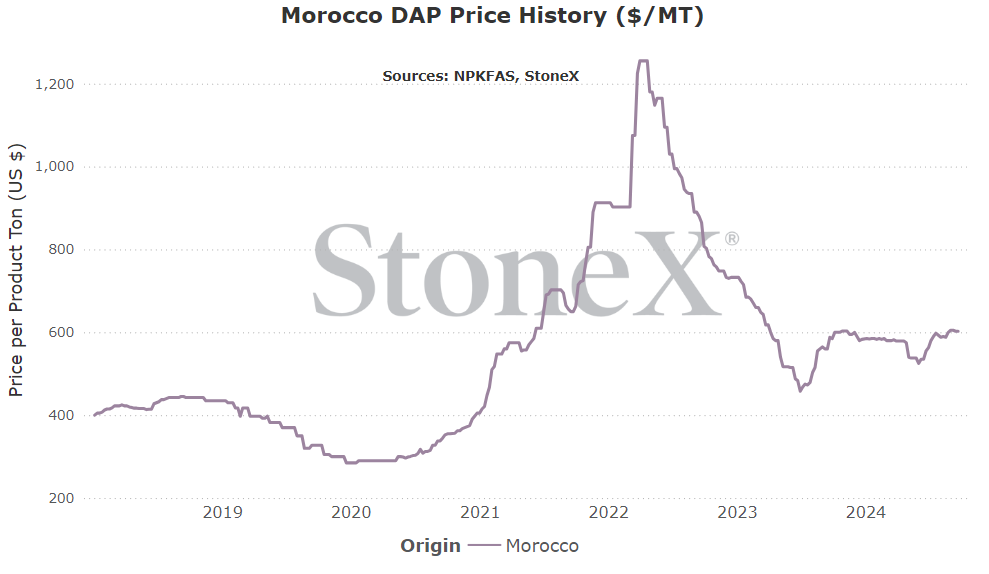
Morocco DAP price comparison
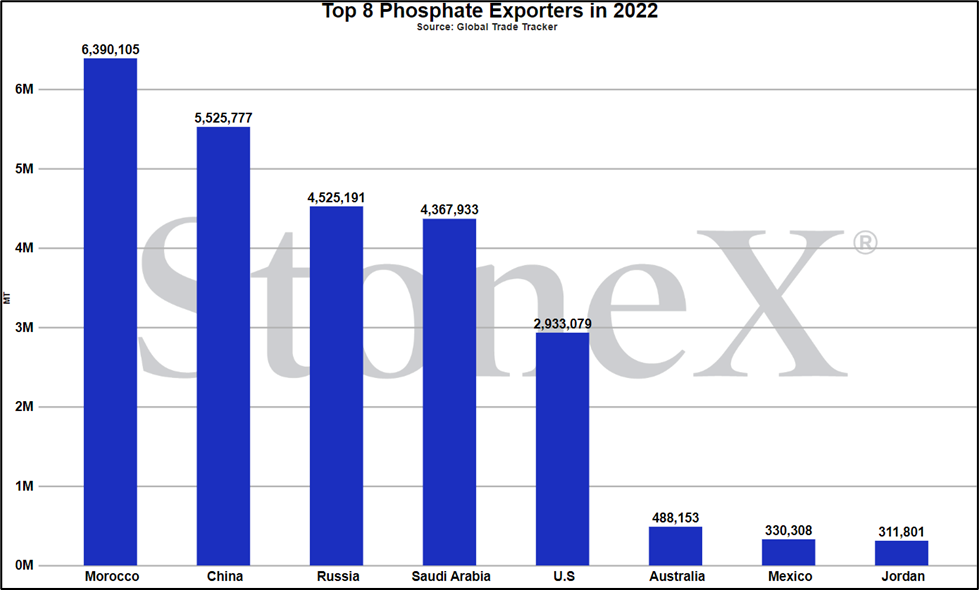
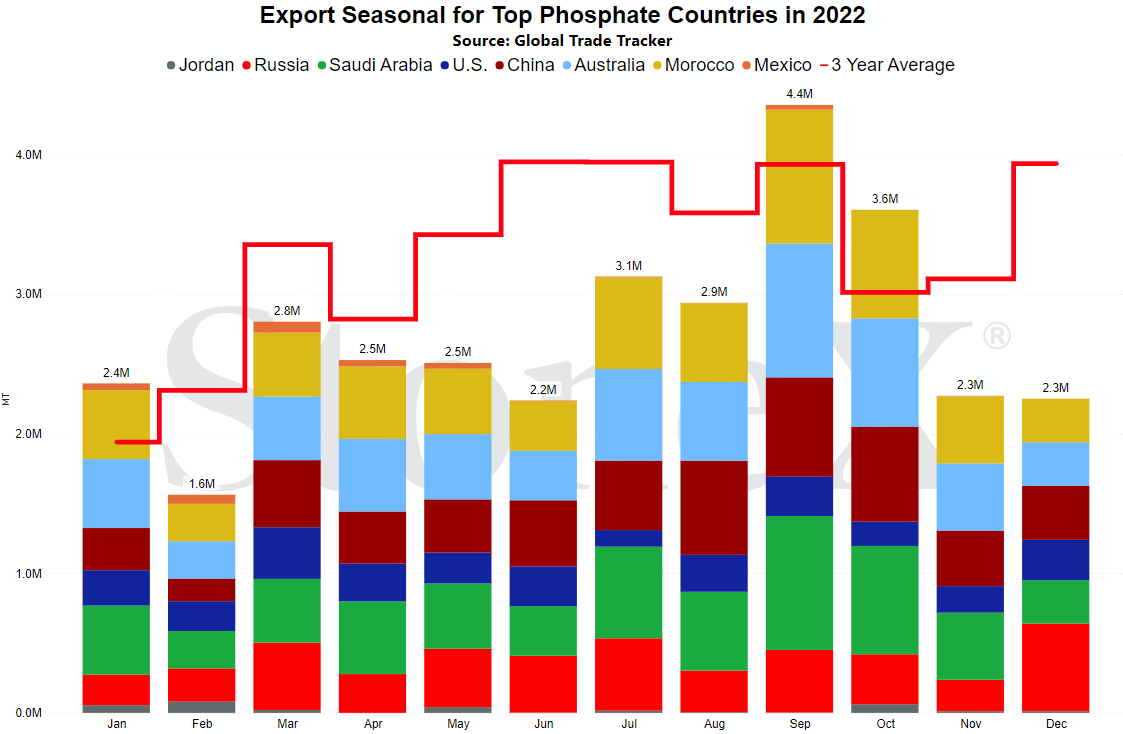
Number 1 global exporter in 2022
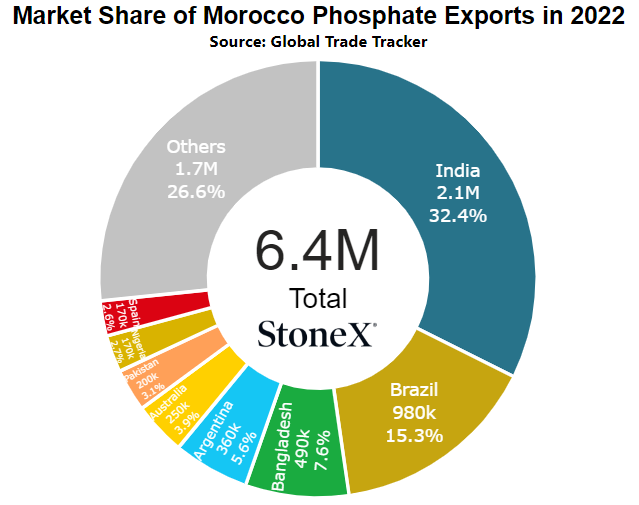
Price comparisons:
Vs 30 days ago - unchanged vs last month
Vs 90 days ago - 9% or approximately $48 higher
Vs 6 months ago - 4% or approximately $24 higher
Vs 1 year ago - 3% or approximately $15 higher
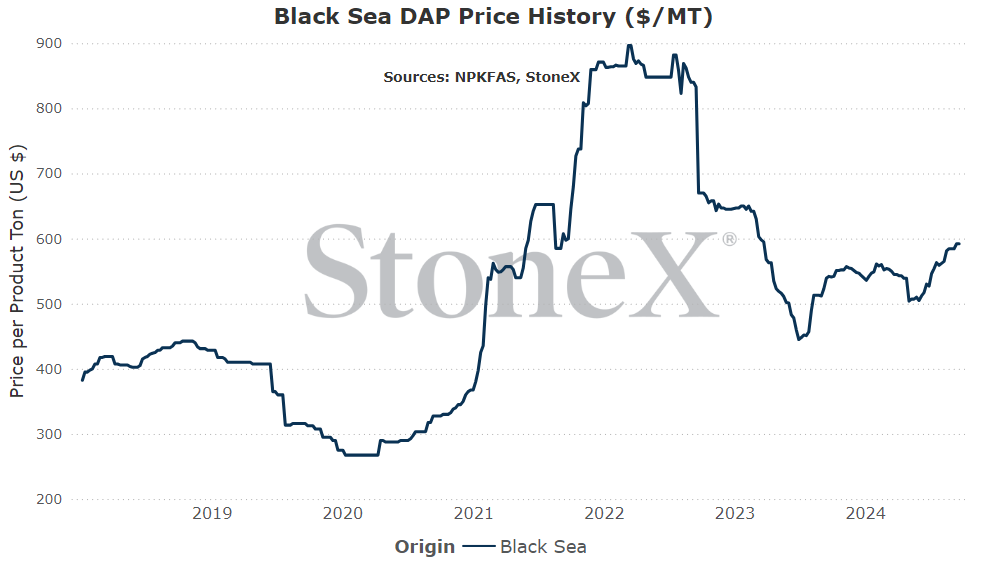
Black Sea DAP price comparison
Number 3 exporter of DAP/MAP in 2021
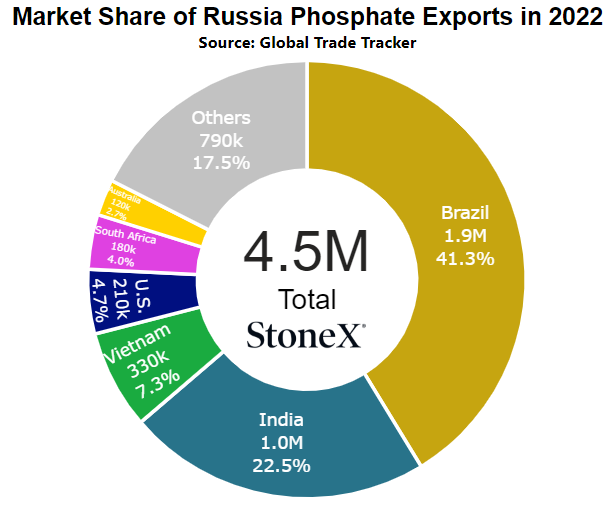
Price comparisons
Vs 30 days ago - 1% or approximately $8 higher
Vs 90 days ago - 12% or approximately $62 higher
Vs 6 months ago - 9% or approximately $48 higher
Vs 1 year ago - 9% or approximately $50 higher
China DAP price comparison
Number 2 global exporter in 2021
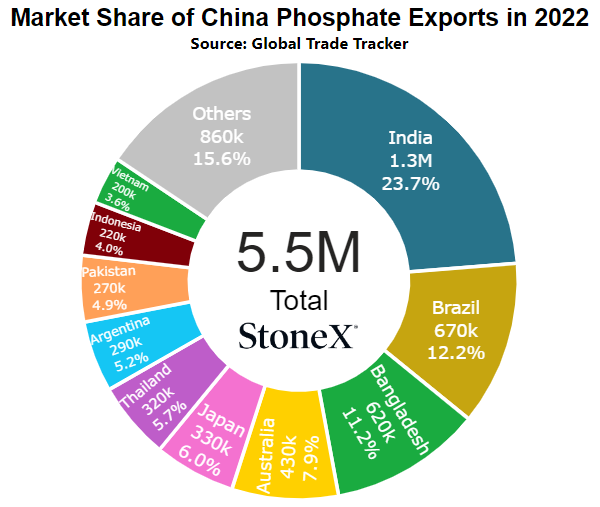
Price comparisons
Vs 30 days ago - 2% or approximately $10 higher
Vs 90 days ago - 13% or approximately $73 higher
Vs 6 months ago - 8% or approximately $45 higher
Vs 1 year ago - 7% or approximately $40 higher
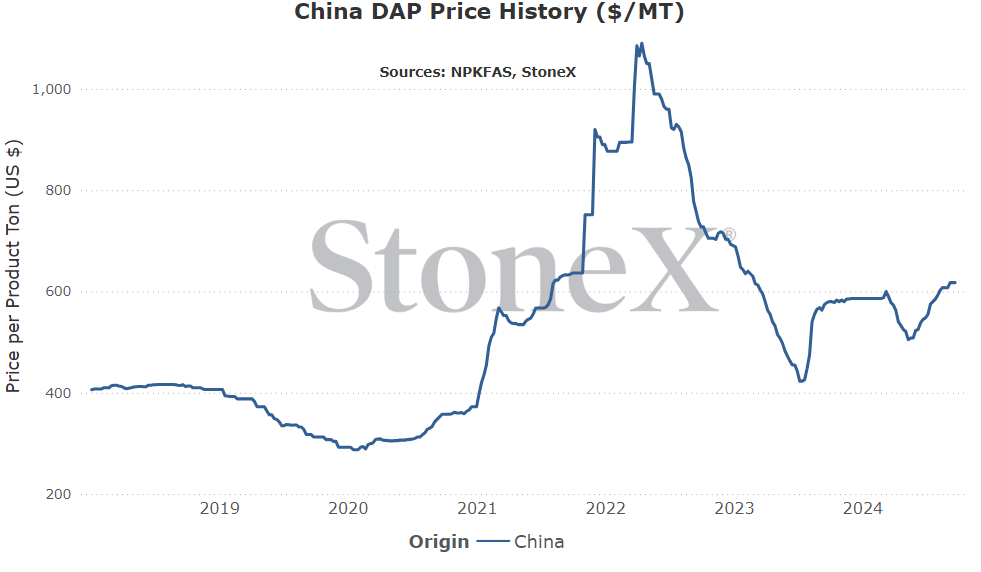
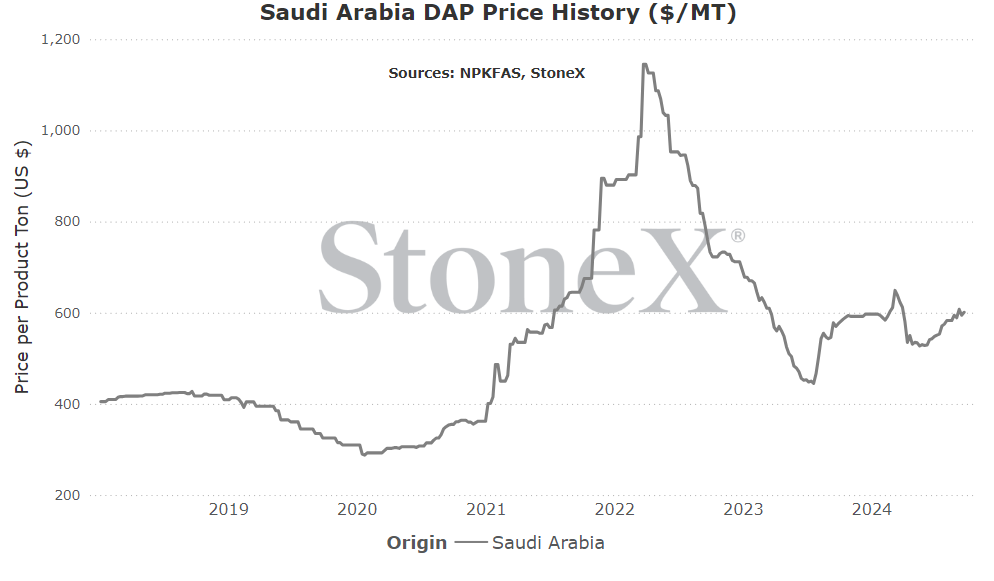
Saudi Arabia DAP price comparison
Number 4 global exporter in 2021
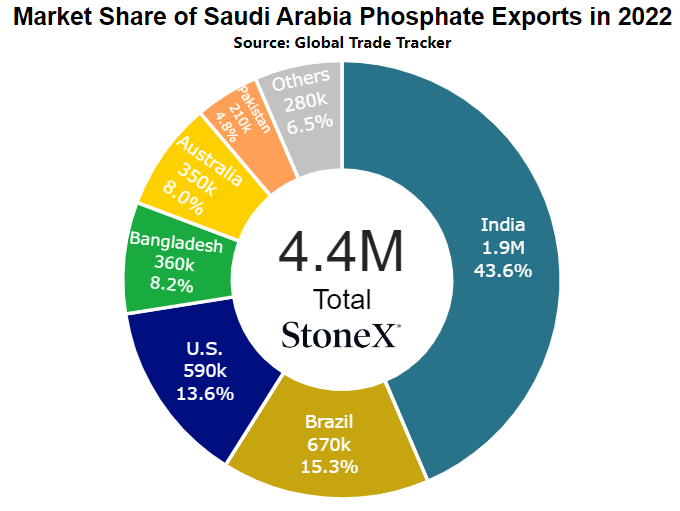
Price comparisons
Vs 30 days ago - 1% or approximately $7 higher
Vs 90 days ago - 11% or approximately $59 higher
Vs 6 months ago - -2% or approximately $11 lower
Vs 1 year ago - 5% or approximately $31 higher
- Chinese exports continue behind normal trends...and could get worse in Q4 – you cannot talk global phosphate market without talking about China. They are historically the world's largest exporter...which means when they start cutting back, the world needs to take notice. Unfortunately, that continues to be a story. Not only is China behind at this point in the calendar, there are signs that they could pull back even further in Q4. The more this happens, the worse it hurts the global S&D.
- India continues to play catchup on stockpiles – I sure wish this was a factor that we had listed in past editions that had not come true. Unfortunately, we have had to chalk this one up in the "win" column...sure doesn't feel like a win. The Indian phosphate subsidy rate was finally fixed, allowing importers to start rebuilding stockpiles. Originally, they had been purchasing $630 CFR, then $637, then $642, now reports of $647 being done...and they have a lot more to buy. As their price goes up, so to do manufacturer price ideas for the rest of the world.
- Farmers relent and apply normal amounts – farmers around the world, where possible, have been saying that they expect to lower their phosphate application rate due to the high price. While this is certainly possible, it is harder to actually do in reality. It is hard to break those traditional approaches. When it comes time to really skip, we could see a lot of folks change their minds. In fact, some of the early Northern Hemisphere fall applications are already indicating that this is happening.
- Return to normal for Chinese exports – am I a believer that this will happen? Absolutely not. Would it be naïve of me to think that China couldn't do a complete 180 and start exporting at ridiculously high rates again? Absolutely. Never say never when it comes to China. We do not know what they are going to do and when they are going to do it. All outside signs are that they will scale back on exports hard in Q4 but we could see them change their minds. It has happened before and that would cause values to fall globally.
- Farmers hold true to their approach and demand is much lower – up above, I talked about how we wouldn't be surprised to see farmers return to normal phosphate application rates/timelines. In the same breath, I wouldn't be surprised to see a decent degree of application rate reductions or delays to spring. I think this will be especially true outside the corn belt where the economics are a lot tighter. Why do you think all those country songs talk about hard living on red dirt roads?!!!
- India demand slows down – once the subsidy rate was improved, India has been on a buying spree. That has helped to buoy global price ideas...but that buying pace cannot last forever. What happens when they suddenly get comfortably supplied and no longer need huge purchases?
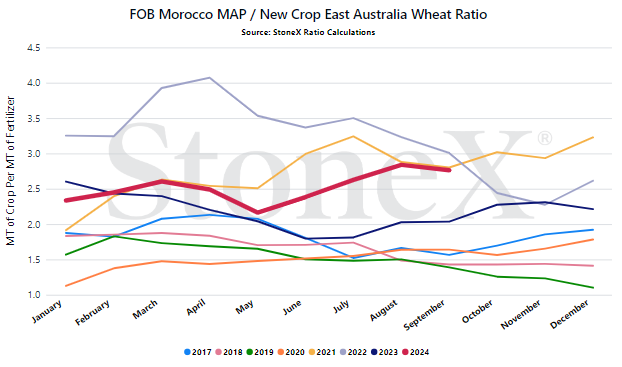
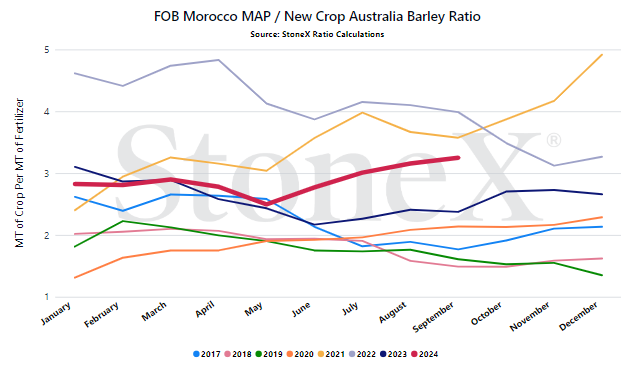
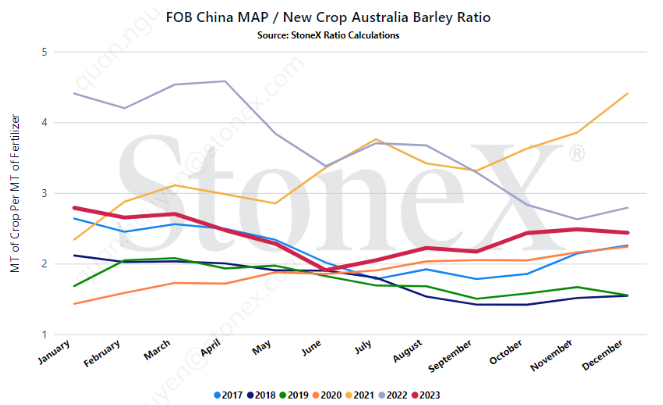
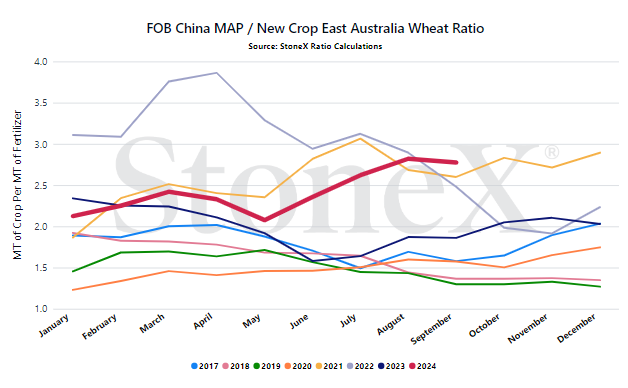
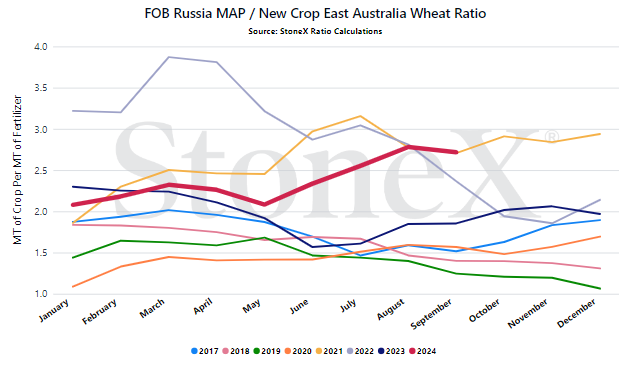
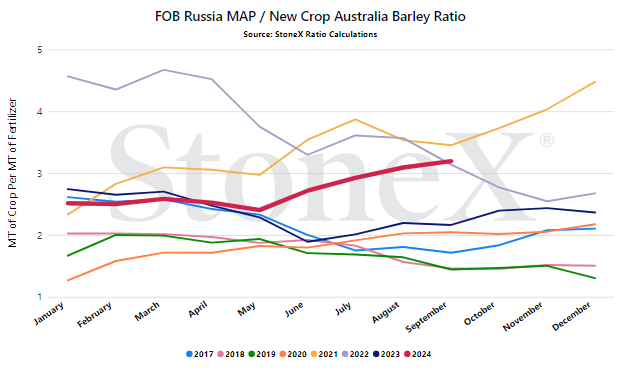
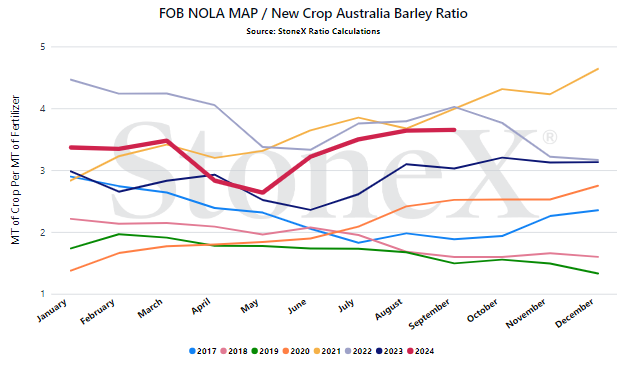
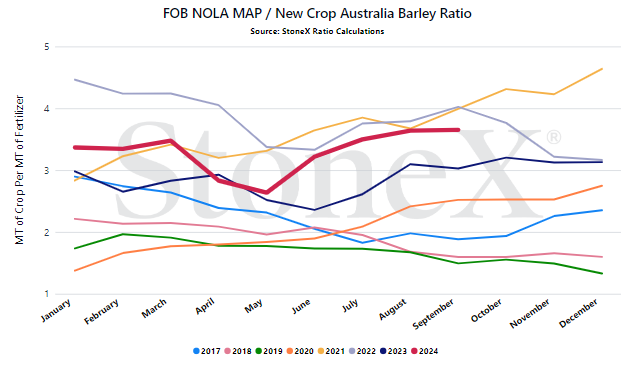
We believe that only looking at the flat price of either grains or fertilizer can be misleading:
-
Only selling grain can hurt you if fertilizer prices rise substantially
-
Only buying fertilizer can hurt you if grain prices fall
We look at the ratio "value" to get a better indication of where we are or how many bushels of X does it take to pay for 1 ton of fertilizer.
Would you rather:
-
Spend 4 ton of grain to pay for 1 ton of MAP
-
Spend 1.5 ton of grain to pay for 1 ton of MAP
When we compare the current ratio value against recent years, we start to see if we are high or low.
YOUR VALUES MAY LOOK DIFFERENT
- Chinese export flows - how do you have a bigger focal point when the world's historically largest DAP/MAP exporter continues to dampen export flows...with fears that it gets worse in Q4? China is not playing a "normal" part these last couple years and unfortunately, it is getting worse. Now, they could easily turn a 180 and start hammering out exports. It's China, one never really knows. We all just make educated guesses and then ignore those guesses when wrong and brag when right. What they do or do not have global implications. Ignore at your own risk.
- How India continues to build their stockpiles - if the world's largest exporter is the number one focal point, then number 2 has to be the biggest buyer in the world. Indian DAP stockpiles have fallen to "dangerous" levels (estimated 1.5M or so). As a result, the government has "fixed" their subsidy rate so importers can import product to rebuild those stockpiles. Now, look at this as a manufacturer/seller. The world's largest exporter, China, is scaling back and reducing supplies and at the same time, the world's largest buyer in India needs to rebuild. What do you do? You take prices higher with each sale and that sets the bar for the rest of the world.
- Farmers reaction to high phosphate values/poor farm economics - globally, my story/POV is that tight supplies and large demand are going to continue to support price ideas. However, that does not mean that farmers are going to just roll over. There are still a lot of farmers whose intention it is to fight high prices with lower demand. Lower application rates. Skip application rates where possible. Delay application from the fall to the spring. All are reactions to poor farm economics/high phosphate values and could help keep a lid on pricing. Ultimately, I think the world price direction prevails but shorter term, farmers can have their say.
StoneX Ratio Calculation
The ratio calculation is derived from Bloomberg historical grains values as well as fertilizer values from StoneX, NPKFAS, and Argus.
The calculation is simply dividing the fertilizer price by each grain price.
All data was sourced from StoneX unless otherwise noted.