USDBRL expected to reflect doubts regarding US interest rate trajectory, IPCA-15, AI bubble concerns, and end-of-month Ptax
- Bullish
- Divergence among Federal Reserve members regarding inflationary risks in the US may reduce bets on an interest rate cut in December, which favors attracting external capital and tends to strengthen the dollar globally.
- Moderation of the November IPCA-15 may increase bets on an early start to a cycle of cuts for the basic interest rate (Selic), which may hinder the attraction of foreign investments and weaken the real.
- Fears of a possible bubble in the Artificial Intelligence sector may increase global risk aversion and harm the performance of risky assets, such as stocks, commodities, and currencies of emerging economies, like the real.
Last week's summary
- The United States unexpectedly removed tariffs on agricultural products, seeking to reduce price pressures on food.
- Although the White House had initially maintained 40% surcharges on Brazilian agricultural products, they were also suspended last Thursday (20).
- The US Employment Situation Report for September showed net job creation stronger than anticipated, but with a slight increase in the unemployment rate.
- Minutes from the Federal Reserve interest rate decision showed high divergence among its members and reduced bets for a rate cut in December.
- Concerns about a possible excess of investment in the Artificial Intelligence sector reduced global risk appetite and harmed the performance of risky assets, such as stocks, commodities, and currencies of emerging economies.
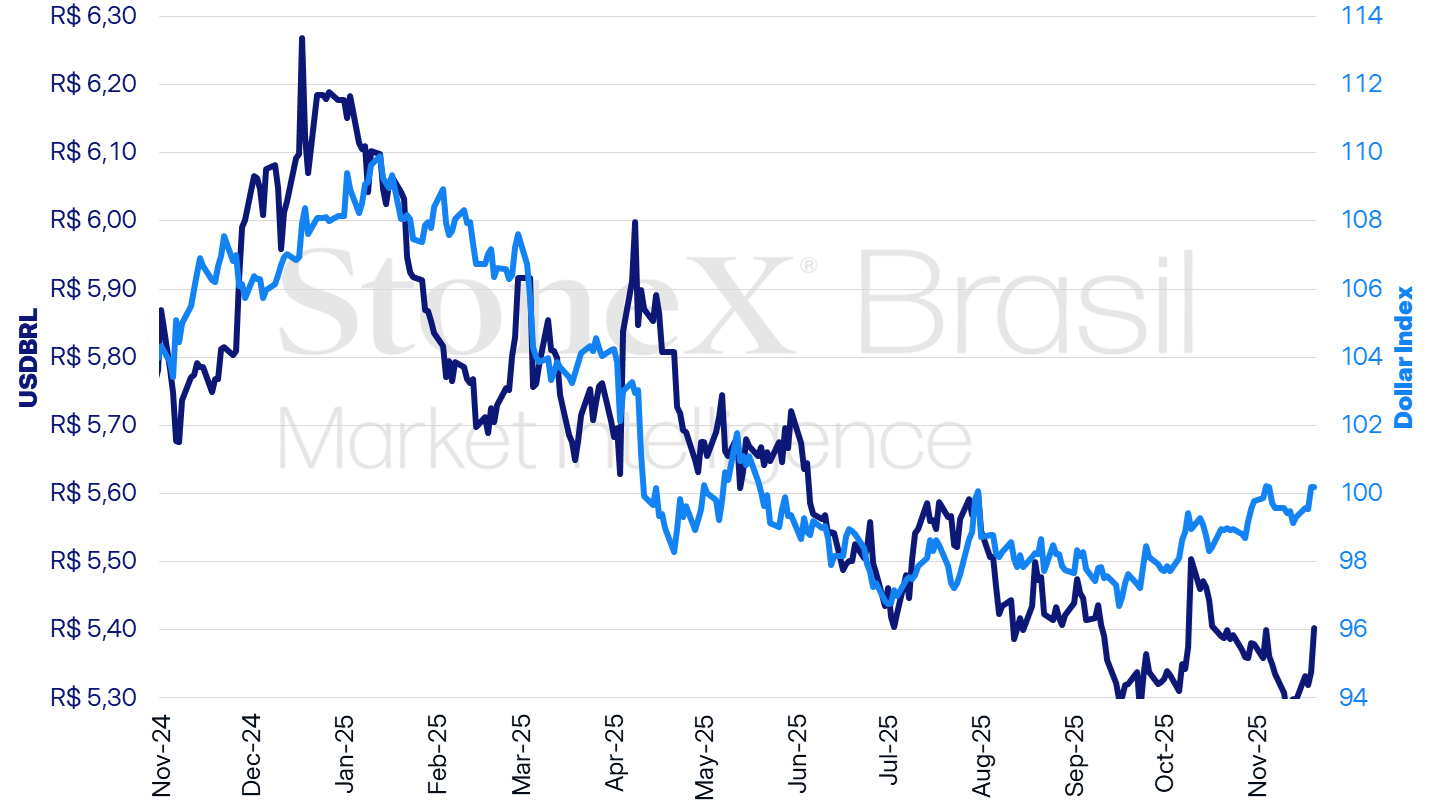
USDBRL and Dollar Index (points)
Source: StoneX cmdtyView. Design: StoneX.
USDBRL Variations | Daily: +1.20% | Weekly: +1.97% | In the month: +0.41% | Year-to-date: -12.56% | In 12 months: -6.34% |
Dollar Index Variations | Daily: +0.01% | Weekly: +0.89% | In the month: +0.40% | Year-to-date: -7.34% | In 12 months: -6.08% |
KEY EVENT: Uncertainties in the US interest rate trajectory
Expected impact on USDBRL: bullish
Bets for the Federal Reserve interest rate decision on December 10
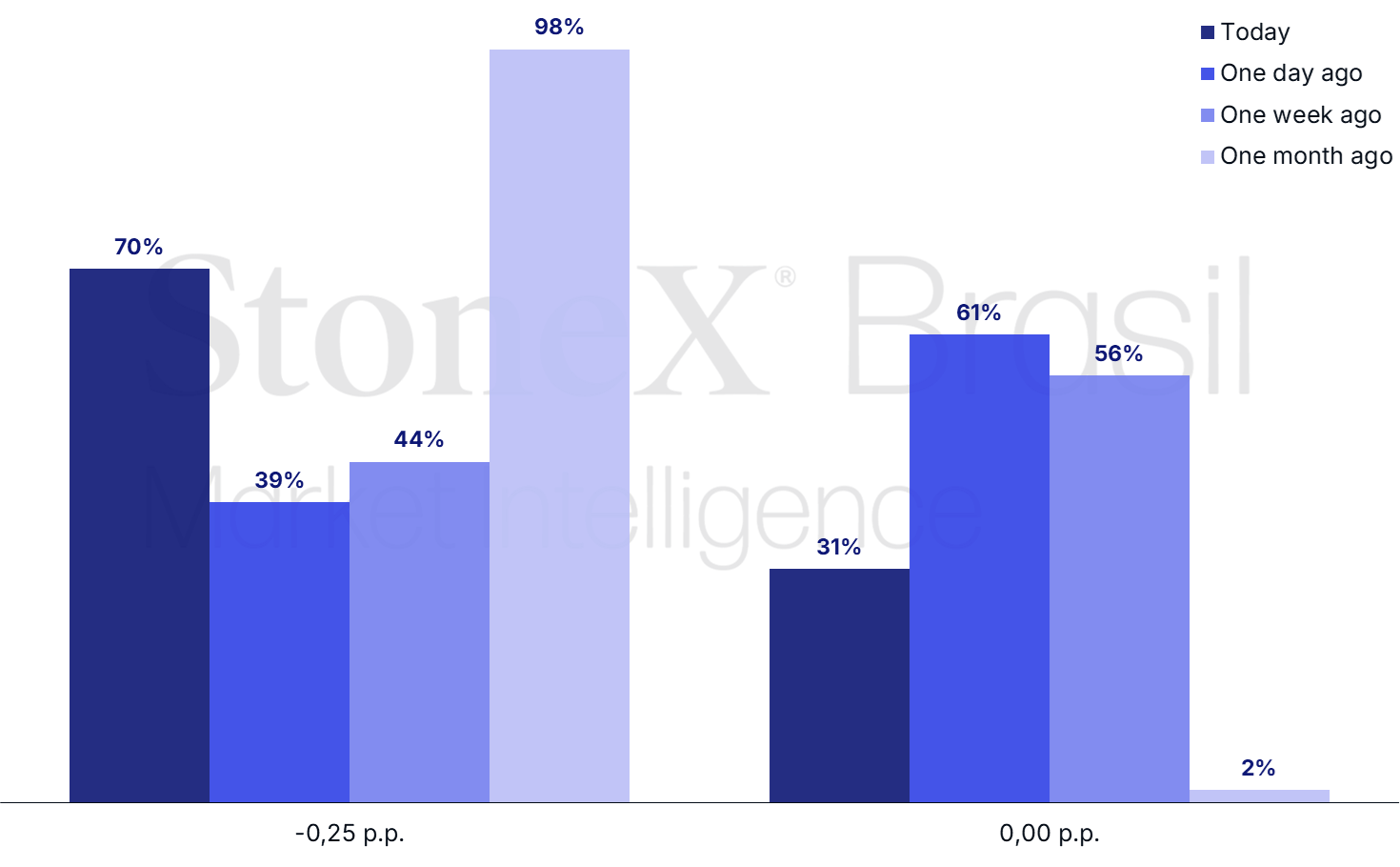
Source: CME FedWatch Tool. Preparation: StoneX. Probabilities in the interest rate futures market with reference to November 21, 2025.
Investors' bets for the Federal Reserve (Fed) interest rate decision on December 10 fluctuated widely over the past week, revealing a high degree of uncertainty regarding the path of US interest rates.
Why this is important: Uncertainty regarding the path of US interest rates may increase the perception that the Federal Reserve will be more cautious before deciding on new cuts, which should boost the yield of US Treasury bonds and favor the attraction of foreign investment, strengthening the dollar globally.
Contradictory scenario: The resumption of official statistics releases by the US government, albeit with significant delay, continued to point to contradictory results.
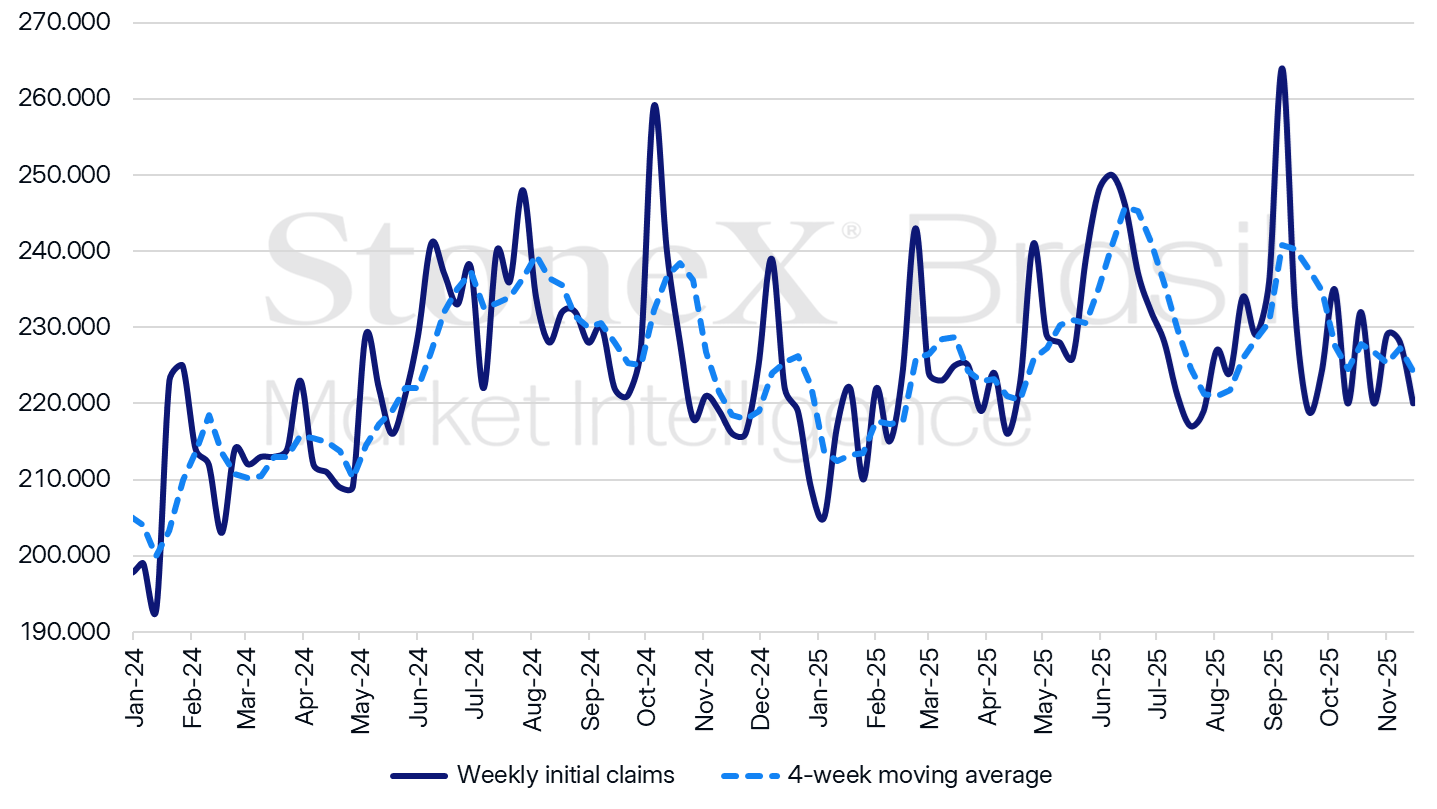
- Some indicators pointed to a more vigorous labor market performance, such as new weekly jobless claims, which remained stable in October and the first half of November, and net job variation in September, which was larger and more comprehensive than anticipated.
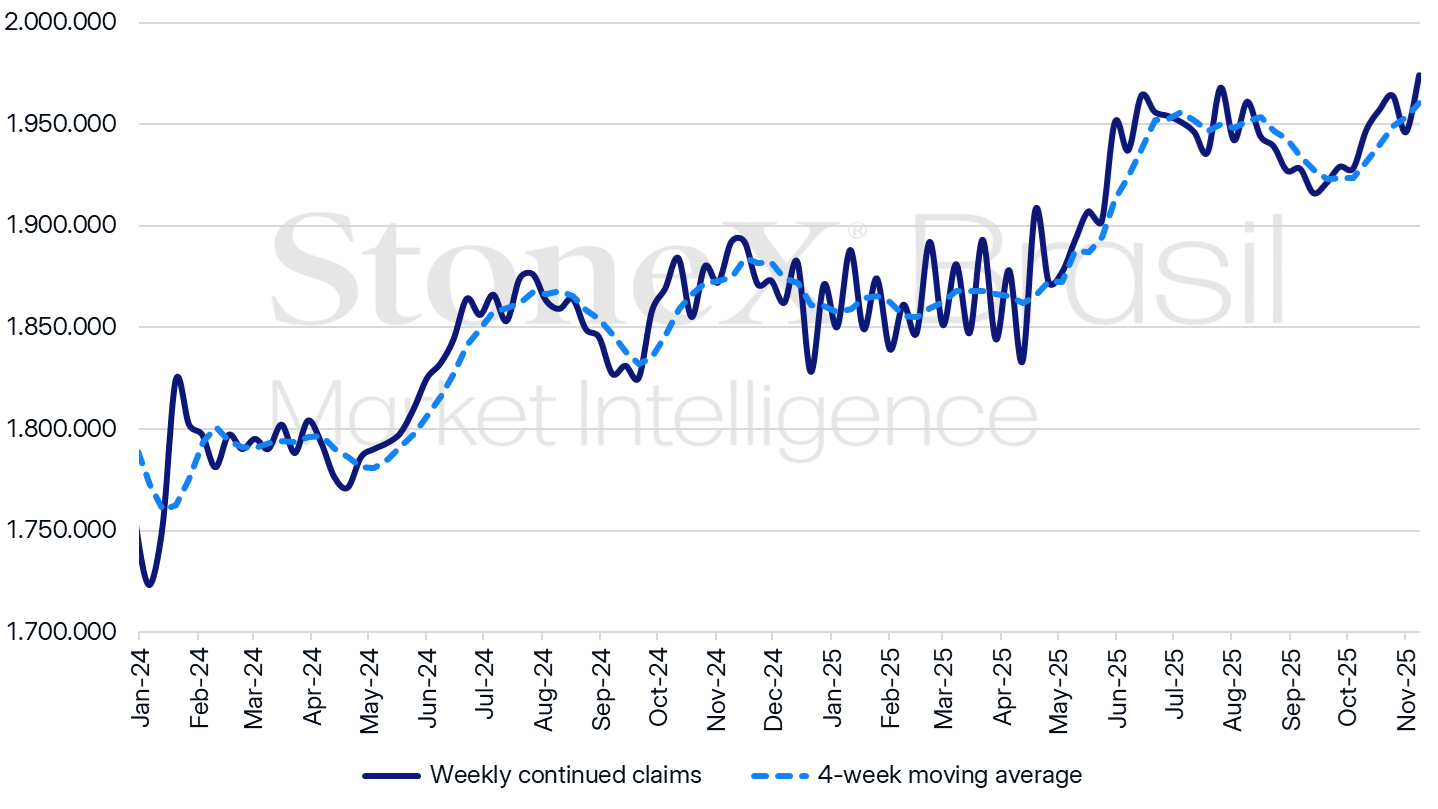
- Other data, however, suggested a faster weakening, such as an increase in the unemployment rate in September and also in continued jobless claims during October and the first half of November, suggesting that the pace of hiring is insufficient to absorb the number of people seeking employment.
- In any case, although the scenario is contradictory, it seems more consistent with a trend of gradual labor market deceleration than with a sharp and intense worsening of the economy.
- Therefore, there apparently is a greater balance between the risks of accelerating inflation and a weakening labor market, suggesting that it is more likely that the Federal Reserve will keep its interest rates stable in the decision on December 10.
Number of new weekly claims (left) and continued weekly claims (right) for unemployment benefits in the United States
Source: U.S. Department of Labor (DOL), Federal Reserve Bank of St. Louis. Design: StoneX.
Source: U.S. Department of Labor (DOL), Federal Reserve Bank of St. Louis. Design: StoneX.
Variation in total urban employment (thousand people) and the unemployment rate (%) in the United States
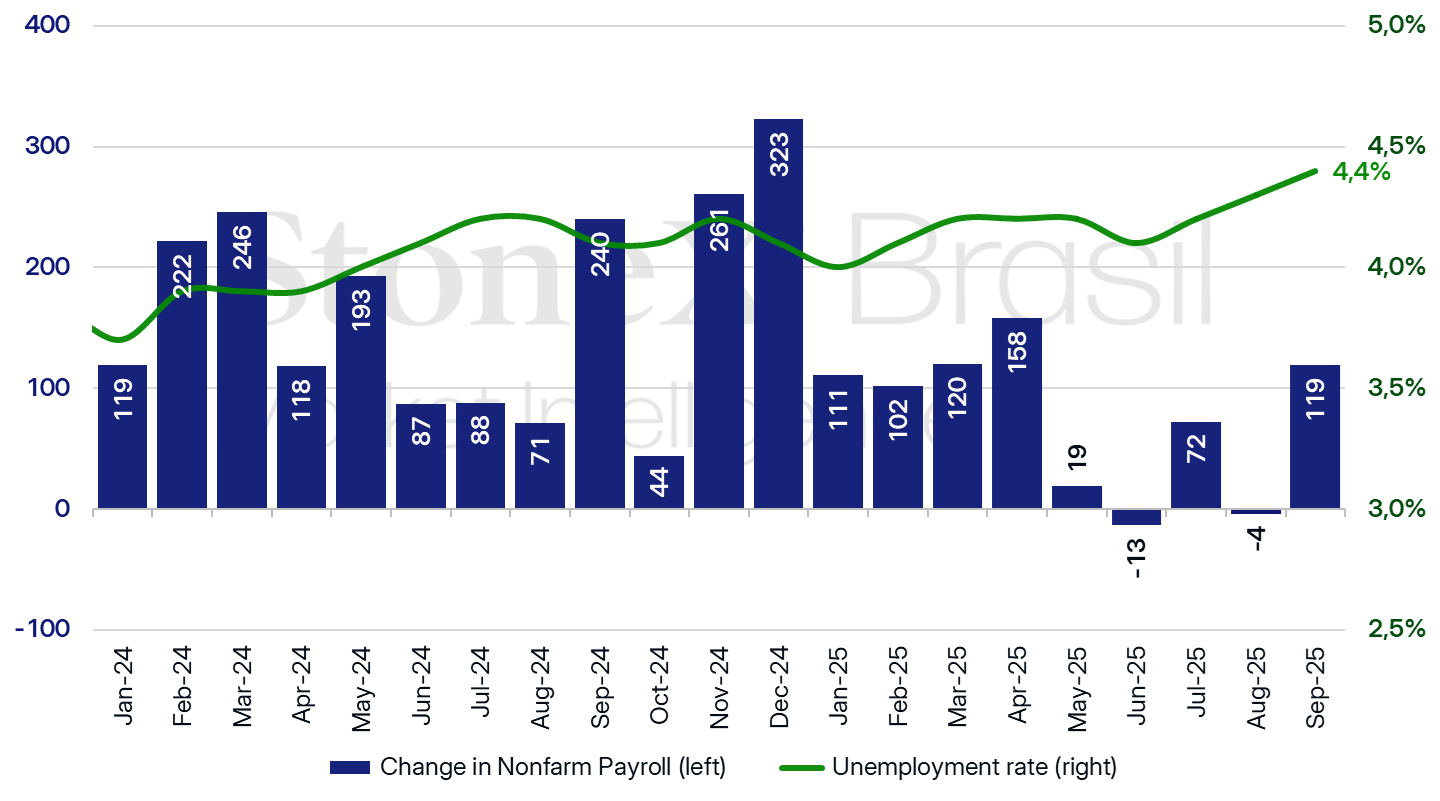
Source: U.S. Bureau of Labor Statistics (BLS), Federal Reserve Bank of St. Louis. Design: StoneX.
Contradictory readings: This contradictory scenario, in turn, also leads to different readings among Fed members regarding the economic juncture and the balance of risks faced by the US.
- For example, the minutes of the last Federal Open Market Committee (FOMC) decision showed significant divergence among its members regarding the most appropriate conduct for monetary policy.
- The document stated that "several participants" believe the most appropriate action would be a new reduction of 0.25 p.p. in the interest rate at the December decision, while "many participants" judge that it would be ideal to keep interest rates stable.
- Additionally, this divergence is also visible in the statements and speeches of FOMC members, which has caused wide fluctuations in investors' bets regarding the December decision.
- This picture becomes even more uncertain due to delays in the release of statistics due to the recent US government shutdown, as there will be no publication of inflation or labor market data for October before the decision on December 10.
- Therefore, at this moment, maintaining the interest rate level seems more likely than a reduction in this decision.
IPCA-15 and employment data in Brazil
Expected impact on USDBRL: bullish
In Brazil, the week's agenda includes important indicators for investors to calibrate their expectations regarding the Central Bank's monetary policy conduct.
- The highlight should be the release of the Extended National Consumer Price Index 15 (IPCA-15), which tends to decelerate slightly in its rise in November.
- Additionally, investors should follow the National Household Sample Survey (PNAD) for October, which should indicate stability in labor market conditions, with a likely maintenance of the unemployment rate.
Why this is important: If confirmed, the moderation of inflation data tends to increase investors' bets on faster interest rate cuts by the Central Bank, while a gradual stabilization of inflation towards the agency's target is observed.
- This movement may reduce the attractiveness of national bonds and hinder the entry of foreign capital, harming the performance of the real.
- Furthermore, if employment data brings any negative surprise, after a long period of stability in Brazilian labor market conditions, it may also contribute to bets on an early start to the cycle of cuts.
Expectations: The median of projections for the November IPCA-15 indicates a slight deceleration of the monthly index to 0.15%, following an advance of 0.18% in October.
- This result would place the 12-month accumulated rate very close to the ceiling of the Central Bank's inflation target, currently at 4.5%.
- The unemployment rate, according to median estimates, in turn, should remain at 5.6%.
Overview: The most recent inflation data, the Extended National Consumer Price Index (IPCA) for October, left the indicator's accumulated 12-month index at 4.68%, closer to the ceiling of the annual inflation target of 4.5% stipulated by the Central Bank.
- This result evidenced a significant deceleration compared to the recent peak of 5.53% recorded in April 2025, showing progress in the price stabilization process.
- This perception, it is worth noting, was mentioned in the minutes of the last Copom meeting, when the Committee recognized initial signs of cooling inflation but reinforced that any adjustment to the Selic will depend on the evolution of indicators.
Fears of a financial bubble in the AI sector
Expected impact on USDBRL: bullish
In recent weeks, fears among investors that the Artificial Intelligence (AI) segment may be experiencing a financial "bubble" have resulted in greater global risk aversion.
- In particular, these investors fear that the demand for the use of these technologies may not increase enough to make the accelerated growth of investments in productive capacity and the indebtedness of companies in the segment profitable.
Why this is important: The greater global risk aversion generated by these fears tends to harm the performance of risky assets, such as stocks, commodities, and currencies of emerging economies, like the real.
Overview: Since OpenAI publicly launched ChatGPT in November 2022, the use of AI technologies has grown rapidly, intensely boosting the market value of technology stocks in general, and in the United States in particular.
- As a result, investments to expand computational capacity, data storage, and electricity are also accelerating rapidly, seeking to generate productive capacity ahead of demand.
- However, the pace of investments and the market valuation of these companies has grown so quickly that investors fear that demand for these technologies will not increase fast enough to occupy all this productive capacity.
- In other words, there is a fear that an excess of investment is occurring, which could bring losses to technology companies and harm economic activity in the future.
End-of-month Ptax Rate
Expected impact on USDBRL: undefined
End-of-month Ptax Rate – sell (R$/US$)
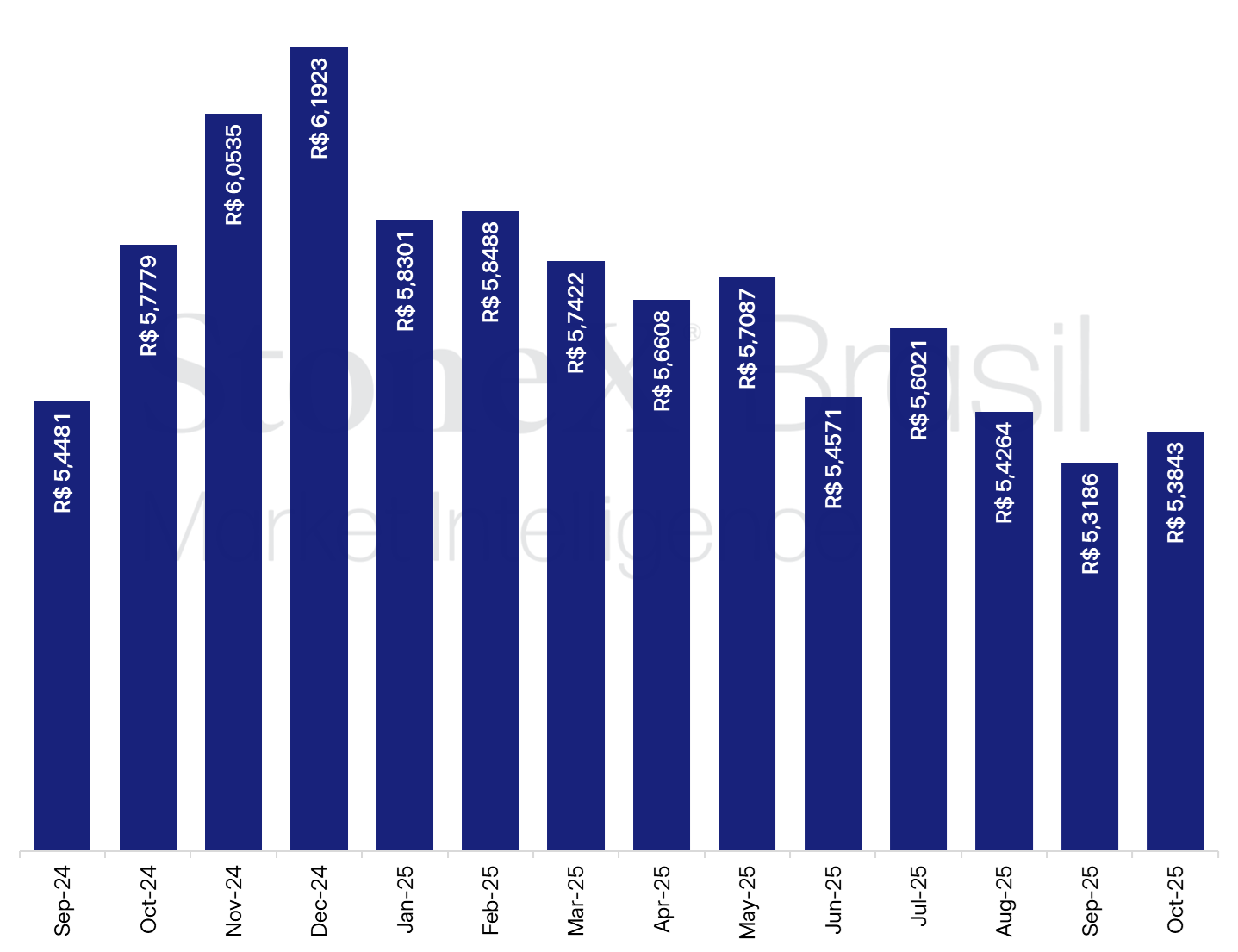
Source: Central Bank of Brazil. Preparation: StoneX.
The Ptax rate is a reference released daily by the BC (Central Bank) and its end-of-month value is widely used in foreign exchange and derivative contracts.
Why this is important: Financial market operators are expected to intensify their operations during the intervals for the formation of the last Ptax rate of November, which makes it difficult to read the movements of the real on the day.
- Trading volume and volatility usually increase during the time windows used by the BC for the calculation of the end-of-month Ptax rate, between 10:00 AM and 1:10 PM.

ECONOMIC INDICATORS TABLE
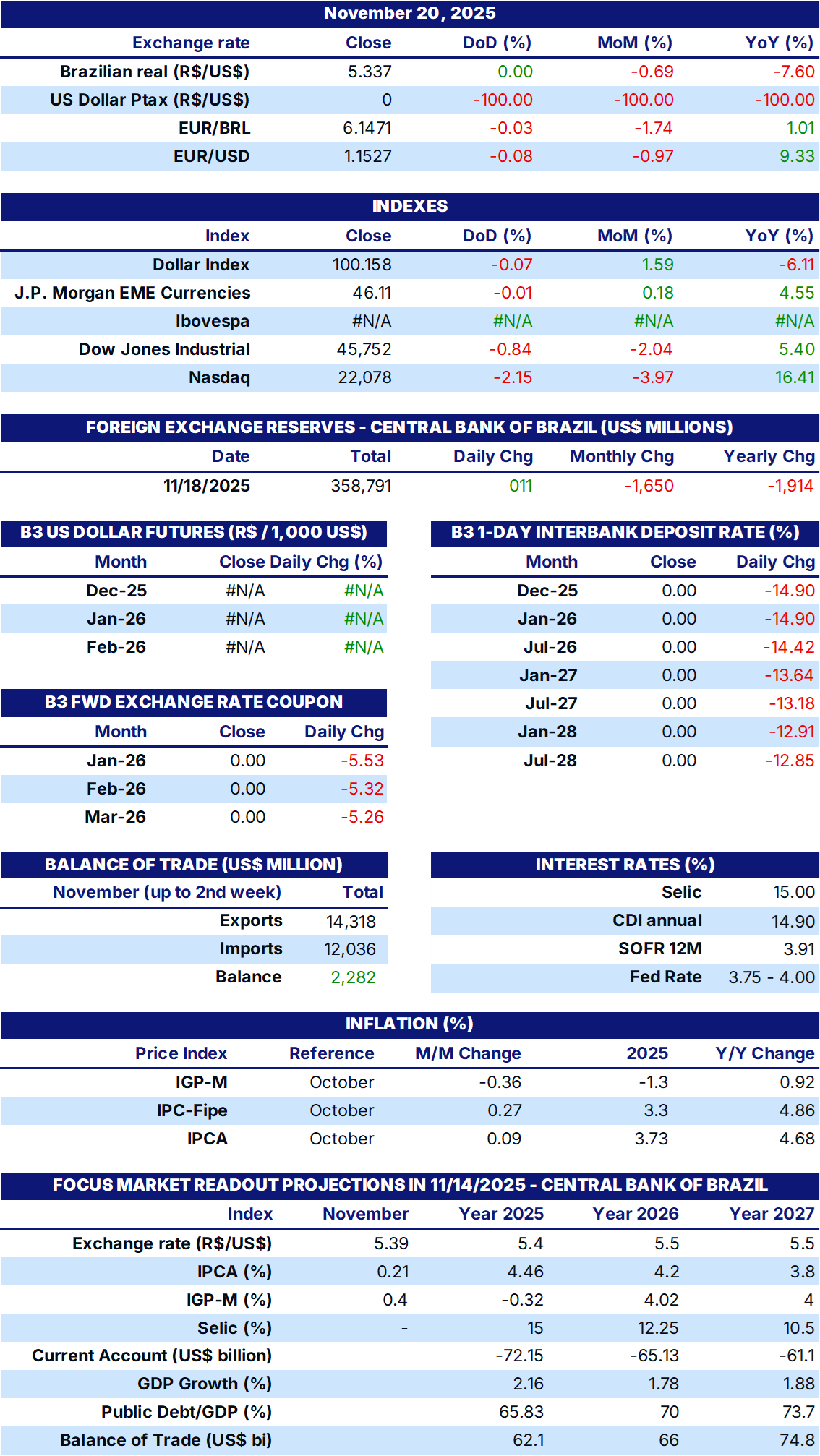
Sources: Central Bank of Brazil; B3; IBGE; Fipe; FGV; MDIC; IPEA and StoneX cmdtyView.