Dollar expected to reflect concerns about Brazil's fiscal outlook and FOMC minutes
- Bullish
- Investor pessimism and skepticism regarding the fiscal outlook under Lula's new administration are expected to increase the perception of fiscal risks associated with Brazilian assets, which tends to weaken the BRL.
- The minutes of the FOMC decision could reinforce bets on further interest rate hikes by the Federal Reserve, which is likely to increase yields on US Treasury bonds and attract external resources to the country, strengthening the USD globally.
- Bearish
- No predominantly bearish factors were identified for the exchange rate this week; however, it is essential to consider that the exchange rate is historically volatile and that a drop remains possible, whether due to frustration with bullish premises or the occurrence of unexpected events.
The week in review
- During the week, the Brazilian real experienced a sharp depreciation, pressured by frustration with Lula's new government's economic policy. Sunday’s (08) announcement did not present concrete measures, and the fiscal package released on Wednesday (11) was deemed modest, maintaining concerns about the country’s fiscal trajectory.
- The Copom minutes (10) also disappointed by maintaining a neutral tone despite the worsening inflation scenario and not signaling further Selic hikes, which heightened the perception of risk for national assets.
- On the external front, the US Consumer Price Index (CPI) for October accelerated beyond expectations, reinforcing bets on a Federal Reserve rate hike in December and driving the Dollar Index to its highest level since April 2025.
USDBRL and Dollar Index (points)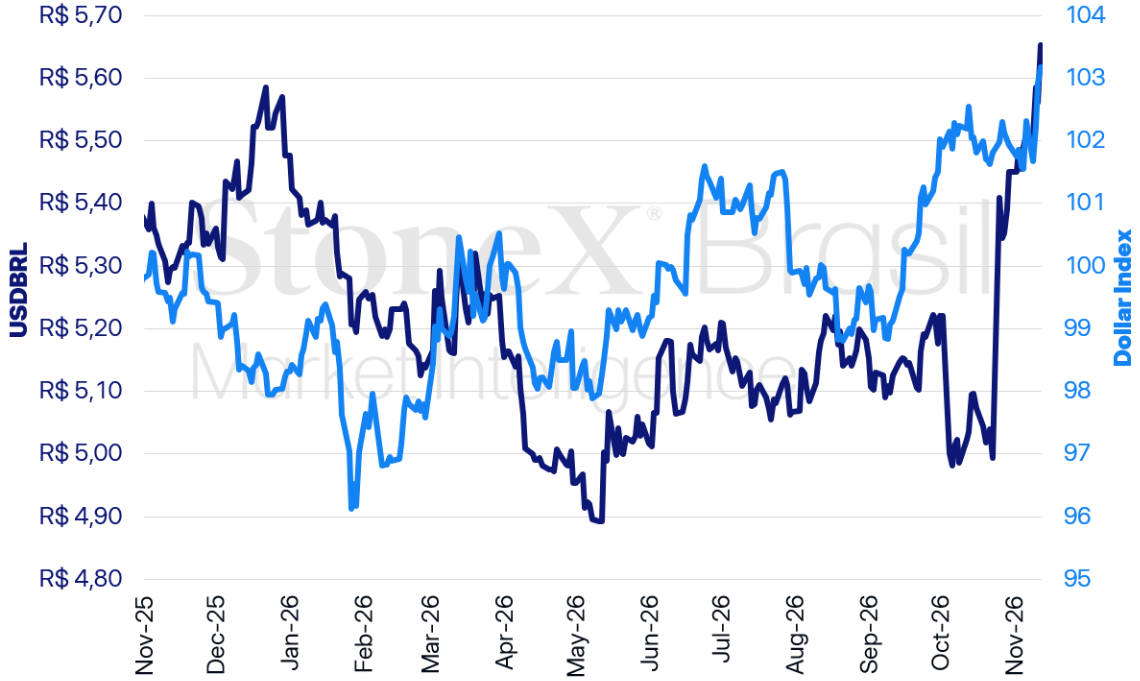
Source: StoneX cmdtyView. Design: StoneX.
USDBRL variations | Daily: +1.66% | Weekly: +2.60% | Monthly: +3.72% | Annual: +3.21% | Over 12 months: +6.80%
Dollar Index variations | Daily: +0.26% | Weekly: +0.84% | Monthly: +1.21% | Annual: +4.93% | Over 12 months: +3.69%
KEY EVENT: concern over Brazil's fiscal outlook
Expected impact on the USDBRL: bullish
The currency market is expected to reflect the environment of investor pessimism and skepticism about Brazil's fiscal outlook, dissatisfied with the government's efforts to curb spending and public debt growth.
- Last week, the Federal Senate approved the main text of a Complementary Bill (PLP) with fiscal adjustment measures for President Luiz Inácio Lula da Silva's fourth term.
- However, the proposal was deemed modest and insufficient to improve the trajectory of public accounts, including counterproductive proposals.
- The highlights of the PLP, which may amend it, will be voted on Tuesday (17), after which it will be sent to the Chamber of Deputies.
- Finally, with Lula's return from his Southeast Asia trips, the president may advance initial appointments for his next economic team, including the Ministries of Finance and Planning, providing clues about Brazil's economic policy direction for the next four years.
Why this matters: Pessimism and skepticism about the next government’s fiscal outlook are likely to increase the perception of fiscal risks associated with national assets and elevate risk premium requirements by investors, weakening the Brazilian real.
Proposal details: According to government calculations, the PLP would impact the 2027 Budget by between BRL 45.1 billion and BRL 56.1 billion, with higher effects in subsequent years.
- The bill includes measures such as creating an expenditure containment mechanism, a linear 20% reduction in tax benefits granted by the government, and instruments to reduce expenditures in areas without constitutional ties.
Concerns persist: Investors reacted poorly to the government’s proposals, arguing the measures would be insufficient for a significant improvement in public debt, intensifying fiscal pessimism rather than alleviating it.
- The PLP includes some proposals that counteract public accounts adjustments, such as excluding approximately BRL 10 billion in diesel subsidies from the primary result target accounting for this year and exempting the growth limit on “structuring investments” in years when the primary result target is achieved.
- Additionally, the bill would allow postponing transfers to states and municipalities, which would not represent effective spending reductions and could face legal challenges.
Upcoming votes: The main text was approved on Thursday (12), but four amendments to the bill, which may alter it, will be voted on next Tuesday (17), after which it will be sent to the Chamber of Deputies.
- Additionally, according to press reports, the government is preparing a Constitutional Amendment Proposal (PEC) to increase the adjustment to approximately BRL 80 billion by reducing expenses currently excluded from the fiscal target and curbing some mandatory expenditures.
- The reports also indicate the PEC would be sent to Congress by the end of the year.
FOMC decision minutes
Expected impact on the USDBRL: bullish
Rate decision bets for the Federal Reserve on December 9
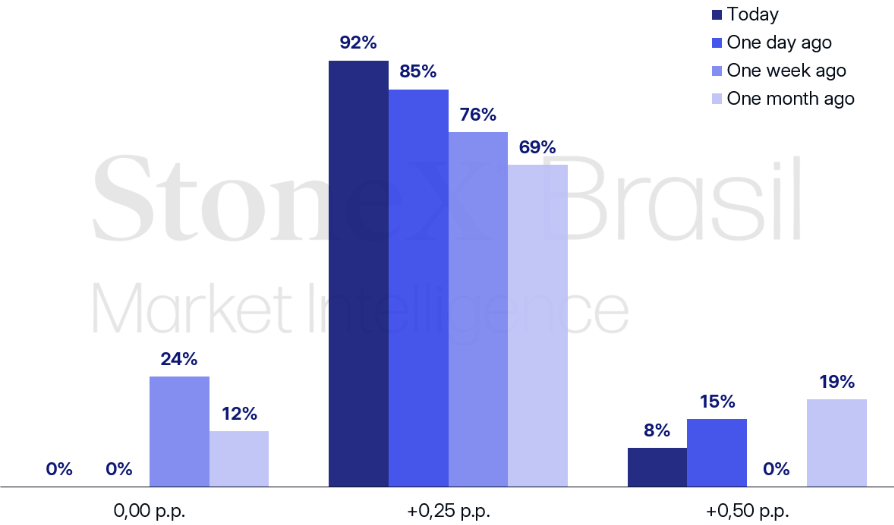
Source: CME FedWatch Tool. Design: StoneX. Futures market interest rate probabilities as of November 13, 2026.
Abroad, the currency market is expected to reflect the minutes of the Federal Open Market Committee (FOMC) rate decision of the Federal Reserve (Fed), which maintained US interest rates at a range between 3.75% and 4.00% per annum.
- The document is likely to indicate the possibility of another rate hike in December.
Why this matters: The release of the minutes may reinforce bets on further rate hikes by the Federal Reserve, which tends to increase yields on US Treasuries and attract external resources to the country, strengthening the dollar globally.
Fed's patient stance: In its October 28 monetary policy decision, the FOMC chose to maintain its rates stable (with two dissents favoring an immediate hike) despite hotter US economic data.
- In a press conference, Fed Chair Kevin Warsh justified the decision, stating the Committee wanted to gather more data before determining its next steps.
What to expect: The minutes are expected to indicate that “most” participants believe further rate hikes will be appropriate in the coming months but preferred not to raise rates in October to gather more information on US economic conditions.
- On the other hand, “some” participants favored an immediate rate hike.
- Additionally, it will be interesting to see if the document mentions discussions about the need for faster rate hikes in the future.
Obscure communication: It will be important to observe whether Warsh's comments during the October press conference, interpreted as excessively patient regarding unfavorable inflation data, adequately reflected the FOMC's rationale for its decision.
- Due to the Fed Chair's evasive, imprecise, vague, and concise communication style, his press conference remarks in previous decisions poorly translated the Committee's opinion as revealed in the minutes.
Higher inflation risks: Economic indicators released since this decision have reinforced the perception of a risk balance that leans toward inflation.
- The first preliminary estimate of third-quarter GDP accelerated compared to the second quarter, driven by growth in personal consumption and business investment.
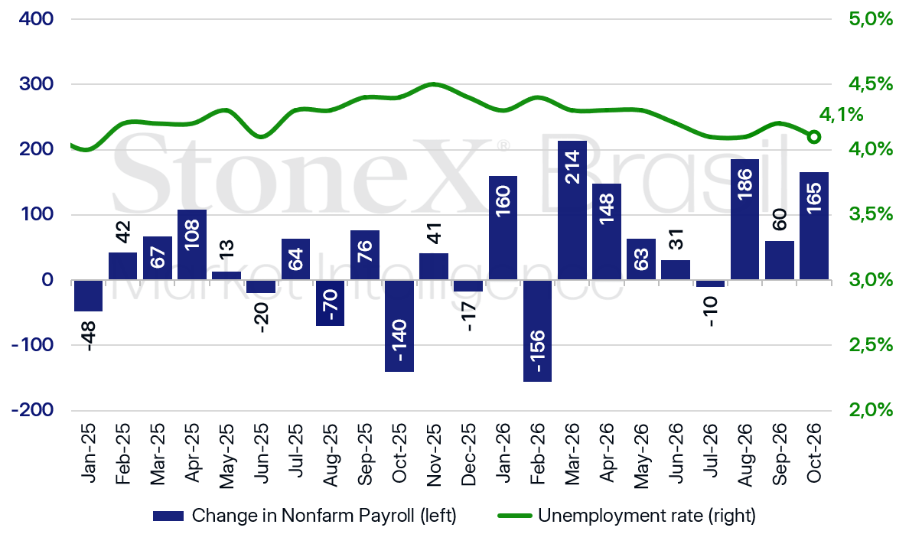
- Additionally, labor market figures were robust, with a net creation of 165,000 jobs in the US in October, well above the median estimate of 62,000, an upward revision of net job gains for August and September, and a reduction in the unemployment rate.
- Finally, the US Consumer Price Index (CPI) showed heated numbers for the third consecutive month, accelerating more than expected in October, suggesting that inflationary pressures are more persistent and widespread than anticipated.
Stronger statements from officials: Last week, several Federal Reserve members suggested US rates might rise more quickly due to hotter inflation.
- Before the CPI release, Federal Reserve Board Governor Christopher Waller had already stated he would support a double hike of 0.50 percentage points in December if the CPI showed above-expected readings for the third consecutive month, which ultimately occurred.
- Dallas Fed President Lorie Logan said, “the [rate hike cycle] might be faster,” while Kansas City Fed President Jeffrey Schmid believes the current rate level is “quite accommodative,” meaning financial conditions are still very favorable for economic activity.
Inflation measures for the United States (%)
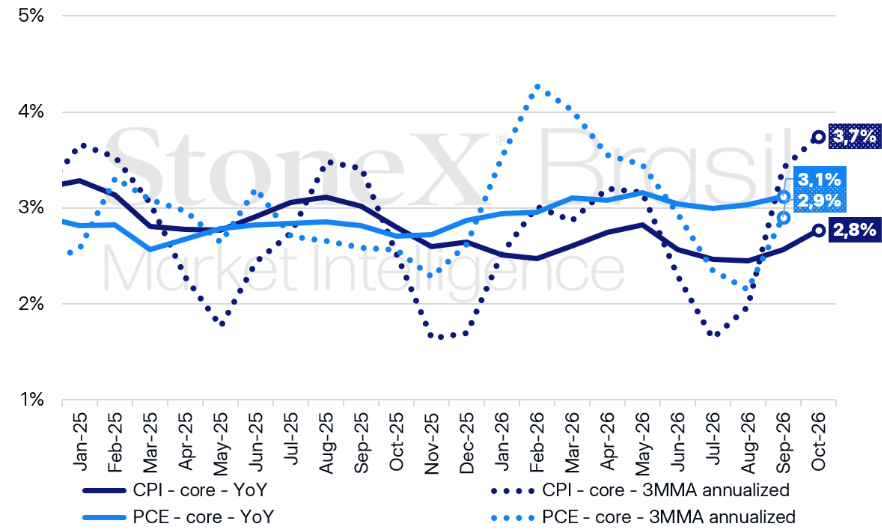
Source: US Bureau of Economic Analysis (BEA), US Bureau of Labor Statistics (BLS), Federal Reserve Bank of St. Louis. Design: StoneX.
Quarterly annualized GDP growth rate in the US, divided by demand category (%)
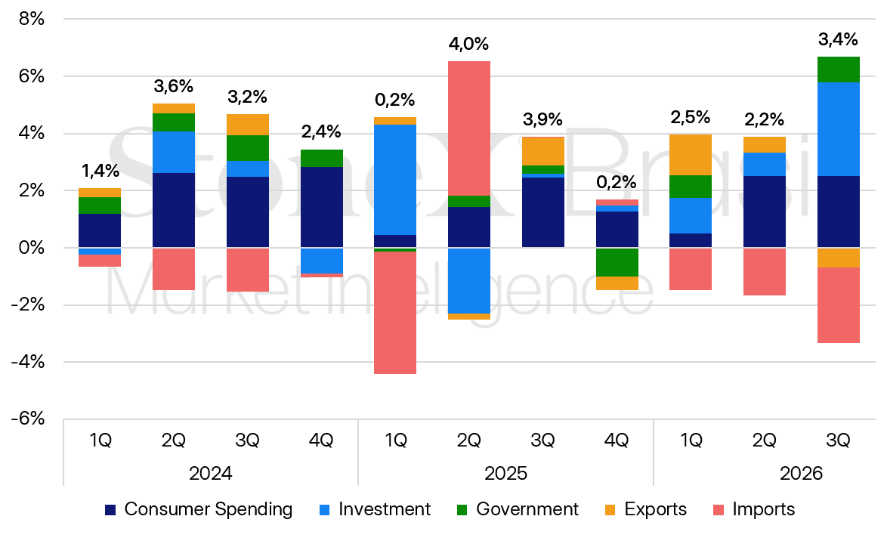
Source: US Bureau of Economic Analysis (BEA), Federal Reserve Bank of St. Louis. Design: StoneX.
Change in total nonfarm payroll (thousands) and unemployment rate (%) in the United States
Source: US Bureau of Labor Statistics (BLS), Federal Reserve Bank of St. Louis. Design: StoneX.

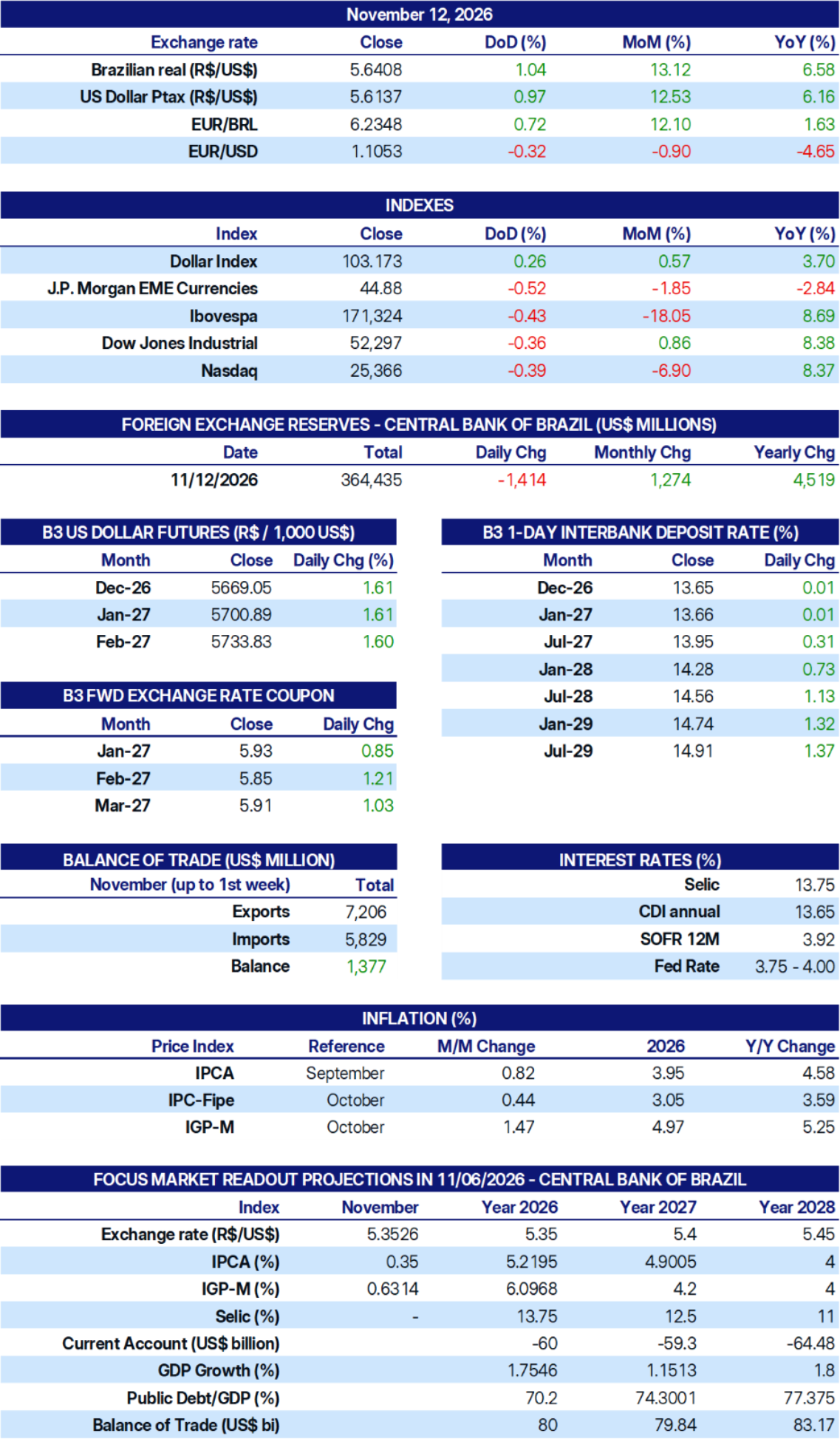
INDICATORS
Sources: Central Bank of Brazil; B3; IBGE; Fipe; FGV; MDIC; IPEA and StoneX cmdtyView.