April 16 – Chip stocks continue to weigh on the broader market at mid-day, with the major indexes all in the red and the Nasdaq leading the way lower as it falls by 2% at the time of writing. The VIX has pushed as high as 33.6 and as low as 29.5 today, but hovers around 31 at the time of writing as fear remains elevated on Wall Street, albeit well off the highs seen last week. The dollar remains near the 99.5 level, continuing to hover near the roughly 3-year lows put in on Friday, but making U.S. exports look more affordable to prospective buyers. Treasuries remain muted today, with 10-year yields at 4.31% and 2-year yields at 3.80%, both just slightly below unchanged. Crude oil prices broken into the green at mid-day, with nearby WTI now trading around $61.70, while the ags largely remain quietly in the green as well.
U.S. homebuilder sentiment improved slightly in April, with today’s NAHB/Wells Fargo Housing Market Index rising to 40 in April from the 39 seen in March, reversing course from market expectations of a further decline to 37. This snapped a two-month losing streak that saw a sharp drop from the recent high seen in January at 47 as concerns regarding the impact of impending tariffs took their toll. 60% of builders surveyed reported that their suppliers have already increased their prices or announced their intentions to do so because of the increased cost of materials due to tariffs, with an average increase of 6.3% being seen. Builders estimate the increased cost of building a typical home at ~$10,900 due to these tariffs. On an optimistic note, the subindexes gauging current sales conditions and traffic of prospective buyers both rose in April to 45 (+2 month-on-month) and 25 (+1 month-on-month), respectively. On the pessimistic side, the subindex gauging builders’ six-month sales expectations fell by four points down to 43, the worst reading seen since November 2023.
Industrial production in the U.S. fell 0.3% month-on-month in March, down from 0.8% growth in the month prior and sharper than expectations of a 0.2% decline. This was driven largely by a decline in utilities due to warmer temperatures, as output for electric and natural gas utilities dropped by 5.1% and 11.1% month-on-month, respectively. Conversely, U.S. manufacturing output rose 0.3% month-on-month, down from the 1.0% growth in the month prior but marking the fifth consecutive monthly gain, driven mostly by increases in the production of durable goods. Mining output also grew at an impressive rate of 0.6% month-on-month. With the above in mind, headline U.S. capacity utilization fell to 77.8% in March, below market expectations of a slighter drop to 78.0% due largely to the sharp drop in utility sector utilization to only 69.1%, while manufacturing utilization rose 0.2 points to 77.3% and mining utilization rose 0.5 points to 90.6%.
Crude oil inventories in the U.S. rose by 0.515 million barrels in the week ending April 11th, slightly above the average trade guess, while crude stocks at Cushing, OK fell by 0.654 million. Refinery utilization fell by 0.4% versus expectations of a 0.4% increase, while exports hit a roughly one-year high at 5.1 million barrels. On the refined products side, gasoline stocks fell by 1.958 million barrels week-on-week, sharper than expectations of 1.6 million, while distillate stocks fell by 1.851 million, also sharper than expectations of a 1.2-million-barrel draw. WTI crude oil has been attempting to find its footing after falling to a four-plus year low around $55/barrel a week ago, trading in a more consolidated range around the $60 mark since bottoming out.
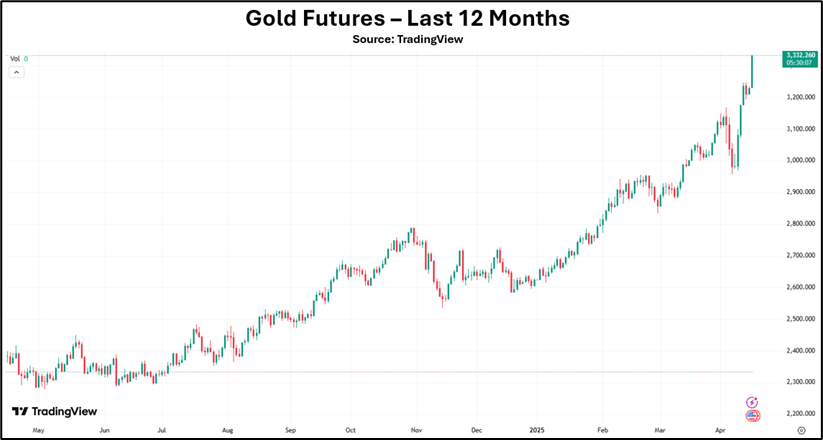
Perhaps the biggest winner of the trade war thus far has been the gold market, with the ongoing economic uncertainty driving investors to seek safe havens amid whipsawing equity markets. Gold futures surpassed the $3,000/oz mark for the first time on record a month ago and have now added over 10% to that, with today’s gains (+3.1% at the time of writing) sending us to fresh record highs above $3,300/oz. For comparison’s sake, the S&P 500 is down roughly 10% since the start of the year, while gold futures are up ~26% over the same period.