April 17 – Stocks are mixed at mid-day, with the S&P 500 and Nasdaq now both narrowly in the green at the time of writing, while the Dow Jones hangs more than 1% lower with United Health (-22.8%) dragging it down following their Q1 earnings miss and weaker 2025 earnings forecast. The VIX has cooled from yesterday but remains relatively elevated as it holds above the 30 level, hovering around 31.4 at the time of writing. The dollar is bouncing back slightly after yesterday's selloff, though it continues to hover near roughly three-year lows as it trades around the 99.5 level. Treasuries are mixed at mid-day, with 10-year yields narrowly in the green above 4.30% and 2-year yields narrowly in the red at 3.77%. Crude oil is continuing its rally into the end of the short week, with nearby WTI pushing above $63.80 on tightening Iranian sanctions. The ags look to end a relatively quiet week on a quiet note, with small gains seen largely across the board, save for soybeans and meal.
The market didn’t like what Fed Chair Powell had to say during yesterday's speech to the Economic Club of Chicago, but it’s nothing we haven’t heard from the Fed already. At their March meeting, we saw the FOMC raise their inflation and unemployment expectations while cutting their growth estimate. Much of their prepared remarks centered around the impact of not only impending tariffs, but also the uncertainty they bring and the subsequent need for the Fed to remain patient and digest more data before being able to make any policy shifts. So, why such a negative reaction?
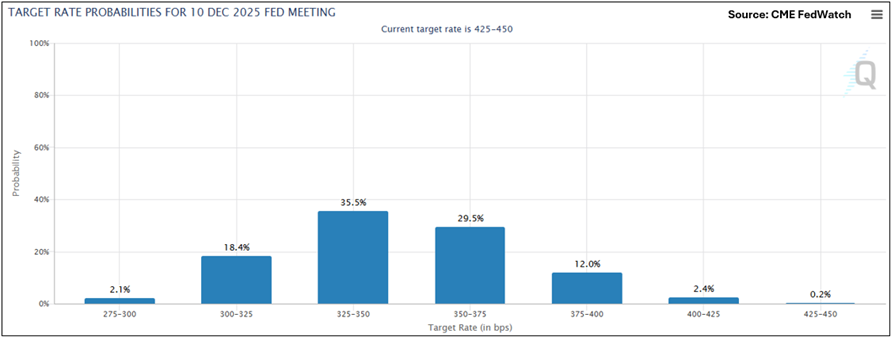
Perhaps the biggest issue was taken with Powell’s comments that the tariffs thus far were “significantly larger than anticipated,” with the last FOMC meeting taking place prior to the April 2nd unveiling. Additionally, when asked if there is a “Fed put” (a scenario the trade has long expected in which the Fed would step in if markets plummet), Powell said no. This feels very familiar, as the market has repeatedly expected an unrealistically dovish Fed for the last few years, consistently pricing in expectations of more cuts than have come to fruition. That may very well be the case yet again, with Fed Fund futures now pricing in four 25 basis point cuts by the end of 2025, with the first coming at the June meeting… That doesn’t exactly jive with what the Fed has actually been saying. Recent U.S. inflation data has largely been much better than expected, which at least put us at a better starting point heading into this shifting U.S. trade policy, but we haven’t yet seen the realized impact on economic data. If we do see an uptick in inflation in the months ahead, the Fed will be put in a much more difficult position to react if we do see slowing growth and softening markets. While this topic has become very politicized, at the end of the day, the Fed’s decisions should be data driven, and we simply don’t yet have the hard data to quantify the impact of 2025’s ongoing uncertainty and shifting trade flows on the U.S. economy. Until then, uncertainty looks to be the new norm, keeping markets on edge.
This morning’s release from the Philadelphia Fed showed an ugly headline reading, with the Manufacturing Index contracting at its sharpest rate in two years, but digging into the data perhaps raises more concern looking ahead. The subindex for new orders tanked to -34.2, sharply below an expansionary 8.7 reading the month prior, and marking the largest contraction seen in exactly five years, dating back to the pandemic lows. With that, the CAPEX subindex, which looks at expected changes in future capital expenditure, fell to 2.0, continuing the freefall since January’s recent peak at 39. At the same time, inflationary pressures continue to rear their head, with the prices paid subindex rising for the fourth consecutive month to sit at 51, the highest level seen since July 2022. To spell it out in plain terms, this data reflects the concerns outlined above, with the uncertainty regarding the tariff situation potentially sending some buyers to the sidelines. The combination of said uncertainty, coupled with rising price pressures, can lead to a slowdown in investment decisions. Again, we simply don’t have enough hard data to justify the panic selling we’ve seen to this point, and this specific reading is only reflective of the situation in the Philadelphia Fed’s district (most of Pennsylvania, New Jersey, and Delaware) but readings like this can certainly raise red flags moving forward, especially in this environment of heightened fear on Wall Street.