April 23 - The tech sector led today's rally in stocks as Treasury yields fell on disappointing data in the latest purchasing managers survey. Yet, that was partially offset by stronger than expected new home sales data. Even so, stocks pushed higher, with the VIX trading near 16, and the dollar index dropping back to trade near 105.7. Yields on 10-year Treasuries are trading near 4.59%, while yields on 2-year Treasuries are trading near 4.94%, after failing to push above 5%. Crude oil prices are nearly 1% higher, while modest gains were seen across the grain and oilseed sector as well on the above dynamics. Wheat remains the leader in the grain sector, while big farmer ownership on both side of the equator continues to limit gains for corn and for soybeans.
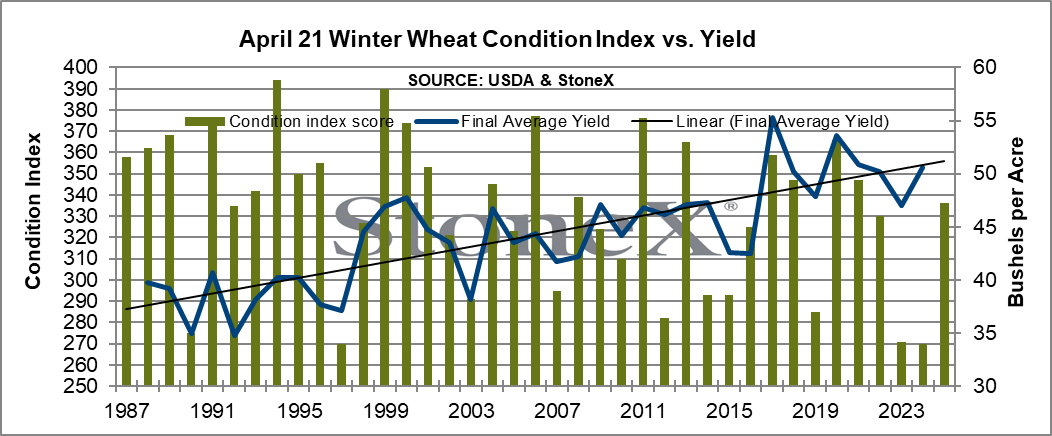
The Midwest soft red winter wheat crop saw modest improvement over the past week, but that was more than offset by additional deterioration in the Plains hard red winter wheat crop. Losses were led by an 18-point drop in the condition index score for Kansas, with the portion of the crop rated Poor to Very Poor jumping to 26% this week. Oklahoma's crop also saw a big drop (16 points) in its condition index score, with notable losses also seen in Texas. These crops could still see considerable improvement if the weather pattern would change. The current stress likely limited head size, but the wheat head can always make up part of those losses by adding another kernel in the mesh if conditions turn more favorable over the next couple of weeks, and the European weather models hints that may be the case. The graphic below shows how this week's national winter wheat condition index score compare to previous years in the same week. Note that just 8 of the past 20 years saw winter wheat condition scores higher than this year's score for this week of the year. Also, keep in mind that the statistical correlation between wheat condition scores and yield is weaker than it is with corn and soybean yields, especially this early in the crop cycle. Despite all the problems with the crop, and partially due to the relative high ratings of the soft wheat crop, this year's overall winter wheat condition index score is still the highest in four years for this week of the year. It suggests that we could still obtain trend or higher yields, but that could be a product of above-trend soft red and below-trend hard red winter wheat yields if we maintain the current pattern. The next several weeks will be critical for determining the yield potential of the crop as a whole.
But recent price strength in the wheat markets is also related to what's happening overseas - perhaps more so. It's been excessively wet in parts of Europe, followed by frost over the weekend. Overall, European wheat production estimates are starting to ratchet lower. But the bigger focus is on eastern Ukraine and southern Russia, which have been warm and dry in recent weeks. Some private forecasters are starting to ratchet down their production estimates for the region, although losses thus far are being partially offset by what could be above-trend yield potential in Russia's central wheat belt. I don't think any of the above justifies a sustained rally at this point, but it does create enough concern to make fund managers holding large short positions nervous, resulting in some short covering. Unlike corn and soybeans, there's not as much cash wheat in the hands of farmers currently to sell against the short-covering, which amplifies the gains. Short covering increases as chart signals begin to turn. Will this rally be one more for the funds to eventually sell? That likely hinges on what happens with Russia's crop in the weeks ahead. To a great extent, the Black Sea Region sets the tone for the world wheat market.