August 2 - It's a "risk-off" day on Wall Street, with active selling impacting both commodity and stock values. The Fitch downgrade of U.S. credit was largely ignored overnight, but U.S. traders are paying more attention to it today. Active selling across the board has most markets in the red, while the dollar follows Treasury yields higher. The dollar index is trading near 102.6 at midday, which is its highest level in nearly four weeks. Yields on 10-year Treasuries are trading near 4.09%, after spiking to a fresh nine-month high near 4.13% earlier this morning. Yields on 2-year Treasuries are trading near 4.89%. Broad-based selling of commodities erased early gains in crude oil after it posted a fresh 15-week high, with prices now down roughly 2.5% on the day. Grain and oilseed prices are also notably lower today in the broad-based selloff.
The fact that corn and wheat prices came under significant selling pressure on the day following the overnight shelling of two Ukraine ports by Russia, and then that weakness was unable to support feeder cattle prices, provides evidence of the "risk-off" sentiment that was dominant in this morning's trading session. That doesn't mean that all markets will necessarily end the day in the red, but it does show the fragility of these markets when our nation's debt problem rises to the surface. It may get stuffed back under the surface again, but we're seeing the vulnerability that both commodities and stocks have to this growing issue that nobody wants to talk about. Our nation has an unsustainable spending problem. You can blame it on one party or the other, but the truth is that neither party has been willing to fully address the problem when in power. Furthermore, fiscal policy currently is working against monetary policy, putting the two at odds, and today's markets provide a taste of where that eventually leads. Demand for commodities is closely tied to the strength of the domestic and global economy, and the debt problem will have a detrimental impact on the economy at some point. The markets have been operating off the assumption that such will occur at some point long in the future many years down the road, but the future is now. This will very quickly become an issue within the next 17 months in my opinion. It needs to be in the long-term risk management plan of every family farm and business. We'll likely recover from the current scare, but this issue will return with increasing frequency.
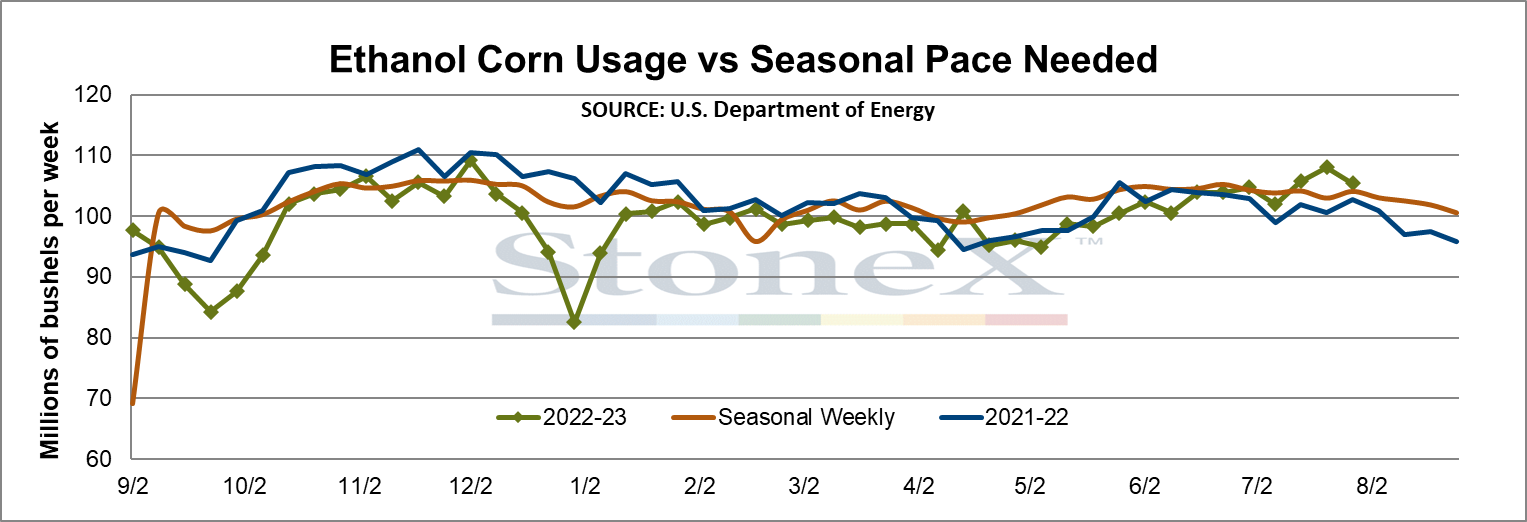
Crude oil prices briefly spiked when the Department of Energy reported that commercial stocks fell by 17.0 million to 439.8 million barrels in the week ending July 28, putting them roughly 1% below levels typically seen in late July. However, that strength didn't last long amid the strong headwinds noted above. Gasoline stocks rose by 1.5 million barrels during the week, leaving them 6% below seasonal levels. Distillate stocks fell by 0.8 million barrels and they remain roughly 15% below the five-year average for the week. Ethanol stocks slipped to 22.9 million barrels in the week ending July 28, down from 23.2 million the previous week, and down from 23.4 million barrels in the same week last year. Ethanol production fell to 1,067K barrels per day during the week, down from 1,094K bpd the previous week, but up from 1,043K bpd in the same week last year. The production of ethanol utilized an estimated 105.4 million bushels of corn in the week ending July 28, as shown below, down from 108.1 million the previous week, but up from 102.7 million bushels the previous year. Estimated marketing year to date corn use for ethanol totals 4.701 billion bushels, down 163 million bushels or 3.3% from the previous year's pace. On a related note, Reuters reported this morning that the Biden Administration is divided on whether to grant a request from the U.S. biofuel industry that would make it easier for sustainable aviation fuel made from corn based ethanol to qualify for subsidies under the White House's signature climate law.