August 24 - The mood is downbeat on Wall Street as we approach midday, as traders anticipate tomorrow morning's speech by Fed Chair Jerome Powell at the Jackson Hole, Wyoming symposium. The VIX is trading near 17 at midday, while the dollar index firmed to trade near 103.8. Yields on 10-year Treasuries are trading near 4.22%, while yields on 2-year Treasuries are trading near 5.00%. Crude oil prices are mixed to weaker, while the grain and oilseed markets are similar. Today's markets are drifting in an August malaise, lacking a reason to rally, while reluctant to add to recent losses without more of a reason to do so. Soybeans have a bit of a firmer tone to them, while Chicago corn and wheat prices are the weakest.
Midwest crop tour results showed solid crop yield potential in much of eastern Iowa, while the western part of the state was disappointing. Results thus far in southern Minnesota have been mixed, but with more disappointing results than I anticipated, or than I think that the trade anticipated. That continues to support the soybean market, which has less margin for error going forward. However, this week's tour has thus far failed to show that any potential decline in production will be enough to offset the anticipated decline in demand - especially for corn. If USDA does cut its yield estimates going forward, it will likely also cut its demand estimates for both corn and soybeans - especially export demand.
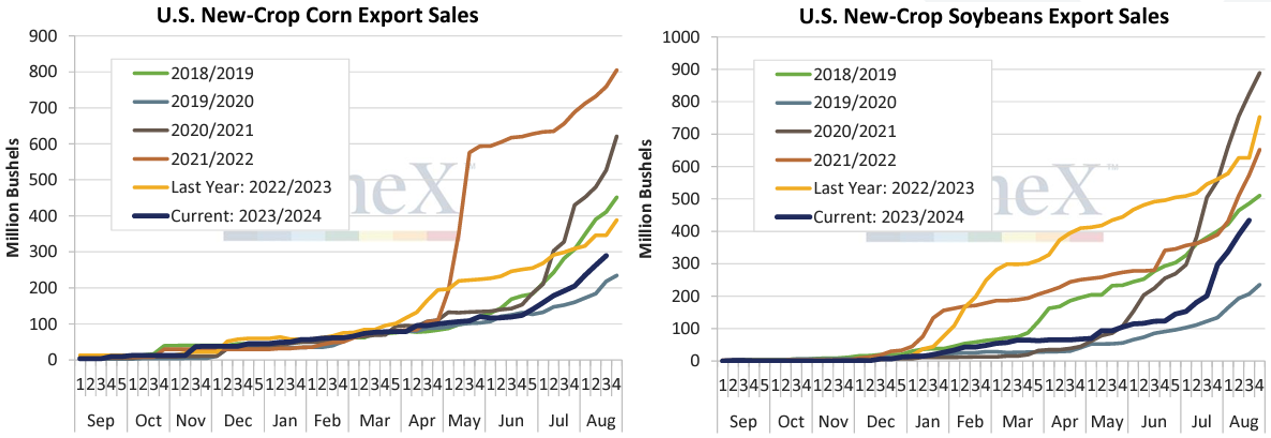
Exporters sold 26.5 million bushels of new-crop corn and 44.8 million bushels of new-crop soybeans in the week ending August 17. The focus is quickly shifting to new-crop demand, with old-crop sales winding down for the year ending August 31st, and time running out to get any fresh old-crop sales shipped. Mexico was the featured buyer of U.S. new-crop corn at 13.8 million bushels. New-crop soybean sales included 15.2 million bushels sold to China and 20.5 million bushels sold to "unknown destinations," which the market will assume is largely soybeans going to China. The graphics below show that new-crop corn and soybean sales remain well below levels seen by mid-August in recent years, raising concerns about our ability to hit USDA's targets for the year that begins September 1. New-crop sales to date to all destinations total 289 million bushels of corn and 434 million bushels of soybeans. The 10-year average for new-crop sales on the books in the first week of the new marketing year is 546 million bushels of corn and 750 million bushels of soybeans. We're currently on pace to have the second lowest amount of corn on the books to start the new year of the past 10 years - second only to 2019 - while the same is true for soybeans as well. Remember that 2019 was in the middle of China's African Swine Fever outbreak and still a part of the U.S. / China trade war period. We ended up exporting 1.777 billion bushels of corn and 1.679 billion bushels of soybeans in the 2019/20 marketing year. USDA's current targets for the new marketing year are 2.050 billion and 1.825 billion bushels at a time when Brazilian production is exploding and Chinese demand is flat.
The Kansas City Fed manufacturing index was zero for August, meaning that the sector neither contracted nor showed growth month-on-month. That's an improvement from the -11 registered for July, showing a bit of resiliency for the region. Survey participants indicated some expectation for future activity to improve a bit going forward, reflecting some optimism. They also indicated that finished product prices are declining, while input prices for raw materials are rising, but they expect both to increase over the next six months, which translates into more inflation.