December 4 – Despite craziness elsewhere in the world, U.S. stock markets are cruising right along with the major indexes in the green at mid-day, led by the tech-heavy Nasdaq which is pushing to fresh all-time highs yet again. The tech sector is having another great day, led by big jumps in Marvell Technology (+23%) and Salesforce (+9%), while market mover Nvidia is up roughly 3% as well. The VIX is off its lows below 13 earlier this morning but remains muted just below the 13.2 level. The dollar index has reversed course through the morning to now trade lower, hovering in the low 106’s. Treasuries are slightly in the red as well, with 10-year yields falling just below 4.2% while 2-year yields trade at 4.13%. Crude oil has also reversed course to trade in the red, with the nearby WTI contract pushing above $70.50 earlier in the session but now trading around $69.30/barrel. The ags are largely in the red across the board, save for some of the softs.
The U.S. service sector saw mixed results today, with updated November PMIs from S&P Global and ISM painting different pictures. On the positive side, S&P’s Services PMI saw a relatively minor drop from the preliminary 57 reading down to 56.1, still showing a marked improvement from October’s 55 but also showing the highest reading since March 2022. Additionally, that reading showed the slowest monthly growth in output prices seen in four-and-a-half years, an optimistic note for potential service sector inflation. On the more negative side, ISM’s Services PMI fell sharply to 52.1 in November from October’s two-year high of 56 while missing expectations of a slight easing to a 55.5 reading. With the labor market in focus this week, it is worth pointing out that both indexes showed a month-on-month decline in their respective employment portions. Both also noted last month’s election playing a role in their hesitancy for expanding hiring due to uncertainty regarding the impact of potential tariffs with the new administration.
Average 30-year mortgage rates hit a six-week low at 6.69% in the week ending 11/29, down from 6.86% in the week prior to mark the largest week-on-week decline seen since August. Mortgage rates had fallen notably from their peak of 7.9% back in October 2023 down to a low of 6.13% this September before rallying again through the fall as expectations of a more hawkish Fed set in. At the same time, mortgage applications in the U.S. rose 2.8% week-on-week, down from the 6.3% jump in the week prior but marking the fourth consecutive week-on-week increase after sharp declines seen in response to the aforementioned rally in rates through late September/October. Refinancing applications fell by 0.6% from the week prior.
U.S. factory orders increased by 0.2% month-on-month to $586.7B in October, the first monthly increase seen since July. Durable goods led the way higher, showing a 0.3% month-on-month increase, while non-durable goods rose at a weaker 0.1% rate. Excluding transportation, U.S. factory orders were up 0.1% month-on-month in October, matching the same increase seen in the month prior. This follows more positivity seen in U.S. manufacturing data released on Monday.
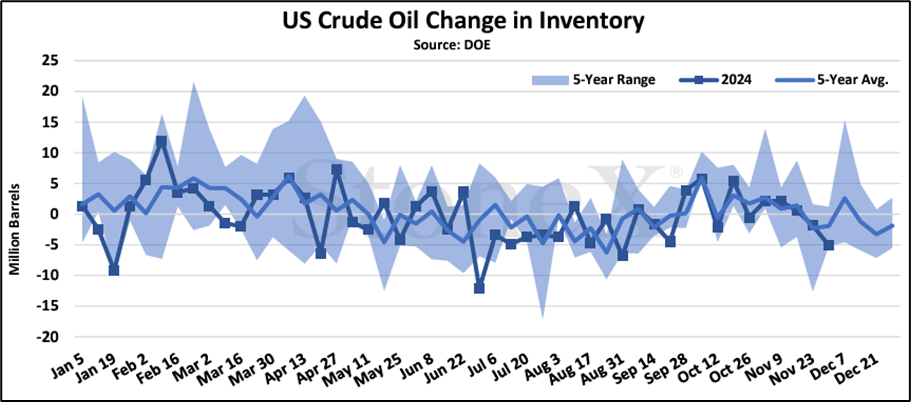
U.S. crude oil inventories fell sharper than expected to 423.38 million barrels (Mb) excluding the SPR, down 5.073 Mb week-on-week versus market expectations of a less than 1 Mb draw. This was the sharpest weekly decline in U.S. crude oil inventories seen in two months. Meanwhile, gasoline and distillate inventories both saw much larger than expected builds of 2.36 Mb and 3.38 Mb, respectively. Despite the unexpectedly large draw in U.S. crude inventories, crude oil prices have fallen through the session to push back into the red with this morning’s disappointing ADP figures and the ugly ISM Services PMI weighing on overall economic sentiment.