February 20 - Stocks tumbled lower today after Walmart's profit forecast fell short of trade estimates. The retailer forecast slower sales and lower profits for its fiscal 2026 sales year, suggesting slower consumer spending, although its e-commerce sales rose by 20% in this morning's report. Walmart made no mention of the impact of tariffs, but rather the market interpreted its lower sales outlook as reflective of consumer fears of inflation. The VIX is trading just above 16 this morning as stocks fall, while the dollar index is notably lower near 106.5, which is a 10-week low, providing some tailwinds for the commodity sector. Yields on 10-year Treasuries are trading near 4.50%, while yields on 2-year Treasuries are trading near 4.26%. Crude oil prices are 1% higher, while the grain and oilseed sector is mixed to firmer, with soybeans and soy products leading the way higher.
Soybean oil prices fell sharply yesterday when reports hit that California's Office of Administrative Law rejected the Low Carbon Fuel Standards amendments first proposed last fall by the California Air Resources Board. That put California's clean air rules on hold. California's OAL disapproved the amendments due to "clarity issues." The amendments sought to limit the use of soybean oil, canola oil, and sunflower oil to no more than 20% of the feedstock used to produce biomass biofuels in California, in addition to other changes. The question is, what part of the amendment did OAL have problems with leading to the disapproval? It could be that it merely wants more clarity of wording so that the intent is easier to understand, or it could want more significant changes.
In the meantime, the rejection leaves the industry in a bit of limbo while waiting for that clarity. Implementation of the new amendment was expected to result in even higher fuel prices for California. CARB will have 120 days to respond with revisions once it gets that clarity from the OAL. Soybean oil prices rebounded today to largely wipe out yesterday's losses. On a related note, the U.S. Environmental Protection Agency reported today that 486 million D4 blending credits for biomass diesel were generated in January, down from 906.8 million in December as the industry still waits for clarity on the 45Z guidelines that were a part of the so-called Inflation Reduction Act. Roughly 1.25 billion D6 credits were generated for ethanol blending, down from 1.30 billion in December.
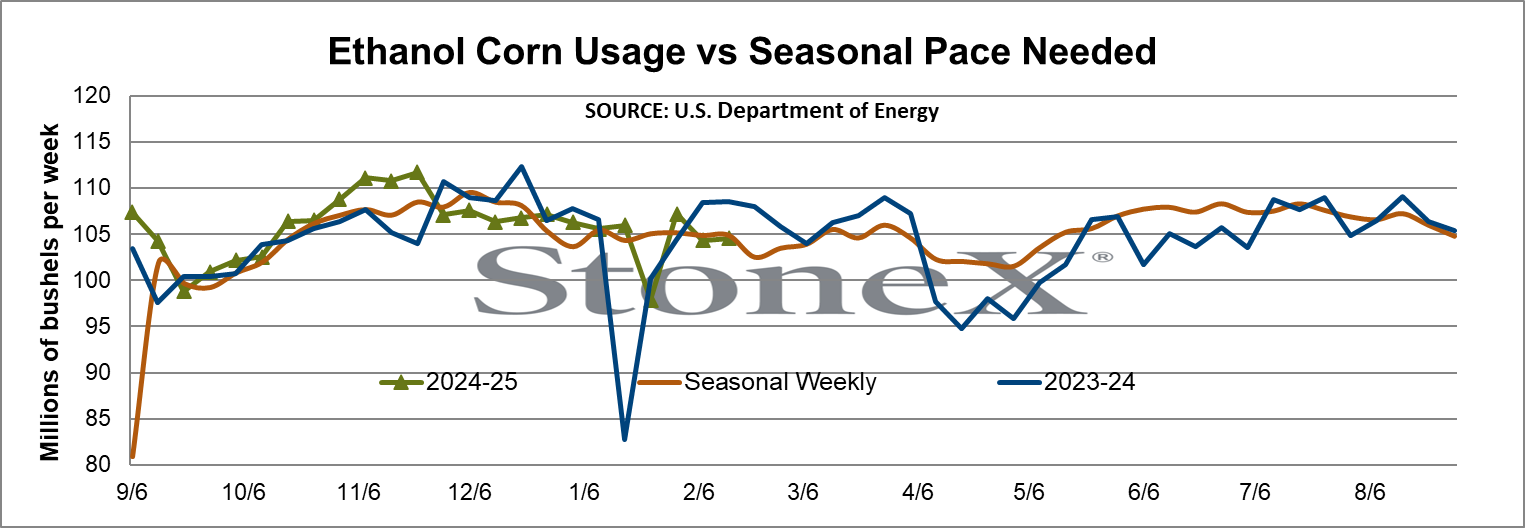
Commercial crude oil stocks (excluding the Strategic Petroleum Reserve) rose by 4.6 million to 432.5 million barrels in the week ending February 14, leaving them roughly 3% below the five-year average for mid-February. Gasoline stocks dropped by 0.2 million barrels, putting them 1% below levels typically seen in mid-February. Distillate stocks fell by 2.1 million barrels, pushing them 12% below seasonal levels. Ethanol stocks rose to 26.2 million barrels last week, up from 25.7 million the previous week, and up from 25.5 million barrels in the same week last year. Ethanol production firmed to 1,084K barrels per day last week, up from 1,082K bpd the previous week, but matching the pace of the previous year. Producers utilized an estimated 104.5 million bushels of corn to produce ethanol last week, up from 104.3 million the previous week. Estimated marketing year to date corn use for ethanol totals 2.523 billion bushels, up 3 million on the year.
The StoneX Kansas City Energy Brief had a nice piece this morning on the unusual marriage happening between "Big Oil" and the biofuel groups. Both see the Biden Administration's push toward electric vehicles as a threat to demand for what they produce. Biden had supported a mandate to see half of all new vehicle sales be EVs by 2030, which would have dramatically reduced demand for both fossil fuels and for liquid biofuels. They now see the opportunity to join together to fight that push, riding the momentum of the Trump Administration. The two forces are advocating for higher blending rates, with multi-year standards to provide greater long-term certainty needed for the industry to make its investments.