February 6 – Stocks are mixed at mid-day, with the Nasdaq and S&P 500 slightly in the green while the Dow Jones hangs slightly in the red and the VIX cools below the 15.5 level. The flurry of earnings season continues, with the next major market mover being Amazon due to report after today’s close. The dollar is attempting to stop the bleeding after this week’s selloff as it rebounds to trade above 107.65 at the time of writing. Similarly, treasury yields are bouncing from early week losses as 10-year yields trade at 4.45% and 2-year yields trade at 4.21%. Crude oil has traded both sides of unchanged today, with the nearby WTI contract clinging to slight gains at the time of writing as it trades just above the $71.20 level. The grains and oilseeds are now mostly in the green after trading lower earlier in the session, while the livestock complex is largely in the red with feeder cattle leading the way down.
This morning’s Challenger Job Cuts report showed U.S. employers announce 49.975k cuts in January, rising from December’s 38.792k but coming in well below the 82.307k seen in the same month last year. In fact, this was the lowest job cuts for the month of January since 2022. Despite the mostly optimistic reading, Challenger leadership did note “it seems this quiet is unlikely to last,” pointing to recent layoff announcements. The tech sector saw the largest job cuts at 7,488 due largely to top firms’ efficiency drives largely centered around AI implementation, while the retail sector followed in second with 6,419 cuts. Most of this week’s U.S. labor market data has beaten expectations, and the market will cap the week off tomorrow with updated Non-Farm Payrolls and unemployment data.
Unit labor costs in the U.S. rose 3.0% in the fourth quarter of 2024, marking a sharp rise from the 0.5% seen in the third quarter but still coming in below the average trade estimate of a more aggressive 3.4% increase. This total was a combination of a 4.2% rise in hourly compensation and a 1.2% rise in productivity. The productivity side came in below expectations of 1.4% growth and marked the slowest growth seen since the first quarter. In total, U.S. labor productivity rose 2.3% in 2024.
The Bank of England announced a 25-basis point cut at today’s meeting, brining its benchmark rate to 4.50%. The BOE has been among the most conservative of the big central banks in the last few years, with this being only their third cut since the pandemic. Today’s decision brings the BOE’s target rate closer to the Fed’s 4.25% - 4.50% target. However, BOE Governor Andrew Bailey pointed to concerning signs in the world’s sixth largest economy, commenting that they expect U.K. GDP growth to be “notably weaker in the near-term,” while also stating that they expect inflation to rise in the coming months. This raises fears of stagflation, though Bailey did his best to avoid this topic in today’s press conference. BOE’s decision sent the pound sterling lower today, providing further tailwinds for the U.S. dollar.
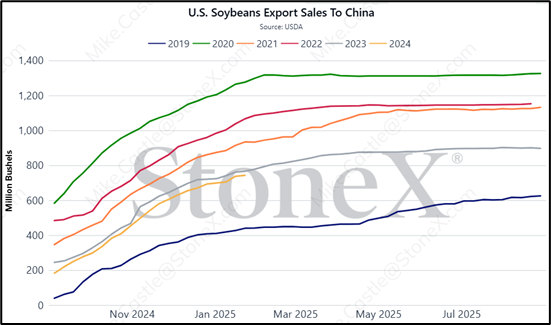
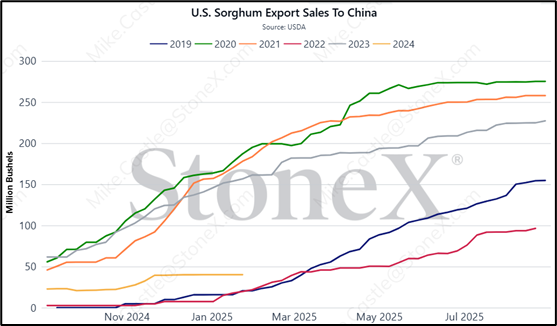
The first U.S. milo sales in five weeks appeared on this morning’s export sales report, with China’s miniscule ~250K bushel purchase accounting for almost all of the volume. Net U.S. milo sales over the last 10 weeks remain slightly negative due to previous cancellations, leaving us over 37% behind the seasonal pace needed to reach USDA’s 220-million-bushel export target. Sales to China, our traditional top milo export destination, are down 74.4% year-on-year to sit at their lowest pace in two years. Soybean sales remained seasonally weak as well at 14.2 million bushels, coming in towards the bottom end of the expected range and marking a four-week low. China was again the featured buyer here, with marketing year ‘24/’25 year to date soybean sales to China now trailing last year by only 3.1%. Cheap Brazilian soybeans hitting the market as harvest progresses look set to dry up demand for U.S. beans regardless of potential tariffs, however, barring some kind of trade agreement that includes goodwill purchases being reached.