January 9 – It’s a quiet day with the stock market closed and other markets closing early in observance of our National Day of Mourning for former President Carter. Trading action has certainly reflected that, with limited moves seen at mid-day. Of note, the U.S. dollar remains firm as it pushes back above the 109 level to flirt with the two-plus year highs seen a week ago today. Crude oil is up slightly on the day, with the nearby WTI contract pushing back above the $74 level after dipping yesterday following a more bearish than expected DOE report. The ags have traded both sides of unchanged in today’s session but are mostly trading narrowly in the red at mid-day, save for strength in livestock futures. The excitement should return in the ags tomorrow, with export sales delayed due to the holiday today and a massive data dump from the USDA on deck.
A second port strike has been averted for the East and Gulf Coasts, with a tentative deal being reached on a new six-year contract, avoiding the potential logjam to supply chains and subsequent economic toll. Full details of the new contract will not be released until it is officially approved, but a joint statement from the two sides noted “this is a win-win agreement that creates ILA jobs, supports American consumers and businesses, and keeps the American economy the key hub of the global marketplace.” With all the uncertainty happening, the market should be happy to see one issue tentatively put to rest.
Challenger Job Cuts came in at 38.8K in December, down from 57.7K in November and marking the lowest monthly cuts seen since July. This is the latest sign of a resilient U.S. labor market in this week’s tranche of data, though tomorrow’s Non-Farm Payrolls figures will be the most watched. In total, this caps off cumulative 2024 U.S. job cuts at 761,358, up 5.5% from 2023 and marking the highest level seen in a year since 2020. It is worth highlighting the fact that, excluding the pandemic skewed 2020 data, this would be the largest annual job cuts in the U.S. since 2009. While this sounds quite ominous, these were very front-loaded in the year with January, February, and March being the three largest months of cuts in the year, while December’s figures are less than half of the peak of 90.3K hit back in March. The U.S. tech sector saw the biggest cuts in 2024 at an annual total of 133,988, though that was down 20.3% from an ugly 2023. However, the auto sector in the U.S. saw job cuts rise 43.2% in 2024 to a total of 48,219 after facing a wide variety of challenges, from labor negotiations to high borrowing costs to shifting plans for electrification.
The minutes from the Fed’s December meeting showed a shifting of sentiment among FOMC members towards more caution in the year ahead, with one of the main themes being uncertainty, specifically at the policy level. They pointed to “elevated uncertainty regarding specifics about the scope and timing of potential changes to trade, immigration, fiscal, and regulatory policies and their potential effects on the economy,” referring without name to the incoming administration later this month. With the above all pointing to renewed inflationary pressures, inflation in 2025 was expected to remain about the same as in 2024, with inflation not forecasted to fall to their mandated 2% level until 2027. This week’s mostly stronger than expected U.S. economic data, along with the warning sign of potential heating up of inflationary pressures in the service sector (highest Prices Paid subindex since Feb 2023), has likely added to that cautiously hawkish sentiment, though a surprise to the downside in tomorrow’s jobs data could impact that as well.
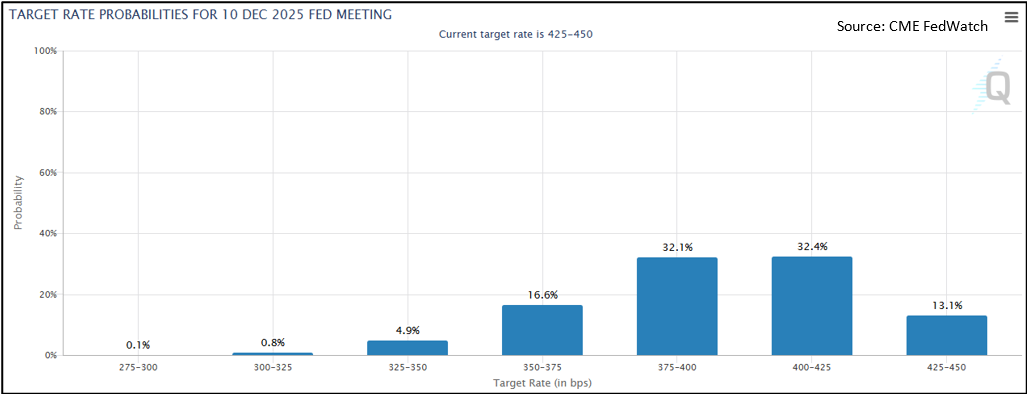
Traders get to hear from a wide range of Fed officials today, with Philadelphia Fed President Patrick Harker and Boston Fed President Susan Collins both speaking earlier this morning, while Richmond Fed President Thomas Barkin, Kansas City Fed President Jeffrey Schmid, and Fed Board of Governors Member Michelle Bowman are set to speak at various events later this afternoon. To give a sense of the cautious tone being taken by Fed members, Patrick Harker’s speech this morning was titled “Right Now, It’s Putting One Foot in Front of the Other.” While we shouldn’t expect to hear anything too surprising from today’s speakers, it is interesting to see market expectations on the timing of rate cuts shifting slightly today, with the highest odds of the first cut briefly shifting to the May meeting instead of June before reversing course back to June. Additionally, the probability of only seeing one 25-basis point cut in 2025 has declined from yesterday, now almost even with the probability of a total of 50-basis points of cuts being seen by the Fed’s December 2025 meeting, as shown in the below graphic.