Today's Perspective Video: Tariffs Return: 90-Day Pause Ends - What Markets Need to Know
July 10 - Stocks traded mixed this morning as diplomatic negotiations appear to be ramping up between the United States and Brazil after President Trump announced late yesterday that he will place a 50% tariff on that country. The VIX is trading below 16, while the dollar index is trading near 97.7. Yields on 10-year Treasuries are trading near 4.37%, while yields on 2-year Treasuries are trading near 3.88%. Crude oil prices are 2% lower, while the grain and oilseed sector is mixed to firmer. Wheat prices continue to trade steady to higher as Russian harvest results disappoint, and amid unconfirmed rumors that China may be buying. Corn and soybean prices continue to face pressure from rising yield prospects with this year's crops, although we are seeing some consolidation ahead of tomorrow's big USDA WASDE crop report.
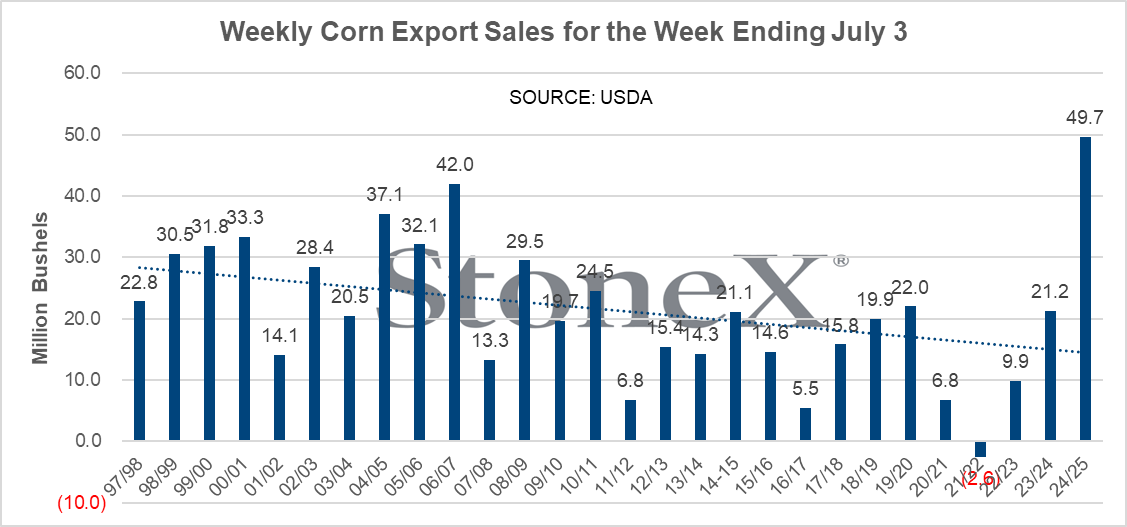
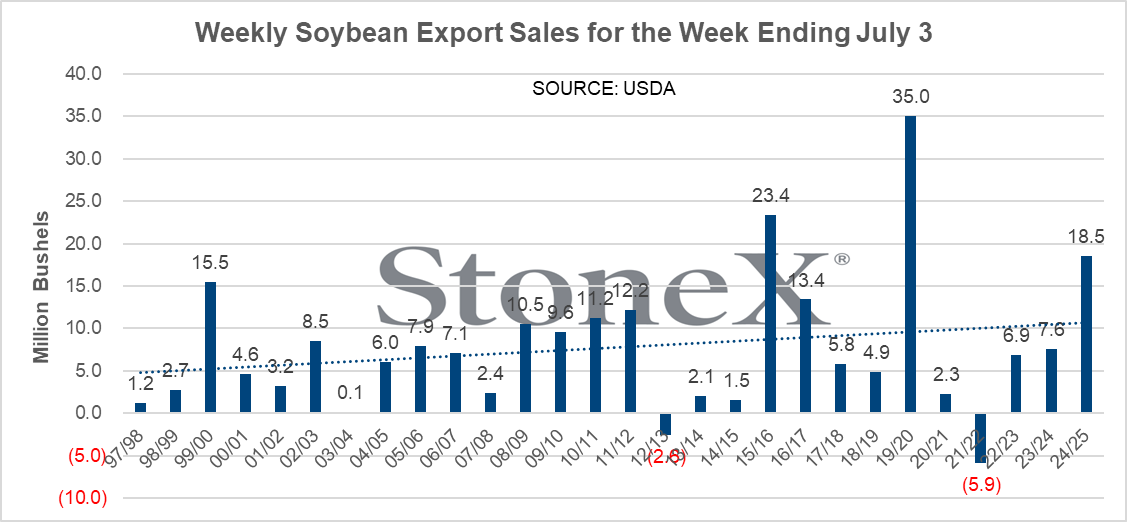
Exporters sold 49.7 million bushels of U.S. old-crop corn in the week ending July 3 - the largest total sold during that week going back to at least the past 27 years - along with 35 million new-crop bushels. They also sold 18.5 million old- and 9.1 million new-crop soybean bushels, along with 20.9 million old- and 0.3 million new-crop wheat bushels and 0.7 million bushels of grain sorghum. Mexico was the featured buyer of U.S. corn during the week at 18.5 million old- and 16.7 million new-crop bushels. The purchase comes as the Mexican border is again closed to feeder cattle flowing north into the United States due to the discovery of another New World Screwworm - this one just 370 miles south of the U.S. / Mexico border. The nearly 30,000 head of feeder cattle per week that used to flow north into the United States must now be fed in Mexico, requiring a lot more corn to flow south to feed them. Japan was the second largest buyer of U.S. corn in the week ending July 3rd, netting a total of 17.2 million old- and 12 million new-crop bushels. The featured buyer of U.S. soybeans during the week was "unknown destinations" at 4.2 million old- and 7 million new-crop bushels. China wasn't listed once again, although it is possible that China was involved in the "unknown destination" sales. We won't know who the buyer was for those soybeans until freight is lined up.
Marketing year to date corn export sales total 2.731 billion bushels, above USDA's target for the year of 2.650 billion, and second only to the 2.745 billion bushels on the books at this point in the 2020/21 marketing year. Total shipments that year reached a record 2.747 billion bushels. This year's sales to date are 594 million bushels or 28% above the previous year's pace, and they exceed the seasonal pace needed to hit USDA's target by 200 million bushels. It's possible that some of those sales will be rolled into the next marketing year in two months, so we can't count on final export shipments reaching that pace, but I can make the argument that the current pace of sales and shipments justifies at least a 75 million-bushel increase in tomorrow's WASDE crop report, pulling projected ending stocks possibly below 1.3 billion bushels. However, the markets are clearly focused on new-crop currently, as the assumption is now that we will not run out of corn before the next harvest. Marketing year to date soybean export sales total 1.853 billion bushels, above USDA's target of 1.850 billion for the year ending August 31, and 206 million bushels or 12% above the previous year's pace. The total exceeds the seasonal pace needed to hit USDA's target by 8 million bushels, while actual shipments exceed it by 66 million bushels. USDA could raise its target by 10 - 20 million bushels tomorrow, although it also has reason to consider lowering its 2025-26 marketing year export target due to a lack of Chinese business.