July 11 - Optimism remains at play on Wall Street ahead of tomorrow's inflation data, boosted by encouraging data out of China as well. The VIX is trading near 15 at this hour, while the dollar index is trading lower near 101.8, after setting fresh eight-week lows today. Yields on 10-year Treasuries are trading near 3.98%, while yields on 2-year Treasuries are trading near 4.89%. Crude oil prices are 2% higher on the above factors, while the grain and oilseed markets are higher as well. Soybeans led the way on expectations of tighter stocks in tomorrow's USDA WASDE report, but profit taking pared back prices ahead of tomorrow's report as those prices approached key chart objectives. The risk of surprises from USDA will be elevated relative to normal in tomorrow's July WASDE report. Corn and wheat garnered support from ideas that the Ukraine grain initiative is dead, as well as ideas that this year's corn yield was likely hurt to some degree by the weather stress in June.
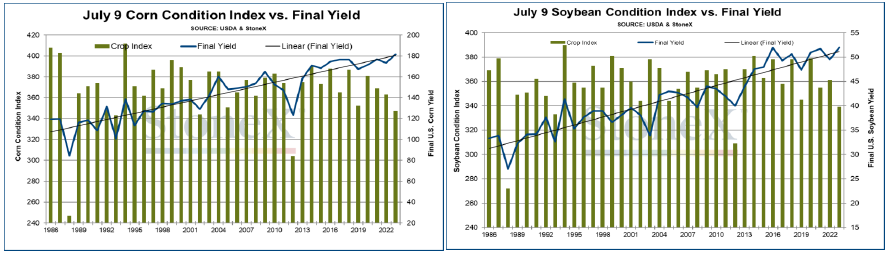
This week's corn and soybean condition index scores rose by 7 and 2 points respectively, but they remain well-below the 10-year averages for this week of the year, as shown in the graphics below. The corn condition index score of 347 is very close to the 348 for this week of the year in 1992, and the current weather pattern is very similar to that seen in 1992 as well. But I still do not feel believe that we will see the same yield bounce-back to above-trend levels that we saw in 1992. I do expect yield potential to recover from current levels to some extent, but my past agronomy experience suggests that we are probably not looking at above-trend national average yields for this year's corn and soybean crops. Currently, my gut tells me we're looking at a 177 bushel per acre corn yield if this weather pattern continues to play out, with soybeans coming in just above 50 bpa. Both of those are above my yield models currently at 171.7 and 49.7 bpa respectively for corn and soybeans.
I would not typically expect USDA to adjust its corn and soybean yields in the July report. It typically does not like to do so prior to NASS releasing its first estimates in August. That may still prove true for soybeans this year, even though I submitted a pre-report estimate of 51 bushels per acre. USDA will have enough trouble making its balance sheet work with the lower acreage number from June 30, necessitating that it slash demand to do so. Cutting yields at this point would make that job even more difficult. It will likely cut crush, but that fails to recognize the growth in crush capacity that firms will want to justify. However, USDA needs to recognize that China is stockpiling Brazilian beans at a very rapid pace this summer, reducing its need to import from the United States this fall, allowing it to cut a couple hundred million bushels from that use category. Keep in mind that the current strength in soybean prices is encouraging Brazilian farmers to expand planting intentions for the coming
The corn balance sheet will be more telling of where USDA is at. It's demand estimates are already inflated for the new marketing year, and more old-crop export and ethanol cuts make the problem bigger. Adding two million more planted acres per the June 30 report make stocks even more challenging for the coming year. The USDA WASDE committee typically does not like to change its yield estimate until NASS submits a yield in August, but it may use this year's dry June as an excuse to do so to aid in trying to make its corn balance sheet work in light of the larger acreage. I submitted a 177 bpa yield, which I feel is quite reasonable for this year's crop at this point, considering June stress and an expected favorable July and August weather pattern. Even so, that leaves a very inflated supply well over 2 billion bushels for the coming marketing year - likely between 2.2 & 2.6 billion, depending on your view of demand going forward. Corn demand is quite soft in China currently - although it faces some weather production risks - while cheaper corn supplies are so abundant in Brazil that farmers are not expected to expand production per normal in the coming year.