July 16 - The Dow Jones Industrial Average is on pace to have its best day since November 2nd if it holds as Wall Street trades this morning's solid retail sales data, expectations of a Federal Reserve rate cut, and expectations of a Trump 2.0 presidency that would be expected to reduce regulations in a business friendly economy. The VIX continues to trade near 13 at this hour, while the dollar index remains firm at 104.4. Yields on 10-year Treasuries are trading near 4.19%, while yields on 2-year Treasuries are trading near 4.46%. Crude oil prices are well off their nearly three-week lows posted earlier this morning, while the grain and oilseed markets are mixed to firmer.
Wheat prices were under pressure early as Russian production estimates come off their lows amid harvest reports of better-than-expected yields, with the global cash market under pressure as Russia dumps newly harvested supplies onto the market at cheap prices. However, corn and soybean prices found support following yesterday's collapse, after U.S. crop ratings failed to rise this week as the trade anticipated, and as wire service articles highlight problems with the Black Sea summer crops. Ukraine farmers fear that yields my fall by 30 - 35% this year due to heat and drought, while Russian authorities indicate that crops in Rostov are facing temperatures as high as 50°C (122°F) that threatens summer crops. Crops certainly are under stress in those regions, and we will likely see smaller crops there as a result. However, we shouldn't see that positively impact our export shipments for another four to six months, if then. Last night's Midwest wind storms also added support today.
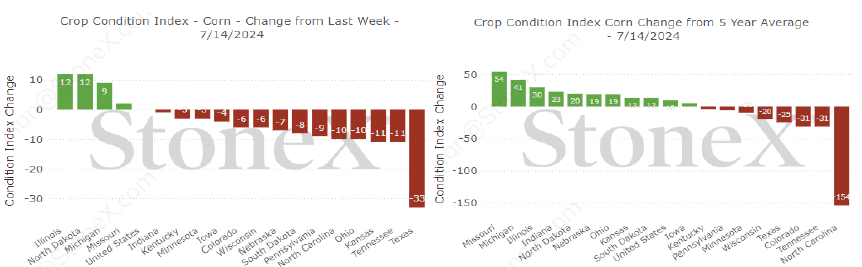
Fundamentally, the primary focus is still on the U.S. crops as we enter the critical reproductive phases. The graphic on the left below shows the week-on-week change in condition index scores for the U.S. corn crop on Monday afternoon. The overall score remained unchanged at 372 this week, up from 351 in the same week last year, and up from the five-year average for the week of 362. USDA has been reporting crop condition ratings since 1986, or nearly four decades. The average score for this week for that entire period is 368, down 1 point from the previous week. The portion of this week's crop rating Good to Excellent was unchanged at 68%, versus the five-year average of 63%. Any way that you look at it, this year's total crop rating for this week of the year is above average. We definitely have problems created by the June flooding in the northwest portion of the Midwest, but ratings elsewhere are thus far making up for losses in that area.
It gets a little more interesting though when you break down this week's data. Condition scores were unchanged on the week for corn, no matter which rating you look at for the national crop - condition index scores, % Good to Excellent, or even % Poor to Very Poor. But there was a lot of movement among states this week, and ironically, most of it was negative. The ratings rose in four states this week, as indicated below, including in Illinois, North Dakota, Michigan, and in Missouri. However, they fell in 14 other states, including some pretty significant moves. The ratings are weighted by production in each state, so this week represented one of those oddities where most states saw declining ratings, but the weighted average for the top 18 states was unchanged.
The graphic on the right below shows how the condition index scores in each of those states compare to the five-year average for those states for this week. The scores are higher than the five-year average in 10 of the top 18 states, while lower in eight. A few weeks ago just a few states were below average, so we're definitely seeing a shift. Yield models can be built for each state and/or the national crop as a whole. Either way they still show a national average crop that is near trend or better, although this crop isn't without its set of problems that will need to be monitored as it continues to develop. The weather outlook for the next couple of weeks suggests improving yield potential, but we'll need to see how this plays out with the crop.