July 18 - Tech stocks led Wall Street on a roller coaster this morning, with the VIX continuing to creep higher as well. In other related news, the index of leading economic indicators fell 0.2% in June, which was better than the 0.3% decline expected by analysts. Furthermore, the May LEI index was revised upward to -0.4% from the -0.5% previously reported. This says that the economy remains stagnant, but that it is slowly improving, even without a rate cut. The Federal Reserve sees its current policy as working to control inflation while providing a safe landing for the economy, but it also doesn't want to reverse course too soon. The VIX is trading just below 15 this morning, while the dollar index is trading near 104.0. Yields on 10-year Treasuries are trading near 4.17%, while yields on 2-year Treasuries are trading near 4.44%. Crude oil prices are modestly lower late morning after failing to test $84 per barrel earlier in the session. The grain and oilseed markets are mixed in relatively quiet late July trade.
Minneapolis wheat was the strength of the grain and oilseed complex through the morning, as traders begin to worry about supply risks from hot dry weather in portions of the Northern Plains, Canadian Prairies and in the Black Sea Region. It's more about short covering at this point than it is about pushing prices higher to ration demand. Traders also took note that export sales have also been good in recent weeks for U.S. wheat. Supplies are quite ample, so a sustained rally doesn't look likely at this point, but prices have come down a long way, and some buyers see value at current price levels. Corn and soybean prices though continue to be lethargic. Yes, hot dry weather in the Black Sea Region is stressing crops, but shortfalls there wouldn't be expected to boost U.S. exports for another six months or more. Rather, traders are focused on how the farmer is the big "long" in the market, which continues to be a weight over futures prices.
The big question surrounding this year's crops may come down to harvested acreage, more than yield potential itself, if we maintain the current weather pattern. That's not to say that there aren't areas where yields are hurting. That's certainly the case, especially in areas of the northwestern Midwest that saw record rainfall in June, as well as storm damaged areas of Nebraska, Iowa, Illinois, and elsewhere. But both the crop ratings and the satellite-derived NDVI plant health scores suggest that the "good" currently offsets the "bad" - possibly more than offsetting it. The current weather pattern is favorable for development. Maintaining this weather pattern for another six weeks or so would likely keep the above in place, if that happens. Currently, state NDVI scores are above the longer-term norm for every major corn producing state except Minnesota and Colorado, and the current weather pattern supports that continuing into next month.
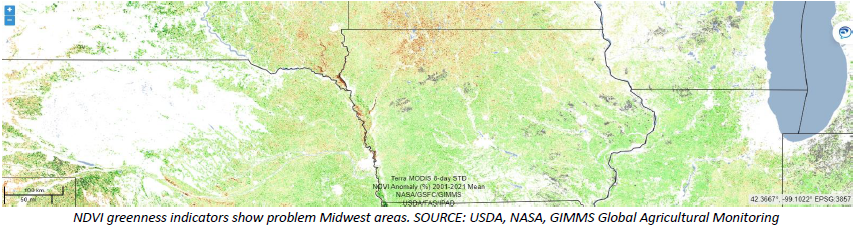
But what about acres? The problem areas of the Midwest will likely see a reduction of harvested acres. We could see the first signs of that showing up in the August WASDE crop report, with further adjustments in following crop reports. The graphic below shows the satellite-derived plant health indicators colored, with green representing healthy crops and brown those crops that are not healthy. Dark brown areas can be seen along the Missouri River and other major streams where crops drowned and were unable to be replanted. Other brown areas reflect ponding and/or less-than-healthy crops that were a product of the saturated soils. You can even see the brown streaks in Nebraska where significant hailstorms destroyed crops. Current estimates suggest that up to 3 million acres may have been lost in the areas described, but that number is still fluid. Every million acres of corn not harvested takes 181 million bushels off the size of the crop on USDA's balance sheet, which means 181 million bushels off ending stocks if usage remains the same. For soybeans, it would be 52 million bushels off the bottom line for every million acres not harvested. I think we'd be hard pressed to currently say that the acreage losses are enough by themselves to justify rationing demand with higher prices, but they do reduce the margin for error should another weather problem develop, either here or in a major producing areas overseas.