July 18 – Stocks are losing steam at mid-day after the S&P 500 and Nasdaq both pushed to fresh record highs this morning, while the VIX continues to cool as it falls below the 16.5 level with additional optimistic U.S. economic data easing concerns today. The dollar is taking a break from its July rally to end the week, hovering around 98.25 at the time of writing. Treasuries are down slightly at mid-day, with 10-year yields trading at 4.42% and 2-year yields at 3.86%. Crude oil is quietly lower as well, with nearby WTI trading around $66.40 at the time of writing, while the ags are largely in the green across the board, save for the cattle complex taking a slight breather to end the week.
U.S. consumer sentiment continues to improve by more than expected, with this morning’s headline reading from the University of Michigan rising to 61.8 in July, up from 60.7 in June and above analyst estimates of a slighter improvement to 61.5. This is now the highest U.S. consumer sentiment reading since February. Increases were seen for both the Current Conditions portion (66.8 in July vs. 64.8 in June) and the Expectations portion (58.6 in July vs. 58.1 in June).
Consumer inflation expectations cooled as well, with year-ahead inflation now seen at 4.4%, sharply below market expectations of holding steady at the 5.0% seen in June. In fact, this was below even the low-end trade estimate of a drop to 4.7%. This is now the lowest year ahead inflation expectations have been since February, down hard from the peak of 6.6% seen in May that represented a 23-year high at the time. Similarly, 5-year inflation expectations fell to 3.6% in July, down from 4.0% in June and also marking the lowest level seen since February. Obviously, 4.4% and 3.6% are still quite elevated relative to historical levels, but the unexpected improvement from the consumer perspective is still a step in the right direction. The U.S. economy continues to remain surprisingly resilient, allowing the stock market to continue trending higher as traders breathe a proverbial sigh of relief for now.
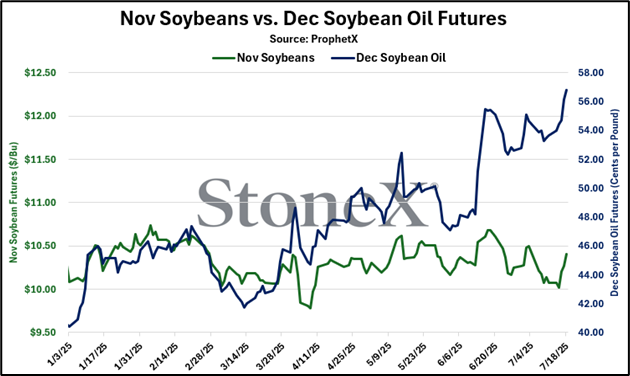
Soybean oil futures are continuing to push higher after closing at nearly two-year highs yesterday, helping soybeans in their attempt to end a solid week on a strong note. November soybean futures are trading at their highest level in two weeks as of the time of this writing, and it will be interesting to see how much of this strength they can hold into the close as they attempt to fill the bearish gap made coming out of the 3-day July 4th weekend. Obviously, there’s not much to be bullish about on the supply side for soybeans, but more focus is landing on the demand side.
While still far from finalized, largely favorable policy support for the domestic biofuel industry has helped ease concerns over U.S. soy demand, with USDA calling for record crush in ‘25/’26 at 2.54 bbu. It’s interesting to note that USDA has domestic soy crush increasing by 120 mbu year-over-year, the exact same amount they have exports falling. As of yesterday morning’s Export Sales report, the U.S. still has zero bushels of ‘25/’26 soybeans sold to China (though sales to unknown destinations have added further fuel to rumors of Chinese buying interest). Given China’s position as the traditional top importer of U.S. soybeans, and as the world’s top soybean importer by a wide margin, replacing them entirely would be extremely difficult, especially amid the backdrop of competing with back-to-back record South American soy crops. More optimism appears to be emerging on the trade front, however, with China’s Commerce Minister Wang Wentao today speaking positively about relations between the two countries, noting that “with leadership and communication at the highest levels, we can properly manage contradictions and resolve our differences.” Any amount of positivity between the two sides is welcomed by the market, but with U.S. soybean growing prospects continuing to look excellent, we’ll need to see more concrete steps taken to ensure these beans have enough homes to avoid a major supply glut by fall.