July 2 - Stocks firmed on an announced trade deal with Vietnam this morning, although traders remain cautious at these high levels as next week's deadline for deals approaches. The VIX is trading back below 17 at midday, while the dollar index is trading near 96.9. Yields on 10-year Treasuries are trading near 4.30%, while yields on 2-year Treasuries are trading near 3.79%. Crude oil prices are nearly 2% higher as Iran breaks relations with the UN nuclear watchdog, while the grain and oilseed markets are mostly firmer on trade deal optimism.
Corn and wheat prices are posting modest gains following this morning's trade agreement announcement, while soybeans are posting double-digit gains. Both corn and wheat supplies are currently on pace to grow over the coming 2025-26 marketing year. The winter wheat harvest is well underway, with high yields being reported. USDA is expected to boost its production estimate next week. USDA won't likely change its corn production estimate before the August WASDE crop report, but yield models followed by institutional investors are currently calling for above-trend yields. That could still change, but for now, large supplies are expected. The possibility of opening up more markets in Vietnam on top of strong demand from Mexico raises some optimism today. Soyoil gapped higher to help support soybeans. The market is counting on strong soyoil demand for biofuel production, now that it is looking increasingly likely that the tax bill containing favorable 45Z funding for the sector will pass Congress and be signed by President Trump. We're still at risk of an unfavorable Small Refinery Exemption assessment by the EPA, but that's a worry for another day.
President Trump announced on Truth Social this morning that he had a trade deal with Vietnam after a personal phone call with General Secretary To Lam. Trump indicated that Vietnam agreed to a 20% tariff on all goods produced in that country and sold in the United States, and a 40% tariff on any transshipped goods coming to America. The latter tariff is to include any goods that China passes through Vietnam to the United States. This is an example of what I've been saying - that trade agreements will include measures to contain China. Ironically, China just threatened to retaliate against any country signing a deal with the United States that would hurt China. It's no accident that President Trump personally got involved in negotiating this deal with China's neighbor, which China has been using to transship products to the United States. In return, Vietnam promises to give total access of its markets to U.S. producers. That opens the door for U.S. pork, wheat, corn, DDGS, etc., assuming that those products are competitively priced. This deal helps build some momentum for other countries to sign deals, particularly those in the Indo-Pacific region.
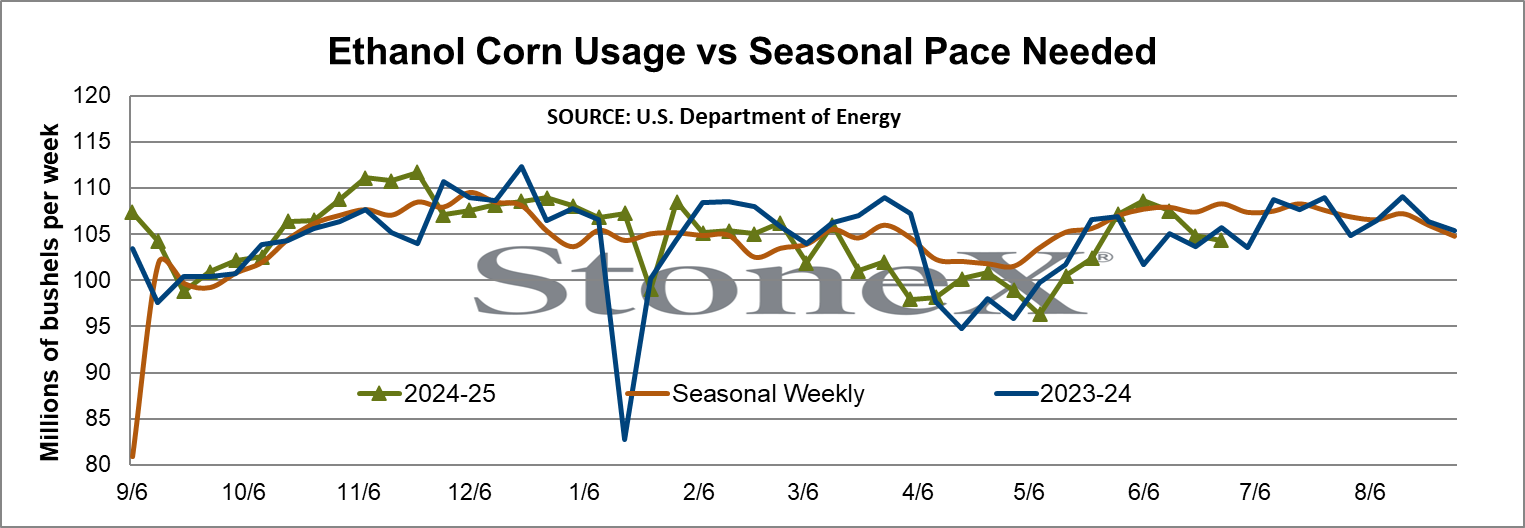
U.S. commercial crude oil supplies (excluding the Strategic Petroleum Reserve) rose by 3.8 million to 419 million barrels in the week ending June 27, leaving them still 9% below levels typically seen in late June. Gasoline supplies rose by 4.2 million barrels, putting them roughly 1% below the five-year average for the end of June. Distillate stocks fell by 1.7 million barrels, dropping them to 21% below seasonal levels. Ethanol stocks dropped to 24.1 million barrels in the week ending June 27, down from 24.4 million the previous week, but up from 23.6 million barrels in the same week last year. Ethanol production slipped to 1,076K barrels per day last week, down from 1,081K bpd the previous week, but up from 1,064K bpd in the same week last year. Estimated corn use to produce fuel ethanol last week totaled 104.3 million bushels, down from 104.8 million bushels the previous week, but down from 105.8 million bushels in the same week last year. Estimated marketing year to date corn use for fuel ethanol production totals 4.486 billion bushels, up 2.2 million bushels from the previous year's target. Last year's corn use for ethanol totaled 5.478 billion bushels, while USDA currently has this year's target at 5.500 billion bushels. That's rapidly becoming less likely now, with just two months left in the marketing year.