July 3 - The Nasdaq cautiously rose to fresh record highs today, with the S&P 500 close on its heels, while the Dow struggled once again ahead of Friday's highly-anticipated monthly jobs report. The markets will be closed for the Fourth of July Independence Day holiday tomorrow. Friday's jobs report is expected to show that the economy added a solid 189K jobs in June, down from 272K the previous month, although still a solid number. The unemployment rate is expected to remain unchanged at 4.0%, while average hourly earnings tick slightly lower while showing 0.3% month-on-month gains and 3.9% year-on-year gains. Today's ISM services index for June fell into contraction territory at 48.8, down from expectations of 53.0, but the PMI Composite was strong in expansion territory at 54.8, with the services sub-index even stronger at 55.3. So, today's data provided something for both the doves and the hawks.
Treasury yields fell notably when the ISM data was released, while stocks remained much quieter. That then led to further weakness in the dollar index, which fell to fresh nearly three-week lows. The VIX is still trading near 12 as the market continues to anticipate a September rate cut by the Federal Reserve, with a second cut by December, while the dollar index trades notably lower near 105.2. Yields on 10-year Treasuries are trading near 4.36%, while yields on 2-year Treasuries are trading near 4.70%. Crude oil prices remain firm at midday, with prices hanging around the $83 per barrel mark. Grain and oilseed prices are mixed at midday, with soybeans following soyoil prices higher as a trade war heats up between China and Indonesia that might result in a hit on palm oil shipments. Meanwhile corn and wheat prices are generally weaker. Wheat prices barely responded to industry rumors today that the Russian Ag Ministry "might" introduce export restrictions on wheat in the first week of August, and that it may set minimum price levels on sales. No export ban is expected, but these rumors suggest that Russia might utilize price to limit sales amid this year's smaller drought-shortened crop. Yet, these rumors come at the same time that Sovecon reportedly raised its production estimate back above 84 mmt.
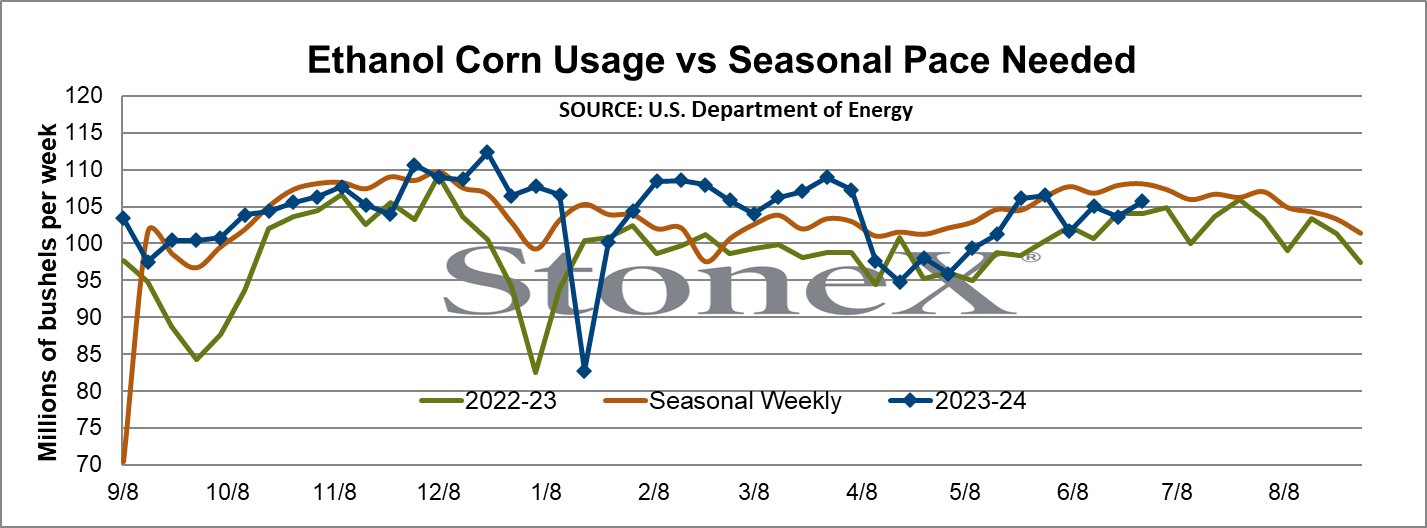
U.S. commercial crude oil stocks (excluding the Strategic Petroleum Reserve) fell by a large 12.2 million to 448.5 million barrels in the week ending June 28, leaving them 4% below the five-year average for late June. Gasoline stocks dropped by 2.2 million barrels, leaving them 1% below seasonal levels. Distillate stocks decreased by 1.5 million barrels, putting them 10% levels typically seen in late June. Ethanol stocks firmed to 23.6 million barrels, up from 23.4 million barrels the previous week as production recovered during the week ending June 28, while also up from 22.3 million barrels in the same week last year. Ethanol production rose to 1,064K barrels per day last week, up from 1,043K bpd the previous week, and up from 1,060K bpd the previous year. The production of ethanol utilized an estimated 105.7 million bushels of corn in the week ending June 28, up from 103.6 million bushels the previous week, and up from 104.9 million bushels the previous year. Estimated marketing year to date corn use for ethanol totals 4.482 billion bushels, up 202 million bushels or 4.7% from the previous year's pace.
China was again a big buyer of soybeans last week, locking in an estimated 33 cargoes of mostly Brazilian soybeans for shipment in July, August, February, March, and April. Our sources estimate that buyers still need to book a little more than 4 mmt for shipment in August to complete the current marketing year, with very little booked for fall shipment thus far. Ironically, Chinese buyers have already booked more than 4 mmt of new-crop Brazilian soybeans for shipment in the February to April period, yet they largely remain on the sideline in regards to booking shipments in the September to January period - a time when U.S. soybean shipments used to dominate trade with China. Thus far, purchases of U.S. soybeans are estimated at just 3 cargoes for this fall, or just 7.3 million bushels.