June 1 - Both stocks and commodities gained today after the debt ceiling deal moved through the House of Representatives to the Senate overnight. The Senate is expected to stay in session until the bill is passed. As such, the VIX fell with the rise in stocks, while the dollar dropped with Treasury yields. The VIX is trading below 16, which puts it just above year-and-a-half lows. The dollar index is trading sharply lower near 103.6, while yields on 10-year Treasuries are trading near 3.61%, and yields on 2-year Treasuries are trading near 4.35%. Crude oil prices are roughly 4% higher as the dollar tumbles, while the grain and oilseed sector is generally 1 to 3% higher, while the cotton market is more than 3% higher on the weaker greenback. First-of-the-month money flow is positive to start June, particularly supported by the above factors. The grains also found support from a bit drier forecast this morning, combined with a weekly Drought Monitor that showed drought spreading across much of the Midwest to close out May.
U.S. crude oil stocks (excluding the Strategic Petroleum Reserve) rose by 4.5 million to 459.7 million barrels in the week ending May 26, leaving supplies 2% below the five-year average for late May. Gasoline stocks dropped by 0.2 million barrels, putting them 8% below typical levels seen this time of year. Distillate stocks rose by 1.0 million barrels, leaving them 18% below seasonal levels. Ethanol stocks rose to 22.3 million barrels in the week ending May 26, up from 22.0 million the previous week, but down from 23.0 million in the same week last year. Ethanol production rose to 1,004K barrels per day last week, up from 983K bpd the previous week, but down from 1,071K bpd in the same week last year. The production of ethanol utilized an estimated 98.8 million bushels of corn last week, up from 96.8 million the previous week, but down from 105.5 million in the same week last year. Estimated marketing year to date corn use for ethanol totals 3.760 billion bushels, down 4.6% or 183 million bushels from the previous year's pace, and 43 million bushels below the seasonal pace needed to hit USDA's target.
The Brazil soybean harvest is essentially complete, so this month's customer survey revealed no changes to its production estimate, leaving it at 157.68 million metric tons. However, early corn harvest results have been very good in Mato Grosso, resulting in higher yield estimates for that region. That bumps the safrinha corn production estimate to 102.9 mmt, up from 100.78 mmt last month. As a result, total Brazilian corn production for this year is projected to be 133.75 mmt (including the small third crop), up from 131.59 mmt the previous month. As a result, Brazilian corn exports are expected to reach nearly 1.9 billion bushels this year, taking away a significant portion of U.S. market share of the Chinese market, just as it has done with soybeans as well.
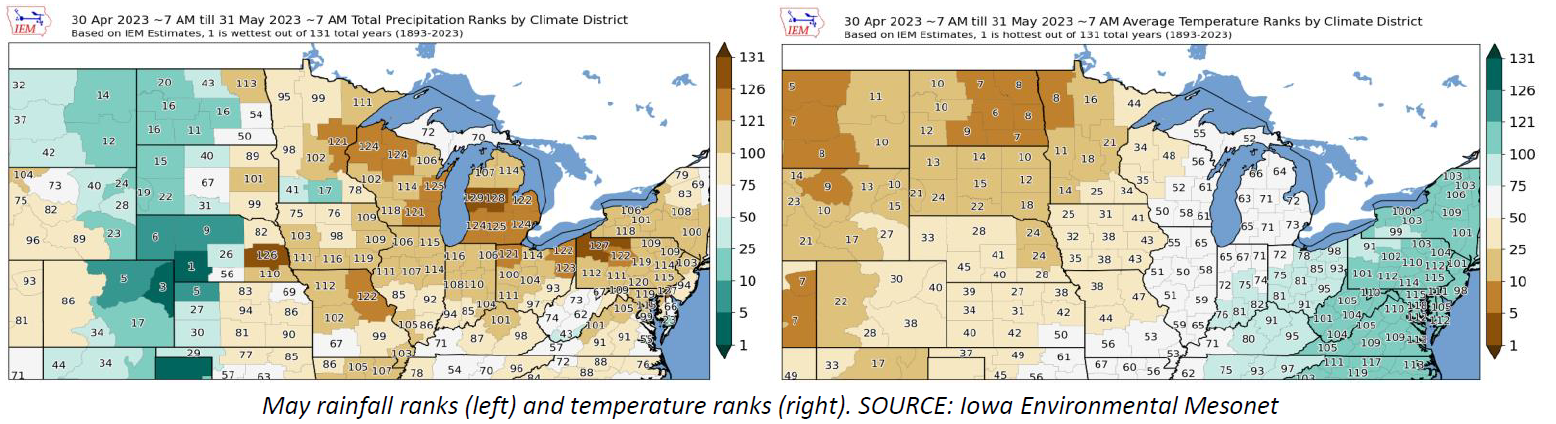
The Midwest was hot and dry in May, particularly in the last half of the month. The graphic on the left below shows rainfall ranks by crop reporting district over the past 131 years of weather data. Note that southwest Nebraska saw its wettest May on record, while east-central Nebraska experienced one of its driest May's on record. Note how dry it was across the Great Lakes Region as well. The graphic on the right shows that above normal temperatures were common in May, especially across the northwestern Ag Belt, which experienced one of its hottest May's on record this year. This pattern is expected to change in the second week of June. The American Ensemble model members are much cooler and wetter than are the European this morning due to their different expectations for the Magellan Julian Oscillation movement in the Pacific, but historically, the European model has struggled more to forecast this MJO movement in this phase, so the bias continues to be that we should see a pivot around June 8 - 10, requiring crops to get through the next 7 - 10 days before things improve, although we're already seeing an increase in scattered thunderstorm development across portions of the region.