June 11 - Stocks pulled back a bit today as traders brace for tomorrow morning's inflation data, followed by the release of the Federal Reserve's updated monetary policy statement later in the day. Either or both could have a significant impact on trade tomorrow, or they could prove to be non-events. But for today, it has traders nervous. The VIX is trading just above 13 at midday, while the dollar index is again firmer at 105.4 after posting a fresh four-week high this morning. Yields on 10-year Treasuries are trading near 4.46%, while yields on 2-year Treasuries are trading near 4.86%. Crude oil prices are trading modestly higher just below yesterday's June highs, while the grain and oilseed markets are mixed. The big movement there is in the wheat market, which is showing big gains that are largely technical and money flow in nature after wheat completes the type of massive price correction off the spring rally already previously seen in crude oil, corn and soybeans. Showers are eroding the area of dryness in Russia, although a third of the crop is expected to remain under moisture stress going forward. The market is otherwise positioning for tomorrow's big USDA WASDE crop report, with a particular focus on possible changes to South American production estimates, as well as possible Black Sea production changes.
Another law change in Brazil could have a significant impact on U.S. corn and soybean exports in the years ahead. Many people don't realize that Brazil has had a law in place that didn't allow farmers to start planting soybeans in major production areas such as Mato Grosso until September 15th each year. That was largely to help break the disease cycle for diseases such as Asian rust. The desire was to have 90 days in which no soybean plants were present to host disease between crops. This past year, some areas were granted exceptions to plant earlier. This year those exceptions were broadened. The new start date will be September 7th in Mato Grosso and September 1st in portions of Parana. Keep in mind that farmers will still wait for the dry season to end before planting soybeans. The dry season typically ends at some point in mid-September, but sometimes that will vary either direction.
Changing the planting date doesn't really impact soybean yields in and of itself, but it does impact a lot of other things. First, an earlier planting date generally leads to an equally earlier harvest date, and an earlier start to shipping new-crop soybeans to China, displacing U.S. soybeans. But the bigger impact may be felt with corn. The challenge each year is to harvest the soybeans quickly so that the winter (safrinha) corn crop can get planted as early as possible. That's because the rains tend to shut off Center-West Brazil in mid- to late-April when the corn is pollinating and going into early grain fill stage. Earlier planting reduces yield risk, and may even encourage more acreage to be planted as well amid the lower risks. A week or two change in planting doesn't seem like that big of a deal to U.S. farmers, but it can make a big difference in Brazil when you're fitting two crops inside the rainy season before the rains literally shut off. And that can make a big difference in the volume of corn and soybeans that Brazil will have available to put on the global export market at generally a cheaper price than U.S. corn and soybeans due to current currency exchange rates.
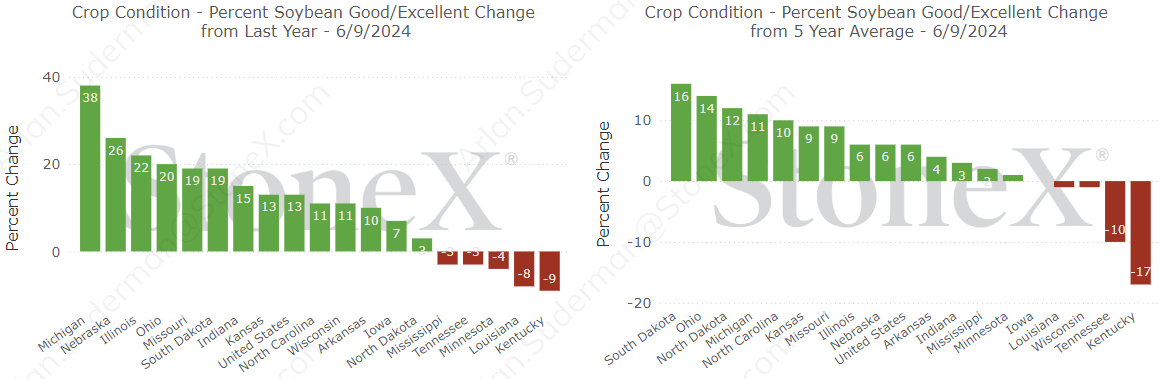
USDA released its first soybean condition scores of the growing season on Monday afternoon. This year's soybean crop rates 72% Good to Excellent as of June 9, which is one of the better initial ratings of the past five years, and among the top 10 initial scores of the past four decades. The graphic below breaks down the condition data by state versus this same time last year (left) and versus the five-year average (right) for this same week of the year. Note that the crop is doing quite well outside of some problems in Tennessee and Kentucky. There are also concerns for excessively wet areas of the northwestern belt, but the crop generally looks good outside of those problem areas, even in the northwest. As such, the focus is now on the USDA June 28 acreage and stocks reports, and on indications of the type of summer weather pattern that we will see set up in the Midwest over the next several weeks.