Today's featured video perspective: Markets React to New China Trade Deal
June 11 - Stocks firmed on today's inflation data, combined with word of a trade agreement with China, while Treasury yields slipped lower on hopes that the Fed will speak of future rate cuts a week from today when it meets. The VIX is trading at three-month lows near 16 at midday, while the dollar index is trading is trading near 98.6. Yields on 10-year Treasuries are trading near 4.44%, while yields on 2-year Treasuries are trading near 3.97%. Crude oil prices are more than 2% higher at fresh demand optimism, while the grain and oilseed markets are mixed in relatively quiet trading, after not being mentioned in the China trade agreement this morning.
The average trade guess for tomorrow's USDA WASDE crop report puts 2025-26 marketing year soybean ending stocks at 298 million bushels, up slightly from 295 million bushels in May. My current estimate for "final" - not USDA tomorrow - soybean ending stocks is 394. Why the big difference? It starts with the world balance sheet. The Brazilian and Argentine soybean harvest is largely complete. As such, those crops are pretty much known at this point, and the combined crop is large. Combine that with evidence that Chinese demand is leveling off as pork consumption softens and policy drives soymeal inclusion in rations lower toward 12%, and Chinese demand is no longer as robust as it once was. Assuming no big trade deal that requires China to buy U.S. soybeans, look for it to continue to favor cheaper supplies from South America over U.S. supplies. The net result is U.S. exports near 1.650 billion bushels in the 2025-26 marketing year, down from USDA's current estimate of 1.865 billion bushels. Yet, that is partially offset by a larger domestic crush estimate on signs that we'll see a stronger biofuel program in the next marketing year. The net result is ending stocks roughly 100 million bushels above USDA's estimates, assuming trend yields for the current growing season.
We continue to monitor weather conditions in China as its growing season moves forward. Roughly one-third of the North China Plain is short of moisture currently, favoring wheat harvest in the region, but stressing nearly 30% of China's corn and soybean acreage. It's a similar weather pattern to what we saw last year, when prolonged dry weather in June caused a reduction in planted acreage, but the crop losses in the area were more than offset by larger harvests elsewhere. Otherwise, weather in China's northeast is going well now for more than half of the country's corn and soybean area, with some showers in the forecast for dry areas. We're also monitoring dry areas of the Canadian Prairies, where some showers are expected this weekend into next week, before drying out once again beyond that. A drought emergency has been declared in Russia's Rostov region, but private production estimates for Russia continue to creep higher. The key to watch will be its spring wheat belt, where excessive wetness may reduce area planted. Russia's winter wheat harvest gains momentum in July, which will provide better data on the overall size of its crop.
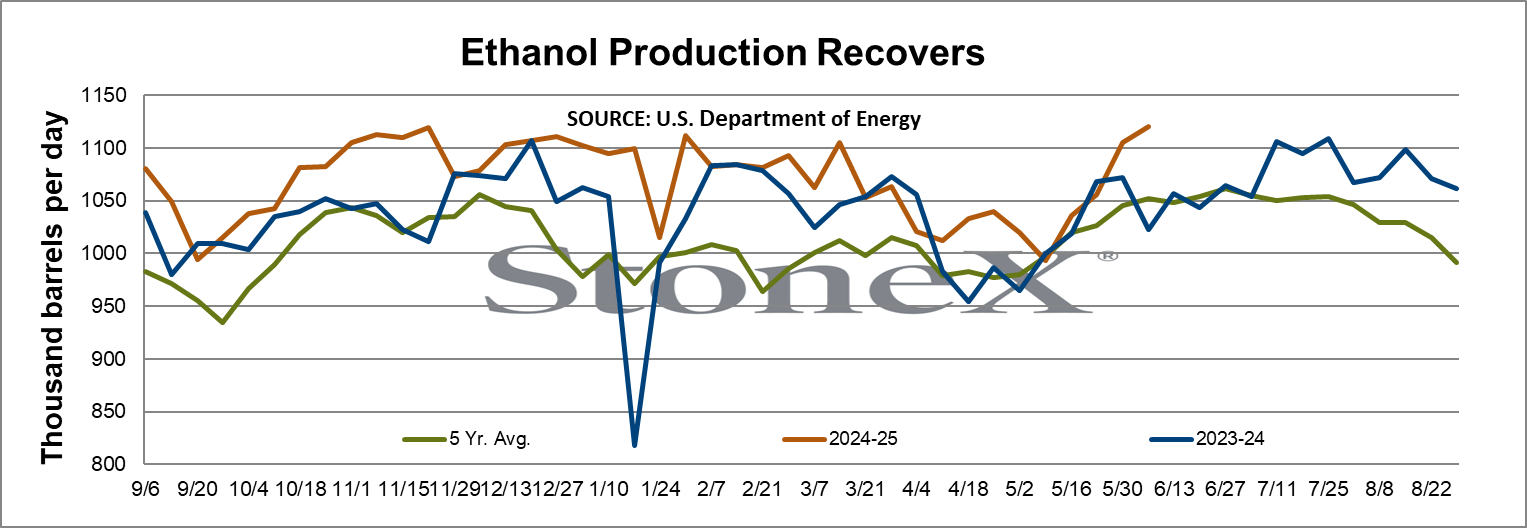
U.S. commercial crude oil stocks (excluding the Strategic Petroleum Reserve) fell by 3.6 million to 432.4 million barrels in the week ending June 6, putting them 8% below levels typically seen in early June. Gasoline stocks rose by 1.5 million barrels, leaving them still 2% below the five-year average for the week. Distillate stocks increased by 1.2 million barrels, but they are still roughly 17% below seasonal levels. Ethanol stocks fell to 23.7 million barrels in the week ending June 6, down from 24.4 million the previous week, but up from 23.2 million barrels in the same week last year. The production of ethanol hit a record high 1,120K barrels per day last week, up from 1,105K bpd the previous week, and up from 1,023K bpd in the same week last year. The production of ethanol utilized an estimated 108.6 million bushels of corn last week, up from 107.2 million the previous week, and up from 101.7 million bushels in the same week last year. Estimated marketing year to date corn use for ethanol production totals 4.170 billion bushels, exactly matching the pace that we saw at this point last year.