June 14 – Stocks are looking to end the week on a weaker note, with the major indexes all in the red at mid-day, though the Dow Jones continues to underperform its peers. The VIX is up on the day but remains low relative to historical levels, hovering around 13. The dollar is surging again after yesterday’s strength, pushing to a month-and-a-half high earlier in the session but falling back to trade near 105.65 at the time of writing. Treasuries are mixed, with 10-year yields slightly lower on the day, trading below 4.21%, while 2-year yields cling to small gains just above 4.69%. Crude oil is taking a breather after a strong week, with nearby WTI down slightly to trade near $78.30/barrel, while the ags are mixed with grain and oilseeds in the red but the cattle complex pushing higher.
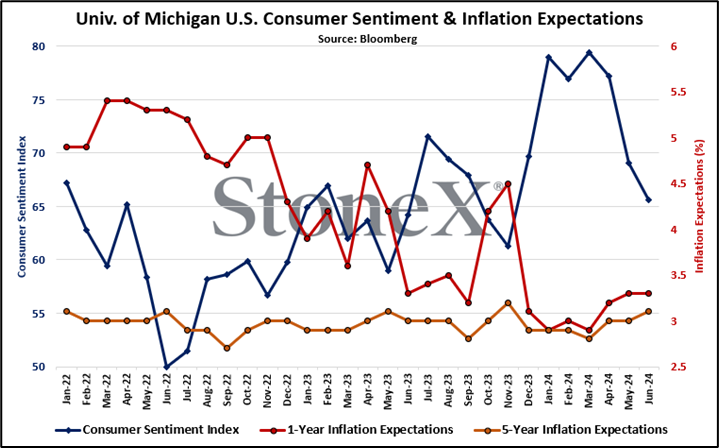
U.S. consumer sentiment fell unexpectedly for a third consecutive month in June, according to this morning’s release from the University of Michigan. The preliminary Consumer Sentiment Index came in at 65.6, down from last month’s 69.1 and sharply lower than expectations of a rebound to 72. The biggest drop in the headline reading was from a harsh dip in the Current Economic Conditions subindex which fell to 62.5, the lowest level seen since December 2022 and drastically lower than market expectations of an improvement to 71. The Consumer Expectations subindex which looks to the future fell less sharply, coming in at 67.6, though still missing market expectations of a climb to 70 and marking the worst reading since December 2023. One-year inflation expectations held steady from the month prior at 3.3%, though five-year inflation expectations ticked up another 0.1% to reach their highest level since November 2023 at 3.1%.
The softening consumer sentiment coupled with cooler inflation readings earlier this week should in theory both be interpreted as dovish for the Fed. However, statements out of the FOMC after their meeting this week were anything but dovish. Fed members have been very consistent in their cautiously hawkish sentiment, repeatedly doubling down on their need to avoid pivoting too early, even if that means causing some economic pain. If we do continue to see signs of a cooling U.S. economy, the Fed’s resolve could potentially be tested. We’ll hear from Chicago Fed President Goolsbee as well as Fed Board Governor Cook later today, though it would be a surprise to hear anything notably different from Wednesday’s formal statements. However, if the recent shift in data continues going forward, traders will likely be parsing Fed members’ comments closely for any cracks in that hawkish tone.
Geopolitical uncertainties continue to keep markets on edge, with weakness in European equity markets weighing globally. Uncertainty regarding the political situation in France, the Euro Zone’s second-largest economy, has dragged European stock indexes and the Euro lower in the wake of snap elections announced by French President Macron following his party’s surprising defeat last weekend. Additionally, Chinese state media yesterday announced the formal filing of an anti-dumping investigation into pork imports from the European Union. This follows the recent implementation of tariffs on Chinese electric vehicle imports to the E.U., similar to measures taken by the U.S. and part of the broader de-coupling of economies along geopolitical alliances. Because of China’s importance as an importer of commodities, trade tensions and the re-shaping of their trade flows have an outsized impact on commodity markets. The health of China’s economy is key as well, and the market has plenty to look forward to next week, with China set to report industrial production, retail sales, and fixed-asset investment next Monday, followed by word from the Chinese Central Bank later next week.