June 26 - Stocks posted solid gains at midday, as Wall Street hopes for a Federal Reserve rate cut slowly grow, aided by this morning's weekly jobless data that showed continuing claims creeping closer to the 2 million mark, suggesting some softening of the jobs market. Yet, the VIX is currently trading just above 16, and just above four-month lows, reflecting a broad calm on Wall Street, despite the ongoing tariff battle, with the dollar index at fresh three-year lows near 97.2. Yields on 10-year Treasuries are trading near 4.27%, while yields on 2-year Treasuries are trading near 3.74%. Crude oil prices are more than 1% higher at midday as the market shifts back to focusing on some emerging demand signals, while the grain and oilseed markets are mixed to weaker, with wheat prices leading the way lower on seasonal harvest pressure and a higher Russian production estimates, while corn prices periodically pop into positive territory on some bargain buying amid steady demand.
The pending home sales index was developed by the National Association of Realtors to provide a gage of interest in the purchase of existing homes. The index rose 1.8% in May, beating analyst estimates of a 0.5% rise, after collapsing 6.3% in April amid the reciprocal tariff announcements. This suggests a rebound in interest in signing contracts for homes as the markets started to calm down again in May after the volatility of April. The index is based on signed contracts for existing homes, so it is considered a lead indicator for what we should see in new home sales a month or two later. Uncertainty was at its highest in April, which scared a lot of people away from committing to a new home. That uncertainty eased in May, rose again in June with the 12-Day War in the Middle East, and it is calming considerably now in the wake of that war. The next round of uncertainty could come around the end of the 90-day reciprocal tariff pause on July 8, unless we see significant trade deal announced ahead of that date and / or we see a much longer extension to the pause, such as I've discussed earlier this week as a possibility. The housing market is one of the sectors of the economy that has been in a recession, even though the overall economy has not been in a recession.
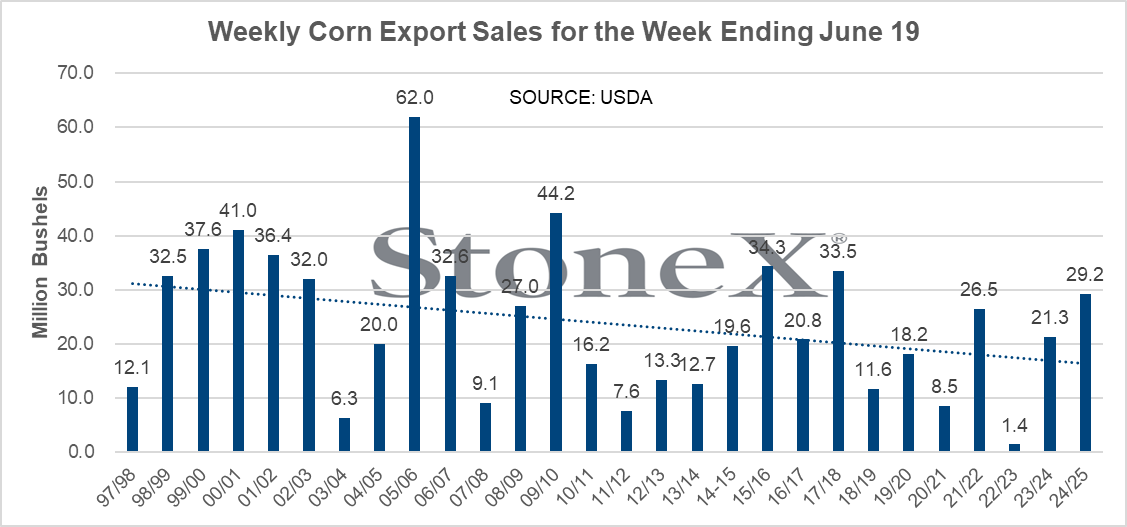
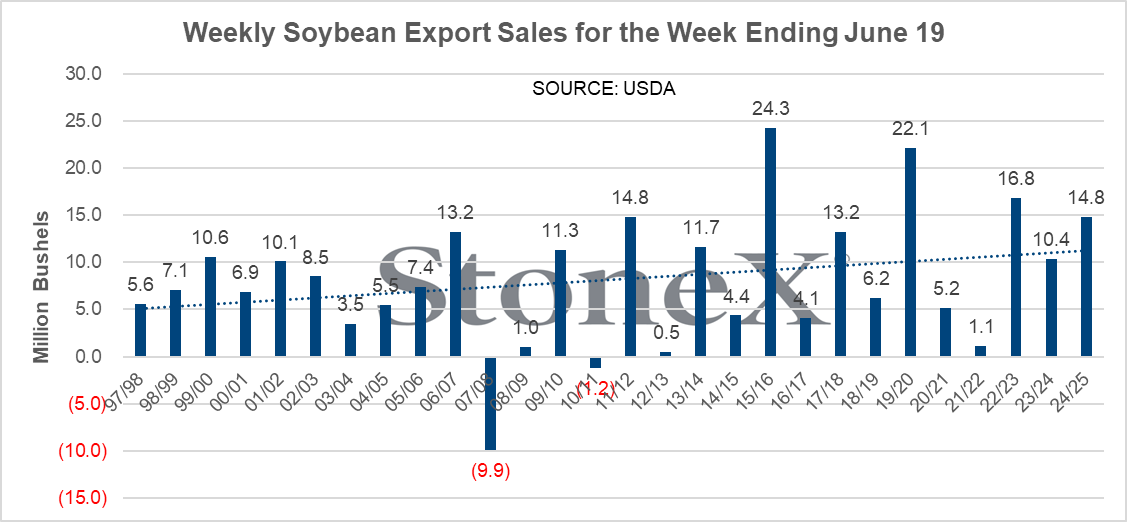
Exporters sold 29.2 million bushels of current year and 12 million bushels of new-crop corn in the week ending June 19, along with 14.8 million old- and 5.7 million new-crop soybean bushels, 9.4 million bushels of wheat and 1.2 million bushels of grain sorghum. The grain sorghum sales were significant, because they were highlighted by a note that China had purchased 2.8 million bushels that didn't impact the weekly total because it was virtually all a switch from previous sales to "unknown destinations." China hasn't purchased any significant amount of U.S. grain sorghum for months. So is this a one-off purchase, or is it a sign of possible thawing of relations? I'm going to remain skeptical until I see more evidence of things thawing with China, but it is certainly worth monitoring. Marketing year to date corn export sales to all destinations total 2.660 billion bushels, which exceeds USDA's target for the year that doesn't end until August 31st by 10 million bushels. That's 559 million bushels or 27% above last year's pace at this point, and it exceeds the seasonal pace needed to hit USDA's target by 160 million bushels, with the gap still growing. Marketing year to date soybean export sales to all destinations total 1.818 billion bushels, which is 183 million bushels or 11% above the previous year's pace at this point, but it falls short of the seasonal pace needed to hit USDA's target by 8 million bushels.