June 3 - The major stock indices pushed into positive territory this morning as investors digested the first of this week's jobs data that reflected a bit of resilience in the economy in the midst of the April tariff turmoil. The VIX slipped below 18, while the dollar index firms to trade near 99.2. Yields on 10-year Treasuries are trading near 4.47%, while yields on 2-year Treasuries are trading near 3.96%. Crude oil prices are trading nearly 2% higher as economic anxiety eases a bit, while the grain and oilseed markets were mostly higher as well, although improving crop ratings weighed on the hard wheat markets.
The long range forecast models have consistently been calling for high pressure to build over the Midwest this summer, yielding below normal rainfall and above normal temperatures for the Corn Belt, especially over central and western areas of the Midwest. But those long-range forecasts have thus far not carried forward into the near term weather pattern. We've seen a relatively stagnant wind pattern over the United States this spring, which can lead to high pressure development. But instead it led to a series of cut-off lows that slowly drifted across the country, providing heavy rains to some areas of the crop belt - including some that had large moisture deficits coming into the spring. The long range models continue to show that high pressure over the Midwest. The question is, will that move forward to the current? Some models started showing that high pressure over the Midwest for mid-June, but so far there is no indication that it will lock in place there. We will likely see that high set up in our nation's mid-section this summer, but it will make a big difference whether it sets up over Iowa, or over Wyoming. That can be the difference between a short crop and a bumper crop.
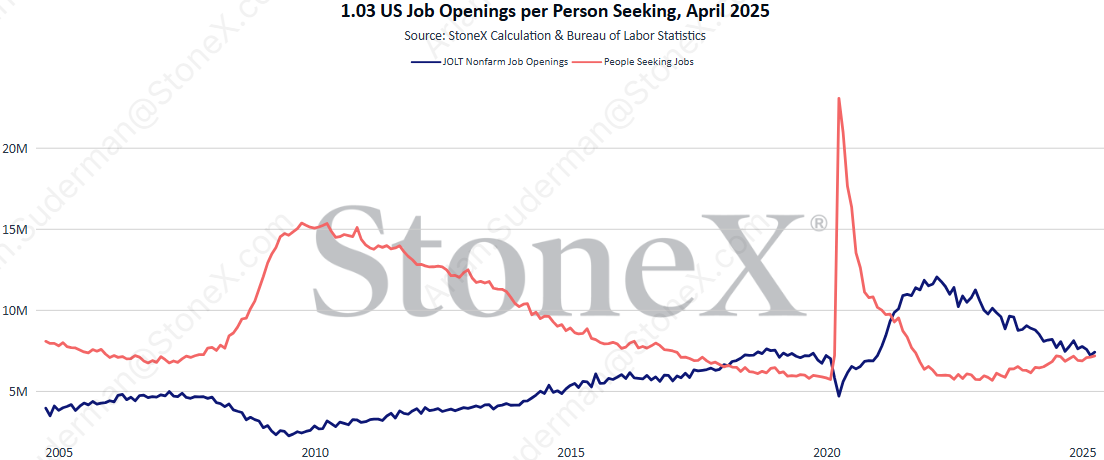
There were 7.391 million job openings posted on April 30, which is nearly 200K more than at the end of March, and it went against analyst expectations that we would see a 100K decline in job openings in the heat of the April trade war uncertainty. Nobody is saying that is a great number, but it is highly significant that job openings, which are reported at the end of the month, went up during a month of tremendous uncertainty and turmoil in our economy. Some would argue that job openings increased because employers were reluctant to fill them amid the uncertainty, and there may be some truth to that. But it also speaks volumes that employers did not close those job openings, but kept them open.
Again, it should be noted that this is one data point, and that other data out there suggests that job demand is still softening. Nonetheless, there are some interesting observations in the data. Josh Cannington, StoneX VP for Interest Rate Derivatives, pointed out to me that job openings for lower paying Leisure and Hospitality jobs are the lowest since 2017 - excluding the pandemic. That's significant, because many of the jobs being created over the past couple of years have been lower paying jobs. However, the April JOLTS report released today showed that we continued to see strength for job openings in education and health services, as well as a decent pick up in professional and business services - higher paying jobs. That's a positive sign for the economy. It's not that this is a robust report showing a strong economy, but rather that this report showed some unexpected stability in a month when uncertainty for employers was at its highest level since the pandemic. The graphic below shows that the number of people seeking jobs continues to slowly creep higher, and the trend of job openings continues to decline, although it shows some signs of stability in a month known for its turmoil. The number of job openings is now roughly in balance with the number of people looking for a job. As such, the quit rate has slowed as well, reflecting relative stability in the job market. The Department of Labor will release its monthly jobs report on Friday, providing a better picture of the employment sector.