June 6 - The World Bank boosted its 2023 global growth forecast today, while trimming back its outlook for 2024. Forecasters were impressed with the resiliency of world economies this year, outside of China, but worried about higher interest rates and China's ongoing problems may limit growth opportunities for next year. Stocks were again mixed at midday as traders battle the current malaise ahead of next week's Federal Reserve meeting. The VIX fell to a fresh year-and-a-half low near 14 this morning, while the dollar is trading near 104.2. Yields on 10-year Treasuries are trading near 3.70%, while yields on 2-year Treasuries are trading near 4.52%. Crude oil prices are modestly lower at midday, while the grain and oilseed sector is mixed. The latter failed to hold overnight gains for the second consecutive session, with U.S. traders selling the overnight strength. Corn and soybeans found modest strength from official confirmation that the White House dropped its proposed electric vehicle volumes from biofuel blending rules, providing better support for the crop-based biofuels, although this was largely anticipated already. Fund short covering continues in the hog market ahead of a scheduled webinar this afternoon in which California is expected to inform the hog industry that it will give some time grace in adjusting to the Prop 12 changes next month.
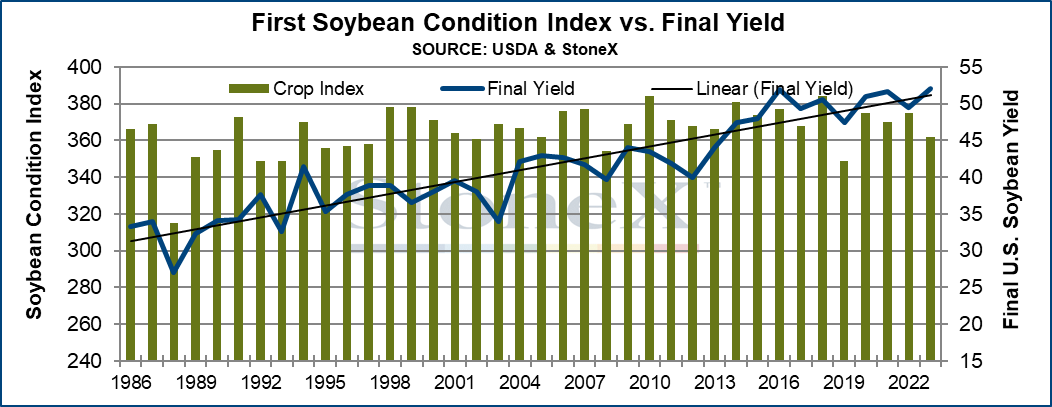
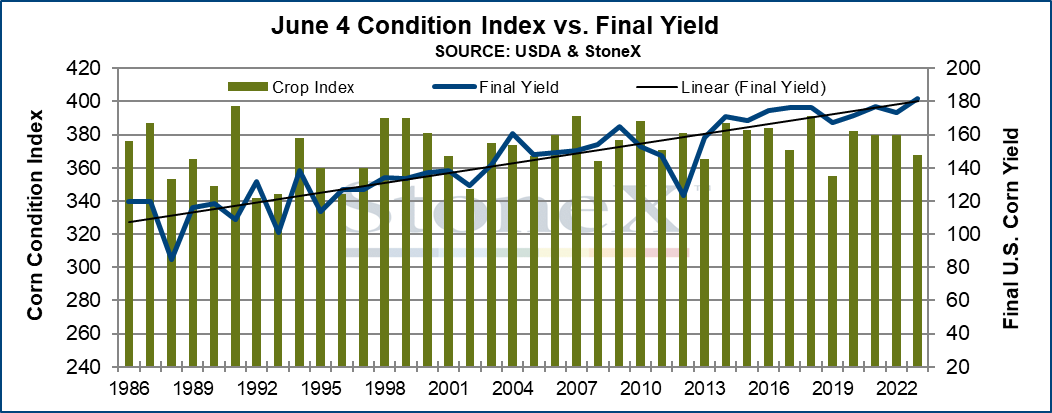
Both corn and soybean crop ratings came in below market expectations in Monday afternoon's USDA weekly crop progress and condition report. USDA gave us our first look at soybean condition ratings this week, with the crop's condition index score coming in at 362 (500=perfect crop), down from the 10-year average for the week of 377, and down from last year's initial rating of 375. The graphic below shows condition index scores for soybeans to start the growing season going back to the 1986 crop against each crop's final yield. The crop's first rating this year is the second lowest of the past 15 years to start the growing season, but the correlation between that and final yield is rather poor, which is similar for corn as well. Obviously, one would feel more confident with a good start to the season than a poorer one, but it doesn't mean that we can't still achieve a trend or higher yield, as illustrated in the graphic.
Today's model runs continue to bring rain forward in the forecast, as expected. We should see rains reach across the Midwest as we get into the weekend into early next week. These will not be drought-busting rains in most cases, but any rain will help at this point. The upcoming rains are part of the pivot in the weather pattern that we've been anticipating to come in the second week of June for nearly the past month. I will say though that I am a bit concerned about how that pivot is setting up. The overall pattern to bringing milder wetter conditions to the Midwest appears to be setting up further south than first expected over the last half of this month, which could leave the northwestern Ag Belt warmer and drier than desired for good yields. Minnesota and the Dakotas currently look most at risk to close out the week #3 & #4 forecast, although the risks also stretch east into Michigan. This will remain an area of concern to watch. I'm not buying into the 2012 comparisons that are frequent on Twitter - most usually by non-weather people. However, the odds of an above-trend national corn yield are declining, and risks for a below trend yield are slowly rising. Note that I'm well aware of specific locations that are hurting much worse, but the market will be focused on the overall crop. Soybeans still have much more time for favorable conditions to develop. As for corn, my primary concern remains on the demand side for the 2023-24 marketing year, which means that we can afford to see some production lost and still see surplus supplies.