March 27 - Stocks traded quietly in positive territory for much of the morning today, although we've seen them come well off their session highs, with the tech sector slipping into negative territory at times as traders brace for Friday's PCE inflation data. The PCE data is something that the Fed puts a lot of importance on in developing monetary policy. Unfortunately, it's being released on a holiday, when the market will not have the opportunity to respond to potential surprises until returning from the Easter break on Monday. Even so, the VIX continues to trade near 13 at midday, with the dollar index trading near 104.4. Yields on 10-year Treasuries are trading near 4.20%, while yields on 2-year Treasuries are trading near 4.56%. Crude oil prices remain modestly lower at midday, while the grain and oilseed markets are mixed to weaker. Corn and soybean prices continue to show weakness following yesterday's bearish chart action on fears that the bird flu discovered in southwestern Plains dairies may negatively impact feed demand, while wheat prices found some support on the recent price break.
The MV Dali continues to be tangled with the wreckage of the bridge that it downed very early yesterday morning, closing the Port of Baltimore. The Dali has substantial damage to the forward part of the ship. It has a containment boom surrounding it to prevent environmental damage from oil spill, etc. The ship was carrying a reported 4,679 large containers for hauling freight, with some of those containers apparently falling into the water on impact. The ship cannot be moved until the bridge that is hanging over it is removed, and little progress is expected on that while the search continues for the six missing victims. There are a few port facilities outside of the bridge, but the vast majority have been cut off by the incident. Smaller boats should soon be able to move under the remaining bridge, but the main channel remains blocked, and it will remain that way for some time until the channel can be cleared. Much of the cargo moving in and out of the port can be rerouted, adding delays and costs, but still moving. The primary risk for agriculture is the poor timing of disrupted fertilizer movement into the eastern fringe of the Corn Belt right ahead of the spring planting season. This may result in increased costs for freight and/or substitution of more costly fertilizers, possibly impacting some shifts in cropping decisions. That said, it will not impact tomorrow's numbers from USDA, and it is not expected to be a significant market impacting event.
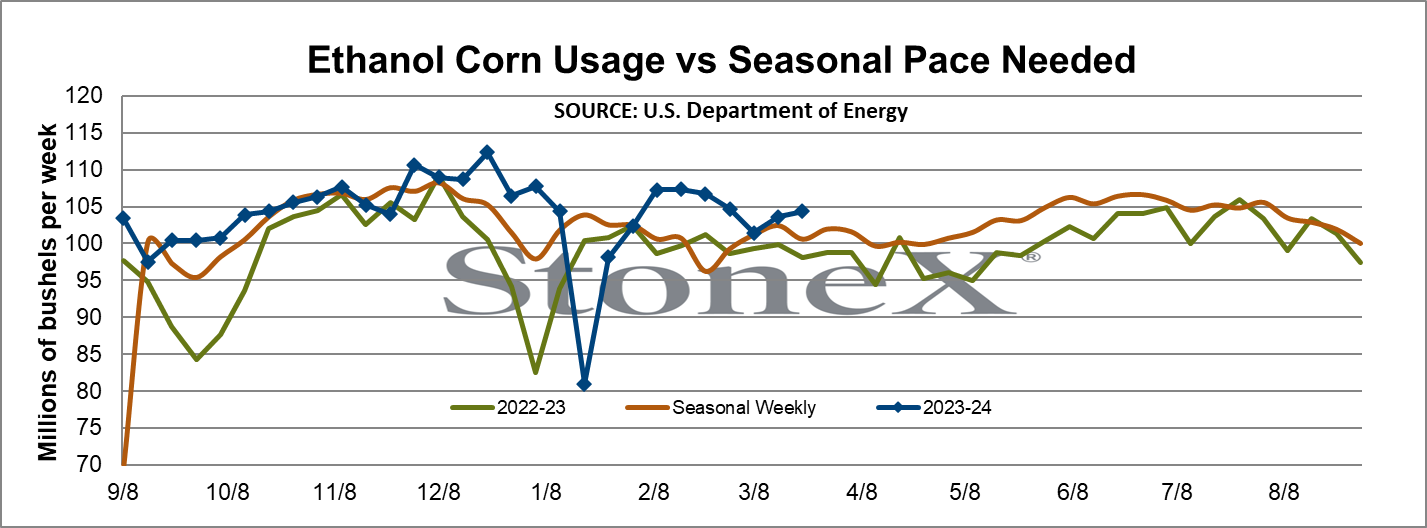
U.S. commercial crude oil stocks (excluding the Strategic Petroleum Reserve) increased by 3.2 million to 448.2 million barrels in the week ending March 22, putting them roughly 2% below levels typically seen this time of year. Gasoline stocks rose by 1.3 million barrels, putting them 1% below the five-year average for the week. Distillate stocks dropped by 1.2 million barrels during the week, setting them at 6% below levels typically seen at this time of year. Ethanol stocks firmed to one-year highs near 26.1 million barrels, up from 26.0 million the previous week, and up from 25.5 million barrels in the same week last year. Ethanol production rose to 1,054K barrels per day in the week ending March 22, up from 1,046K bpd the previous week, and up from 1,003K bpd the previous year. Last week's ethanol production utilized an estimated 104.4 million bushels of corn, up from 103.6 million the previous week, and up from 98.7 million bushels the previous year. That brings total estimated marketing year to date corn use for ethanol to 3.030 billion bushels, up 143 million bushels or 4.9% from the previous year's pace, and the total exceeds the seasonal pace needed to hit USDA's target by 95 million bushels. Cheap prices create demand, and we're seeing that with ethanol, feed, and export demand.