March 7 – Stocks have lost steam through the morning to put the major indexes back in the red at mid-day, looking to close an ugly week on Wall Street on an ugly note. Uncertainty continues to play a major role in setting the mood in the market, with the VIX remaining relatively elevated near the 25 level. The dollar continues its freefall into the end of the week, hitting another fresh 4-month low at 103.43 earlier in the session before rebounding a bit to hover around the 103.6 level at the time of writing, helping provide some amount of support to the commodity sector as U.S. exports look more affordable to international buyers. Treasuries are down slightly on the day, with 10-year yields at 4.255% and 2-year yields at 3.933%.
On the contrary, crude oil is finding its footing into the end of the week, with nearby WTI rebounding from recent losses to push back into the mid-$67’s at the time of writing. Today’s rally is largely headline driven, with Russian Deputy Prime Minister Alexander Novak stating today that OPEC+ could reverse their decision to start ramping up oil production from April onward “if there is an imbalance in the market.” Officials in neighboring Kazakhstan today also pledged production cuts from now through May after frequently exceeding their quotas. Finally, a reiteration from new U.S. Treasury Secretary Scott Bessent on the goal of reducing Iranian crude oil exports “to a trickle” raises some level of supply concerns given their role in the global market. Elsewhere in the commodity sector, the ags are largely mixed at mid-day, with the livestock complex showing some strength to end the week while the wheat complex sells off.
While this morning’s headline Non-Farm Payrolls numbers were relatively mundane, coming in slightly below estimates but close enough to avoid any major discontent, there were some interesting takeaways elsewhere in the data release. To start, the U.S. labor force participation rate unexpectedly fell 0.2% in February down to 62.4%, marking the lowest level seen since January 2023. After crashing during the pandemic in 2020, labor participation in the U.S. has been slowly working its way back toward pre-pandemic levels, hitting highs of 62.8% in late 2023, but has been hovering below these levels through 2024 and now into early 2025.
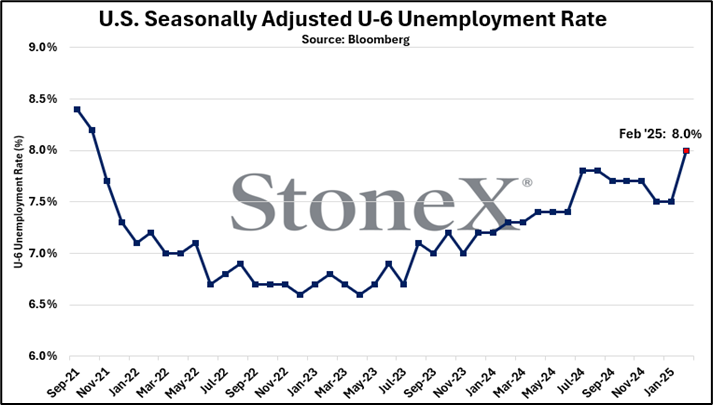
Additionally, while the headline unemployment rate rose by a slight 0.1% to sit at 4.1%, the U-6 unemployment rate, which includes the typical unemployment number plus those who are marginally attached to the labor force as well as those who are employed part-time (less than 35 hours per week) for economic reasons but want to work full-time, rose by a sharp 0.5% month-on-month to reach a seasonally adjusted 8.0% in February. This was the sharpest month-on-month rise seen since the pandemic in early 2020 and marks the highest U-6 unemployment rate seen since October 2021. Coupled with yesterday's spike in Challenger job cuts to their highest level since mid-2020, it appears that we’re beginning to see the impact of the recent rapid policy shifts reflected in labor data. Direct cuts of government employees are only a portion of this effect. The growing uncertainty regarding U.S. trade and immigration policy has led the private sector to become more cautious in their hiring decisions, while canceled government projects eliminate, or slow down, construction in a variety of sectors. While we did see partial reprieve from tariffs on some products from Canada and Mexico with yesterday’s one-month delay, that effectively just kicks the can down the road, allowing the uncertainty to simmer.
It will be interesting to hear the tone of today’s comments from a variety of Fed members due to speak today, most notably Fed Chair Jerome Powell who is set to deliver remarks at 11:30 AM Central. February labor data will not capture the full effect of recent policy shifts, adding further intrigue to figures in the months ahead. The FOMC will get February CPI and PPI readings mid-next week (Wednesday and Thursday, respectively) as well as preliminary March consumer sentiment on Friday, giving them more data to digest ahead of their next meeting set for March 18-19. The Fed has moved relatively slowly and cautiously during the path downward in their ongoing battle with inflation over the last few years, but it will be interesting to see if that approach is continued with the rapid pace of change being seen across the broader markets.