May 15 - Sharply lower Treasury yields fueled today's stock rally as traders bet on rate cuts from the Federal Reserve following today's inflation, retail sales and housing data. Ironically, the drop in interest rates combined with higher stocks are the very thing in the past that has energized housing demand, fueling inflation due to the housing shortage that we have in this country. Nonetheless, the VIX is trading back below 13 at midday, and just above lows for the calendar year, while the dollar index trades at five-week lows near 104.4. Yields on 10-year Treasuries are trading at fresh five-week lows as well near 4.35%, while yields on 2-year Treasuries are trading near 4.74%. Note that the yield curve inversion is widening once again, arguing for a recession, which could take some of the steam out of the recent strength in the broader commodity sector. Crude oil prices are still modestly higher at midday, while the grain and oilseed markets are mixed to weaker, unable to sustain overnight strength. The primary exception to the selloff in the grains has been soybeans and soyoil, which are responding to surprises in the NOPA crush report. Cash cattle are looking at expectations of steady cash trade this week, with the board rally stalling near recent chart highs.
The National Oilseed Processors Association reports that its members crushed 166.034 million bushels of soybeans in April, down 30 million bushels from March, and nearly 20 million bushels below trade expectations. Disappointing margins for Renewable Diesel production, combined with the flood of imported used cooking oil from China displacing soyoil use as a feedstock in biofuel production is backing up supplies. Crushers slowed activity in April for seasonal maintenance after running hard this winter, and then stayed offline a little longer than normal trying to manage the higher supplies of soyoil in inventory. Marketing year to date NOPA crush now exceeds the seasonal pace needed to hit USDA's current target by 15 million bushels, but that's down from 25 million bushels the previous month. Soyoil prices rallied on the data release, after having held above chart support, with meal also initially seeing support from the slower crush pace.
The National Association of Home Builders / Wells Fargo housing market index fell sharply to 45 in May, down from 51 the previous month, and below analyst expectations that we would remain at 51. Today's reading is the lowest since January, while also being below the 50 posted a year ago. The single family present sales index fell to 51, down from 57 in April, and down from 56 a year ago. The single family six-month outlook index also dropped to 51, down from 60 in April, and down from 56 a year ago. The traffic of prospective buyers index fell to 30 in May, down from 34 the previous month, and down from 33 a year ago. The strongest headline index was in the Northeast at 58, while the weakest was in the West at 36.
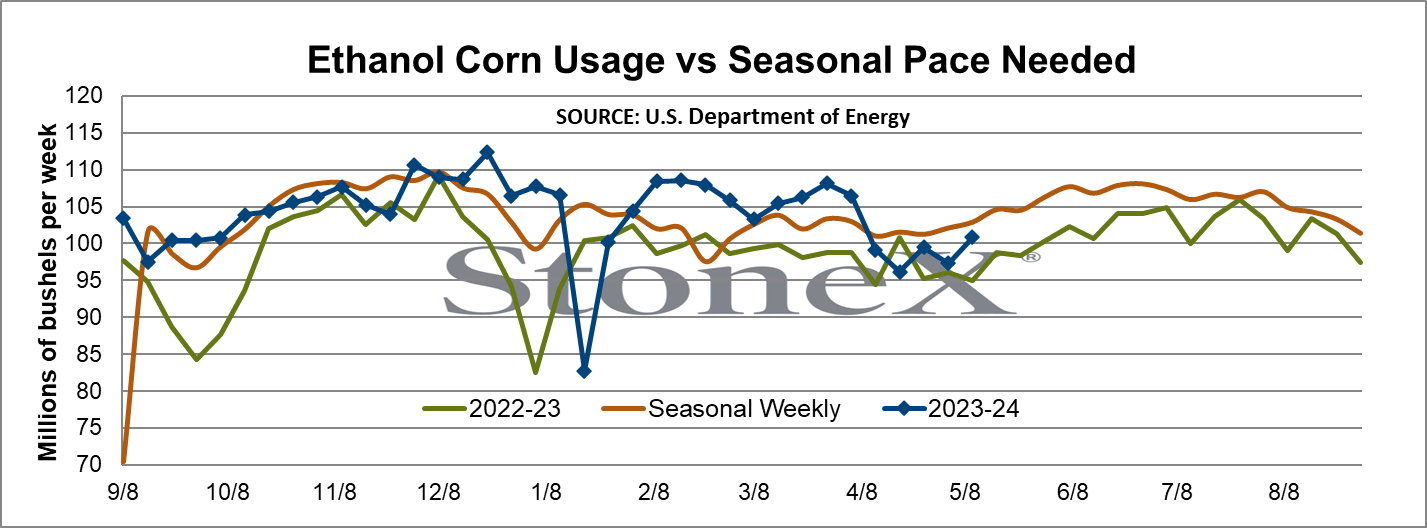
U.S. commercial crude oil stocks (excluding the Strategic Petroleum Reserve) fell by 2.5 million to 457 million barrels in the week ending May 10, leaving them 4% below the five-year average for this week of the year. Gasoline stocks dropped by 0.2 million barrels, leaving them 1% below levels typically seen in the same week. Distillate stocks were just slightly lower on the week, putting them 7% below seasonal levels. Ethanol stocks rose to 24.5 million barrels, up from 24.2 million the previous week, and up from 23.2 million barrels in the same week last year. Ethanol production rose to 1,000K barrels per day during the week, up from 965K bpd the previous week, and up from 987K bpd in the same week last year. The production of ethanol utilized an estimated 100.8 million bushels of corn last week, as shown below, up from 97.3 million the previous week, and up from 98.7 million bushels the previous year. Estimated marketing year to date corn use for fuel ethanol totals 3.756 billion bushels, up 190 million bushels or 5.3% from the previous year's pace, and 65 million bushels above the seasonal pace needed to hit USDA's target.