May 15 - Stocks rallied from overnight weakness after inflation came in cooler at the wholesale level than expected this morning, and Treasury yields slid. The VIX is trading near 18 at midday, while the dollar index is trading near 100.9. Yields on 10-year Treasuries are trading near 4.45%, while yields on 2-year Treasuries are trading near 3.97%. Crude oil prices are down by more than 2% on reports that we are close to reaching a new nuclear deal with Iran, with assumptions that sanctions on Iranian crude oil would then ease. The grain and oilseed sector is mixed, with soyoil and soybeans sharply lower, wheat prices bouncing on bottom-picking buying, and corn prices mixed.
Much of this week's focus is on the weekend agreement to pause tariffs on China for 90 days. The baseline 10% reciprocal tariff remains in place, as does the 20% fentanyl tariff, but we are no longer at 145% for the 90-day window. China therefore lowered its retaliatory tariff to 10%. U.S. retailers can make this work, but they don't know what will happen come August when the 90-day window closes. As such, they're trying to stock up inventory as much as possible while the pause is in place. We've seen a 300% increase in container orders this week for shipment of goods from China to the United States. Container freight has also soared by 2 - 3 times its previous levels. That will make goods cost more, but retailers will absorb some of the cost as they are able to do so to soften the blow and to sustain consumer demand. The 90-day pause also gives a shot to the Chinese economy, which has been suffering.
China's April bank loan data painted a bleak picture of the Chinese economy. Newly increased bank loans shrank by nearly 62% on the year in April, prior to the 90-day tariff pause, as business sentiment sank. Bank loans in the first four months of the year totaled 10.06 trillion yuan ($1.39 trillion), which was down 1.28% from the previous year. Medium to long-term loans to enterprises fell by 40% year-on-year in April alone, while the four-month total was down 11.8% on the year. The household sector added loans during the period totaling 518 billion yuan, which was down 36.3% on the year. Meanwhile, the government issued bonds worth 973 billion yuan in April to stimulate the economy, with the four-month total at 4.85 trillion yuan ($677 billion), up 285% from the previous year's pace.
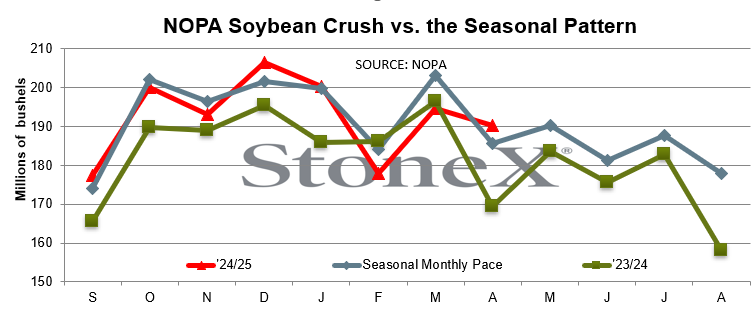
The National Oilseed Processors Association reports that its members crushed 190.2 million bushels of soybeans in April, down from 194.6 million bushels in March, but up from 169.4 million bushels the previous year, and above the average trade estimate of 184.6 million bushels. NOPA crush typically accounts for roughly 94% of all crush activity. The crush industry has significantly increased capacity on expectations of robust demand for soyoil as a feedstock for the production of biomass diesel, but that is essentially on hold currently as the industry waits for clarity from the Trump Administration on its revised guidelines. We know that the EPA submitted its recommendations to the White House Office of Management and Budget yesterday. It's rumored that the biomass diesel production mandate in that recommendation was at the high end of our anticipated range of 4.4 to 4.6 billion gallons, which is a dramatic increase from the current 3.35 billion gallons. Yet, managed money had been hoping for something closer to 5.25 billion gallons. Managed money, which had built up big long ownership in the soyoil market in anticipation of an "imminent" announcement was also disappointed by EPA Secretary Zeldin's testimony to Congress yesterday that the agency would be working on its rulemaking over the next couple of months, raising fears that we'll be left without sufficient certainty for a while longer. That's what precipitated today's daily limit lower for soyoil prices.