May 21 - Stocks are mixed at midday, with the strength of the market currently being in the tech sector. There's a lot of headlines to digest currently, focused on earnings reports, tariffs and movement of the president's tax bill through the House of Representatives. But the presence of hard data is very light this week, leaving stocks drifting sideways just below recent two-month highs. The VIX is trading near 18 at this hour, while the dollar index is trading near 99.5. Yields on 10-year Treasuries are trading near 4.54%, while yields on 2-year Treasuries are trading near 4.00%. Crude oil prices are trading below $62 at this hour, after probing above $64 overnight. The grain and oilseed complex continues to trade mostly higher today, keeping this week's trend in place of speculative short covering and end user buying on ideas that supply risks may be increasing as prices sit at relatively low levels. The soybean complex leads the way higher today, while wheat continues its upward momentum as well. Corn prices are reluctant followers, although some traders are focused on the seasonality of weather markets that often come in June.
The soybean complex maintained support today as traders anticipate the possibility that we could soon hear from the Trump Administration what its guidelines will be for the Renewable Volumetric Obligations, or RVOs. They are most interested in the biomass diesel production mandates. The Environmental Protection Agency sent its recommendations to the White Houses Office of Management and Budget last week. The OMB scheduled its first meeting on the topic for tomorrow, with a couple of more follow-up meetings scheduled after that as well. It took 10 meetings over a two week plus time period back in 2022 to finish the guidelines, although a quicker result is possible this time around.
The industry is hoping for an RVO for biomass diesel of 5.25 billion gallons. Rumors floated through the industry last week that the EPA had recommended 4.65 billion gallons to the OMB, but some in the industry now believe those rumors are unfounded, and that their hopes for something above 5 billion remain in play. Let's keep in mind that 4.65 billion gallons would still be a substantial jump from the current 3.35 billion gallons. Regardless, the size of the impact must also be looked at from the perspective of the quantity of Small Refinery Exemptions that will be granted. A high number with lots of exemptions may not be as good as a lower number with few exemptions. The focus will then shift to the 45Z funding guidance that is part of President Trump's "Big Beautiful Bill" trying to move through Congress currently. Most other "green" spending components have been cut in this bill. Will funding for the Renewable Fuels Standard survive the negotiations? For now, optimism remains in place, keeping a level of support beneath this market. It was widely believed that the RVOs would be announced before Memorial Day. We're running out of time for that to happen, but there is a sense that that they will be announced very soon.
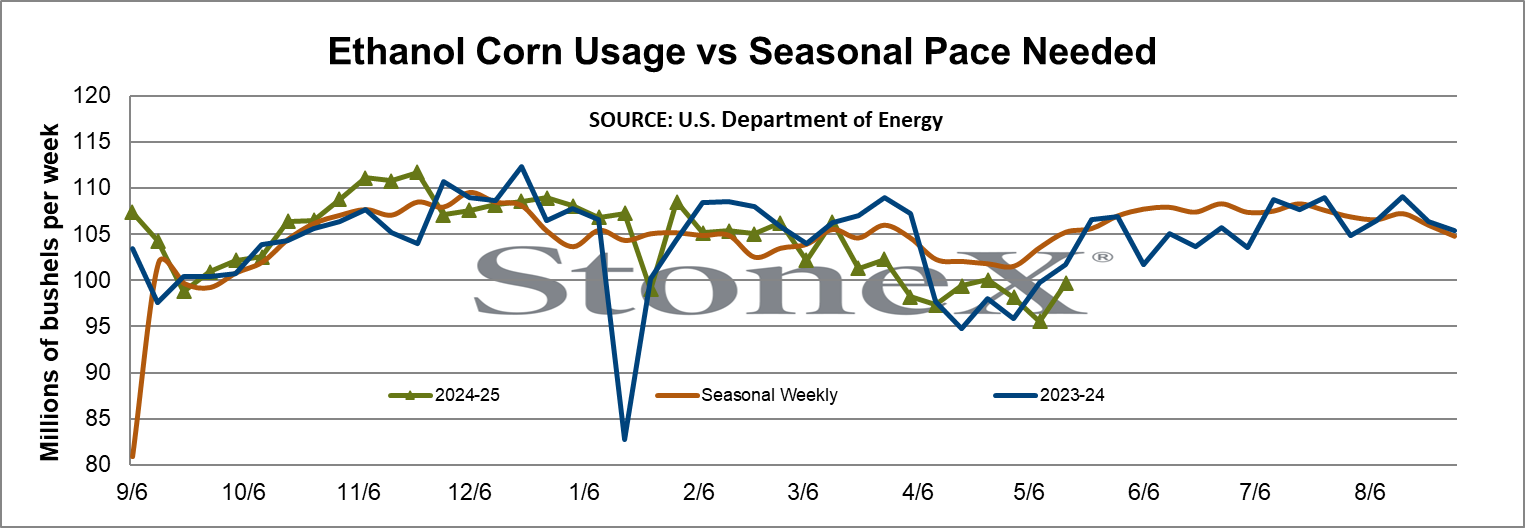
U.S. commercial crude oil stocks (excluding the Strategic Petroleum Reserve) rose by 1.3 million to 443.2 million bushels in the week ending May 16. That leaves them roughly 6% below the five-year average for mid-May. Gasoline stocks increased by 0.8 million barrels during the week, putting them about 2% below seasonal levels for mid-May. Distillate stocks rose by 0.6 million barrels, but they remain very tight at 16% below levels typically seen in mid-May. Ethanol stocks dropped to 24.9 million barrels in the week ending May 16, down from 25.4 million barrels the previous week, but up from 24.2 million barrels in the same week last year. Ethanol production recovered to 1,036K barrels per day last week, up from 993K bpd the previous week, and up from 1,019K bpd in the same week last year. The production of ethanol utilized an estimated 99.7 million bushels of corn last week, up from 95.5 million bushels the previous week, but down from 101.7 million bushels the previous year. Estimated marketing year to date corn use for ethanol production totals 3.848 billion bushels, down 6 million bushels from the previous year's pace, as the recent slowdown in production leaves us at risk of falling short of USDA's target for the year.