May 28 – It’s been a quiet start to the day on Wall Street, with the major indexes all slightly in the red at mid-day after big gains to start the holiday-shortened week yesterday. With the quiet price action, the VIX is muted as well, hovering around the 19.1 level. The dollar is attempting to add to yesterday's gains, pushing slightly higher to trade around the 99.7 level. Treasuries are in the green as well, with 10-year yields trading at 4.48% and 2-year yields trying to push back to the 4% level as they hover near 3.98%. Crude oil is also up slightly at mid-day as it remains in its choppy, range-bound pattern of recent, with nearby WTI up ~1% to trade at $61.60/barrel – as a note, we won’t get our typical weekly DOE report until tomorrow due to the holiday. The ags are largely mixed, with the wheat complex attempting to cling to early gains following the worse than expected U.S. wheat conditions while corn and soybeans push lower.
The minutes of the FOMC’s May meeting will be released this afternoon (1:00 PM Central), giving traders fresh insight into how Fed members are grappling with this environment of increased uncertainty. Fed Chair Jerome Powell, and other Fed members, have all continued to express the need to maintain their data-driven, wait-and-see approach, so much of the comments in the FOMC minutes should reflect this sentiment. Given the rapid pace of headlines and policy shifts seen in recent months, however, it also makes the May minutes a bit staler than they would normally be in this amount of time. It does appear that the market is finally believing the Fed, though, as markets are now pricing in only two 25-basis point rate cuts by the end of 2025, with the first cut now shifted back to September. The U.S. economy has continued to prove more resilient than expected, and progress in terms of the Fed’s dual mandate remains generally on the right track, with unemployment still at only 4.2% and inflation slowly continuing its path downward through April. That’s not to say that things won’t change as the impact of increased tariffs and other policy measures make their way through the economy, but we’re at least starting from a better position than expected.
The Richmond Fed’s Manufacturing Index improved in May to a -9 reading, up from -13 seen in April and matching analyst estimates. Obviously, the contractionary reading is ugly on the surface, but it’s worth pointing out that this index has only seen one month of expansion (February 2025) since October 2023, meaning today’s improvement can be taken as somewhat of a silver lining. Perhaps more surprising, however, was the sharp drop on the services side. The Richmond Fed’s Services Revenue Index tanked to -11 in May, down from -7 in April and marking the worst reading seen since August 2024. Tying back into the Fed’s dual mandate mentioned above, the current employment subindex fell to 0 in May, down from an expansionary 8 seen in April, though the forward-looking employment subindex did show an improvement, rising from 1 in April to 11 in May. On the inflationary front, the prices paid and received subindexes were both relatively unchanged from the month prior, though the wages subindex rose to an expansionary reading of 20 in May, with employers largely anticipating further wage hikes in the next six months.
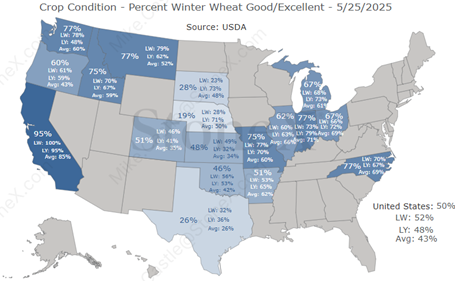
U.S. wheat conditions were worse than expected for both the winter and spring crops on yesterday’s holiday-delayed Crop Progress report from USDA, sending the wheat complex higher in the overnights but running out of steam at mid-day. Winter wheat conditions fell 2% week-on-week to 50% good/excellent, moving in the opposite direction of market expectations of a 1% increase, though remaining above last year’s 48% at this time as well as the previous 5-year average of 43%. The biggest week-on-week declines were seen in Oklahoma (-10%), Nebraska (-9%), and Texas (-6%). Nebraska is overall in the worst shape, with their 19% good/excellent rating and condition index of 240 marking their lowest levels at this time since 2013. Although the Southern Plains have, in general, seen a drastic improvement in moisture conditions this spring, much of that moisture has failed to make its way north as Nebraska has largely continued to miss out, allowing spring planting to advance rapidly but taking its toll on the winter wheat crop. Winter wheat harvest has kicked off in portions of Texas, with yields largely in line with expectations, but recent rains and forecasts calling for more to come in the near-term looks to keep a lid on that progress for now. Forecasts had been calling for a break in the next two weeks but are now shifting a bit wetter for the plains. Once things dry out, we could be seeing wheat harvest underway at once from Texas all the way into Kansas, which could cause its own complications, but if things remain wet, we could also run into quality issues and even potential yield losses.
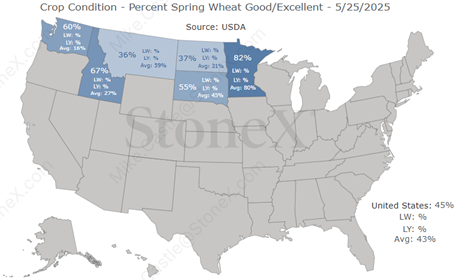
Initial spring wheat ratings of 45% good/excellent are the worst national ratings to start the growing season since 2021, marking a sharp decline from last year’s initial 74% good/excellent ratings. The issues are largely centered around Montana (36% G/E) and North Dakota (37% G/E) due largely to persistent hot and dry conditions there. The high temperatures and below average precipitation look to stick around through the remainder of the week, though forecasts are calling for relief in the 6-10-day window, with cooler temperatures and widespread rains expected. The Northern Plains corn crop would welcome this relief as well, with North Dakota’s initial corn ratings of only 48% good/excellent also the state’s worst to start the growing season since 2021. Neighboring South Dakota is off to a rough start as well, with their initial 55% good/excellent corn ratings the worst to start the year since the moisture-plagued 2019 campaign. Conditions on the Northern Plains will be important to watch this growing season, as the Dakotas and Minnesota combined are expected to plant 1.05M more corn acres than last year and account for roughly 20% of total U.S. corn plantings. If we do see issues there, we could see a drag on national yield and, if USDA’s strong demand estimates prove true, could lead to tightening U.S. corn stocks.