November 15 - Stocks were generally upbeat this morning, although the economy isn't without its problems. Traders took heart from the inflation data of the past two morning's, although the retail sales data sent a mixed message. Yes, slower retail sales mean that higher interest rates are doing their job at cooling inflation, meaning that the Fed may be able to pivot its monetary policy next year. But it also means that the economy isn't doing well. That's an ingredient in tackling inflation, yes, but it's also a challenge for stock valuations, as well as for demand for commodities. Wall Street's translation thus far today has been to support stocks at the expense of commodities, although we haven't seen any major moves to this point. The VIX continues to trade near 14 at midday, while the dollar index is trading near 104.2. Yields on 10-year Treasuries are trading near 4.53% as money has flowed out of the Treasuries this morning, while yields on 2-year Treasuries are trading near 4.90%. Crude oil prices are 1.5% lower this morning on those economic concerns, while the grain and oilseed sector traded mostly weaker this morning as well, albeit with some intra-market spread trading supporting Kansas City versus Chicago wheat as dryness intensifies in the Plains. Forecasts are a bit better for Brazil.
Ukraine reached an agreement with the British government to create a subsidized insurance program for shippers wanting to buy commodities at Ukrainian ports. Insurance costs spiked higher recently when a civilian ship was "errantly" hit by a Russian missile as it neared a port near Odessa. The new program makes insurance more affordable for shippers wishing to buy grain and other commodities from Ukraine via the ports. Higher shipping costs are ultimately bore by the Ukraine farmer, and there are increasing worries that margins are so poor in Ukraine that farmers simply won't risk planting a crop in 2024. That's why we fully expect Europe to do what it can to keep commodities flowing out of Ukraine, despite the costs and despite the protests of its farming community. Exports are currently running at a 3.5 - 4.0 mmt per month pace, but they need to be in the 5 - 6 mmt range to adequately support agriculture in Ukraine, if not higher.
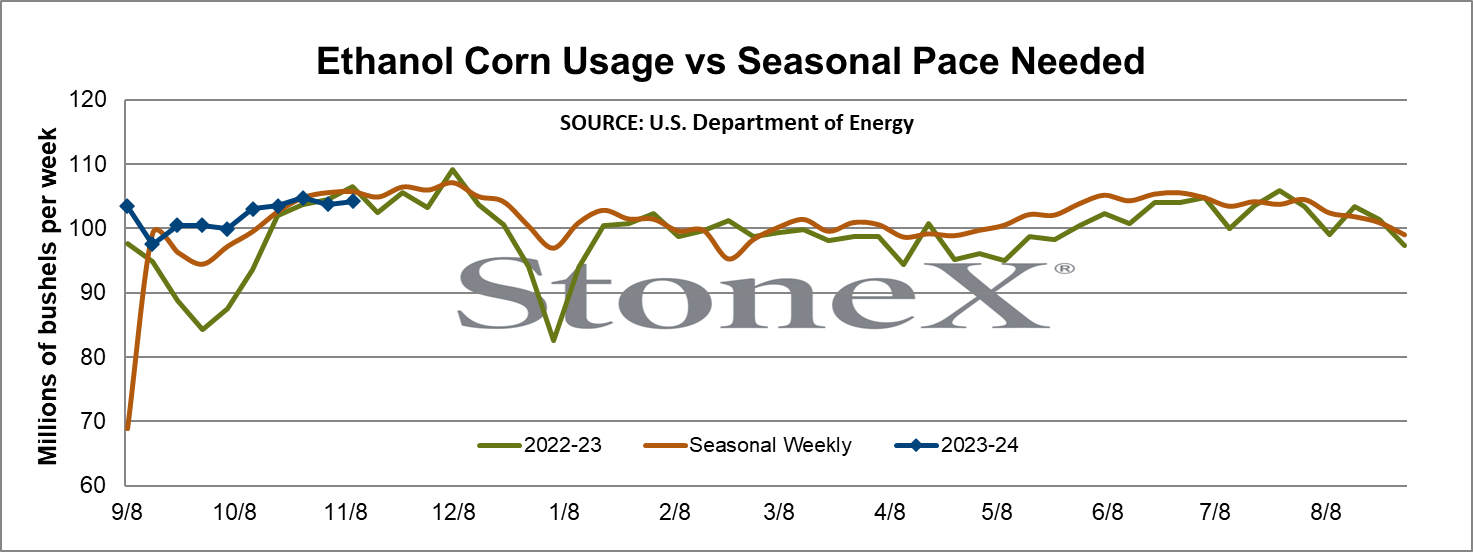
U.S. commercial crude oil inventories (excluding the Strategic Petroleum Reserve) increased by 3.6 million to 439.4 million barrels in the week ending November 10, putting them about 2% below levels typically seen in mid-November. Gasoline stocks fell by 1.5 million barrels, leaving them roughly 1% below seasonal levels. Distillate stocks dropped by 1.4 million barrels, putting them 13% below the five-year average for the middle of November. Ethanol stocks have been unchanged at 21 million barrels for the several weeks, down from 21.3 million in the same period last year. Ethanol production rose to 1,047K barrels per day in the week ending November 10, up from 1,042K bpd the previous week, and up from 1,011K bpd in the same week last year. The processing of corn for the production of ethanol rose to an estimated 104.2 million bushels in the week ending November 10, up from 103.7 million the previous week, and up from 102.5 million bushels in the same week last year. Estimated marketing year to date corn use for ethanol totals 1.035 billion bushels, up 39 million or 3.9% from the previous year's pace, and justifying USDA's recent 25 million-bushel increase in its target for the year. In fact, this remains one of the bright spots for demand this year, with more increases in the target possible in the months ahead. Another positive has been the pulling of cattle forward into feedlots due to the lingering drought, utilizing more grain for feed.