November 20 - Stocks trended weaker this morning on increased Wall Street nerves ahead of tonight's NVIDIA earnings report, and amid rising geopolitical risks in the Black Sea Region. The selling pushed the VIX to a two-week high near 19, with the dollar index trading notably higher to 106.9. Yields on 10-year Treasuries are trading near4.39% as money flows to the relative safety of government securities, while yields on 2-year Treasuries are trading near 4.29%. Crude oil prices are mixed to higher in this morning's trade. Wheat prices rallied modestly on the rising tensions in the Black Sea, pulling corn prices higher as well. Soybean prices were again under pressure today as soyoil prices fell sharply on demand worries amid a lack of 45Z guidelines for the liquid biofuel industry for 2025, and as weather conditions remain favorable in Brazil for a big harvest.
Ukraine fired missiles into Russia for a second straight day today. This time it reportedly fired British Storm Shadow cruise missiles into Russia, after firing U.S. ATACMS missiles into Russia yesterday. The new tactic of using western missiles deep inside of Russia to hit operations supporting Russia's invasion into Ukraine came after outgoing President Biden flipped his previous position that had opposed using U.S. weapons to hit targets deep inside of Russia. Biden reportedly flipped his position following reports that large quantities of North Korean troops were be deployed to the war in Ukraine. Some reports suggest that more than 10,000 North Korean troops have arrived to fight for Russia within Ukraine. For its part, Ukraine appears that it is trying to defend Russian territory that it seized over the summer in Kursk. Possessing that land may give it a bargain chip if incoming President Trump pushes the two sides to peace talks. In fact, both sides appear to be stepping up their attacks to gain leverage in those potential talks. The United States shut down its embassy in Kyiv today "out of an abundance of caution" due to an increased threat of a significant air attack.
Russian President Vladimir Putin is again throwing around the nuclear threat, but the markets aren't worried at this point that Putin will fire nuclear weapons upwind of Moscow. Rather, the wheat market is concerned that this rush to position for peace talks that might come in the early days of a Trump presidency might result in a tit-for-tat escalation of attacks on export infrastructure, or possibly even on civilian ships used to ship commodities - primarily wheat. That risk has long been present, raising the cost of insurance for ships traversing the region. But the market is building risk premium into the market on the possibility that ships might become unwilling to move through the Black Sea. That risk is still relatively low, which is why prices are still down at current levels, but the risk is slowly creeping upward. Corn shipments from Ukraine are also at risk, although the market is focused primarily on wheat. Regardless, we should see movement of wheat out of the Black Sea slow dramatically in the last half of the marketing year as stocks decline.
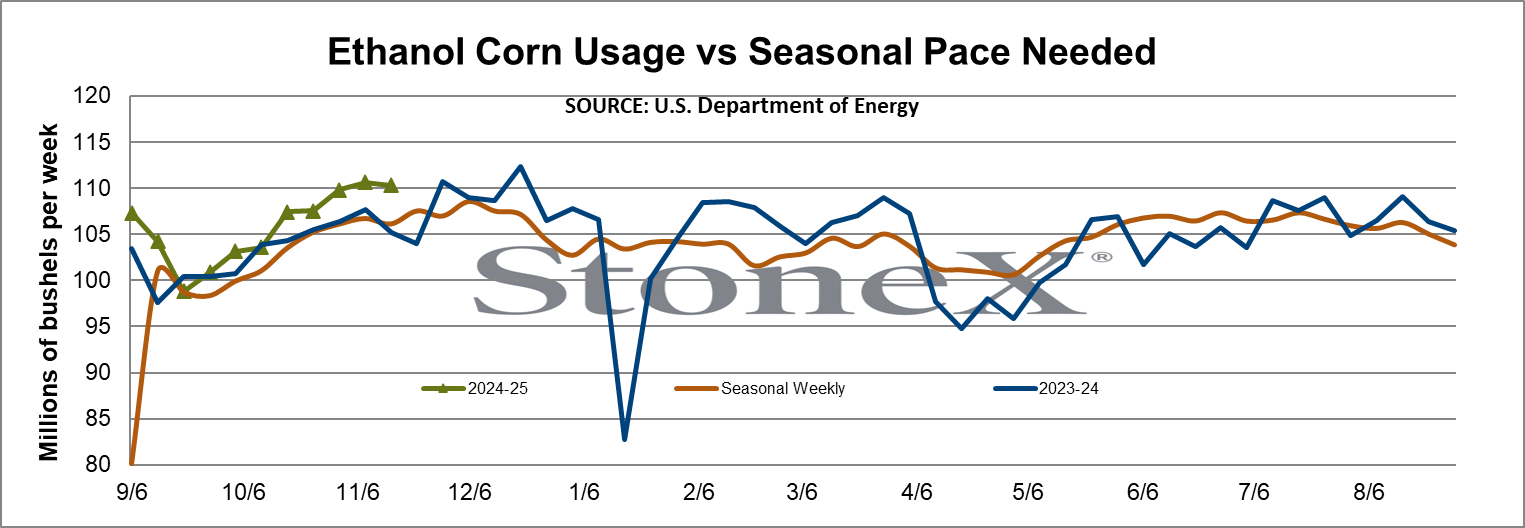
U.S. commercial crude oil stocks (excluding the Strategic Petroleum Reserve) rose by 0.5 million to 430.3 million barrels in the week ending November 15, leaving them still 4% below the five-year average for mid-November. Gasoline stocks increased by 2.1 million barrels, putting them also 4% below levels typically seen in mid-November. Distillate stocks dropped by 0.1 million barrels during the week, leaving them also about 4% below seasonal levels. Ethanol stocks rose to 22.6 million barrels in the week ending November 15, up from 22.0 million the previous week, and up from 21.7 million barrels at this point last year. Ethanol production slipped to 1,110K barrels per day last week, down from the previous week's record 1,113K bpd, but up from 1,023K bpd in the same week last year. The production of ethanol utilized an estimated 110.3 million bushels of corn in the week ending November 15, down from 110.6 million the previous week, but up from 105.2 million bushels in the same week last year. Estimated marketing year to date corn use for ethanol totals 1.148 billion bushels, essentially matching the previous year's pace, but more than 40 million bushels above the seasonal pace needed to hit USDA's target for the year.