October 18 - Any chances to sustain a rally in the equities is being contained by increasing tensions in the Middle East following the massive explosion at a Gaza Strip hospital that killed hundreds of Palestinians. The U.S. has examined evidence that the explosion was a product of a misfired rocket from Hamas, but those countries supporting Hamas are not expected to believe that in a time of war, so now they're threatening to escalate the war further. An escalated war threatens economic growth in the region, but it also directly impacts the output of crude oil and natural gas, with possible indirect implications for fertilizer and grain and oilseed prices. Equity traders are also worried about rapidly rising Treasury yields that threaten economic growth here in the States. Those yields pushed higher again this morning on data showing a rebound in U.S. housing starts.
The VIX is trading near 19 at this hour, reflecting slowly rising fear levels on Wall Street. The dollar index is higher near 106.6 as it follows Treasury yields higher. Yields on 10-year Treasuries are trading at fresh 16-year highs near 4.93%, while yields on 2-year Treasuries are trading at fresh 17-year highs near 5.24%. Crude oil prices are more than 1% higher as traders add war premium to prices, while grain and oilseed prices are mixed to mostly higher. Selling emerged in the soybean market when the lead November contract was unable to uncover significant buy orders above $13, while the same was true for the $13.20 level for the January contract. Selling has been limited though by a relatively tight balance sheet. Corn and wheat prices are generally in the green with modest gains at midday, although that still leaves them largely within their recent trading ranges.
It's largely a dry week in the highly productive area of Center-West Brazil. Dryness remains a concern in this region, although it is not yet considered to be a significant problem. Planting progress thus is just slightly behind the five-year average, with isolated reports of replanting needed due to dryness. Weather models suggest that rainfall should increase significantly as we get into next week, which could facilitate a rapid increase in the planting pace, and a good start for the crop. Chinese buyers are watching these developments closely to see how they impact basis and spreads in the Brazilian market that could make their prices more competitive with U.S. prices. China still needs to buy several million metric tons for November shipment yet, and it still needs to buy most of what it needs shipped for December and January. It's decisions around those purchases are expected to shape the soybean price outlook from this point forward. U.S. corn and wheat supplies are more than adequate currently, but that has not yet been determined for soybean supplies.
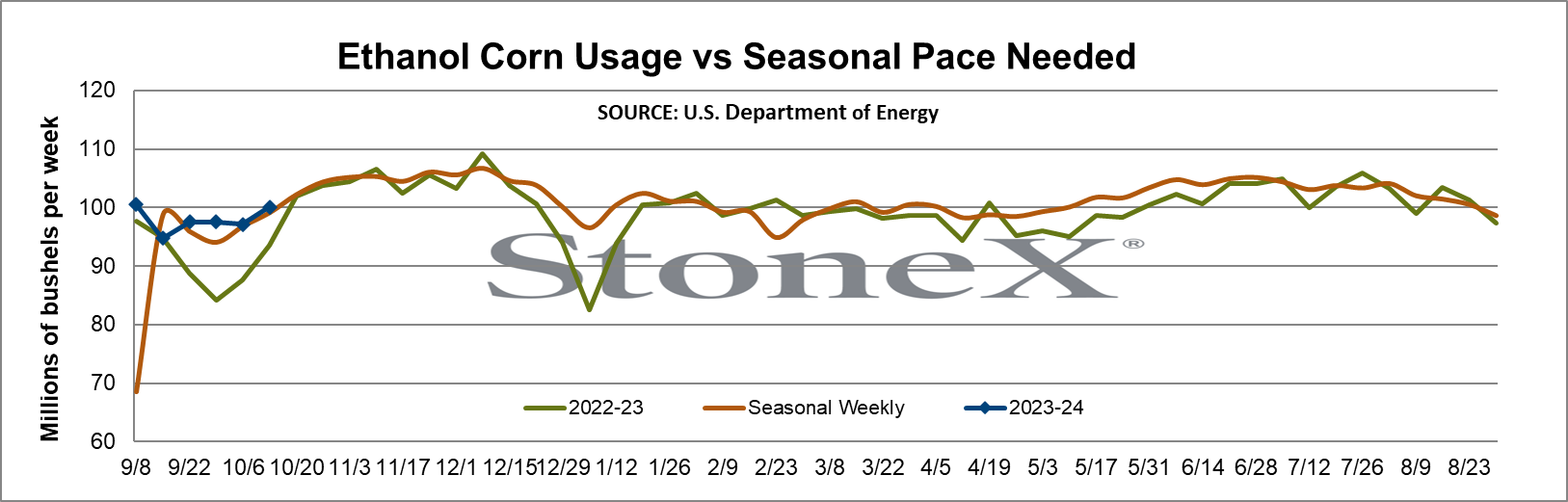
U.S. commercial crude oil inventories (excluding the Strategic Petroleum Reserve) fell by 4.5 million barrels in the week ending October 13, putting them 5% below the five-year average for the week. Gasoline stocks dropped by 2.4 million barrels, leaving them slightly above seasonal levels for mid-October. Distillate stocks decreased by 3.2 million barrels, putting them 12% below levels typically seen this time of year. Ethanol stocks slipped lower to 21.1 million barrels in the week ending October 13, down from 21.5 million the previous week, and down from 21.8 million bushels in the same week last year. They did so despite an increase in ethanol production to 1,035K barrels per day during the week, up from 1,004K bpd the previous week, and up from 1,016K bpd in the same week last year. The production of ethanol utilized an estimated 100.1 million bushels of corn last week, as shown below, up from 97.1 million the previous week, but down from 102.0 million bushels in the same week last year. Marketing year to date estimated corn use for ethanol totals 602 million bushels, up 23 million or 3.9% from the previous year's pace.