October 23 - Both stocks and commodities tried to firm off their lows in today's trade. Commodities have been somewhat successful in sustaining that move, while remaining largely in negative territory, while stocks turned lower on disappointing housing data and higher Treasury yields. The VIX is trading near 19 at midday, while the dollar index continues to trade strong near 104.4. Yields on 10-year Treasuries are trading near 4.22%, while yields on 2-year Treasuries are trading near 4.06%. Crude oil prices are more than 1% lower on higher domestic stocks, while grain and oilseed prices are mixed, after trading mostly lower overnight.
Soybean prices are probing into positive territory at midday, pulling corn higher as well. The market is impressed with recent export sales for both, but it is particularly encouraged by the soybean sales. USDA will update weekly sales on Thursday, and we should see a noticeable improvement in the sales pace. Last week's weekly report showed marketing year to date soybean export sales still trailing the seasonal pace needed to hit USDA's target of 1.850 billion bushels by 137 million bushels, although we should see that deficit shrink over the next couple of weeks. Brazil's planting delays are not expected to shrink the size of its next crop, but they are expected to delay its harvest, which should increase Chinese purchases somewhat, moving us a bit closer to USDA's aggressive target for the year. As for corn, marketing year to date sales exceed the seasonal pace needed to hit USDA's target by 20 million bushels, and we're adding to that surplus. Cheap prices are a cure for cheap prices as they stimulate additional demand. The farmer remains a reluctant seller, which is resulting in the firming of basis in some areas, with the national average basis for both corn and soybeans trending higher despite how the rapid harvest is pushing a lot of bushels into a very tight storage situation.
Existing home sales fell to an annualized rate of 3.84 million units in September, marking a 14-year low, as potential home buyers wait for the highly advertised rate cuts. The September sales were down from 3.88 million units the previous month, and below analyst expectations of 3.90 million. The National Association of Realtors, who released the data, speculated that buyers are waiting for lower interest rates, as has been largely advertised by the market, as well as the results of the upcoming election. Meanwhile, the supply of homes is increasing, bringing it now up to a 4.3-month supply. The industry normally sees a 4 - 7 month supply as a healthy balance, so the supply is back into the low end of that range. Yet, prices are continuing to rise, with the median existing home price now at $404,500, up 3% year-on-year, as sellers are aware that the supply is still relatively tight and that pent up demand is expected to pick up with those anticipated lower mortgage rates. That too will contribute to reinflation when/if it occurs. Currently, those rates are moving higher already anticipating a return of inflation.
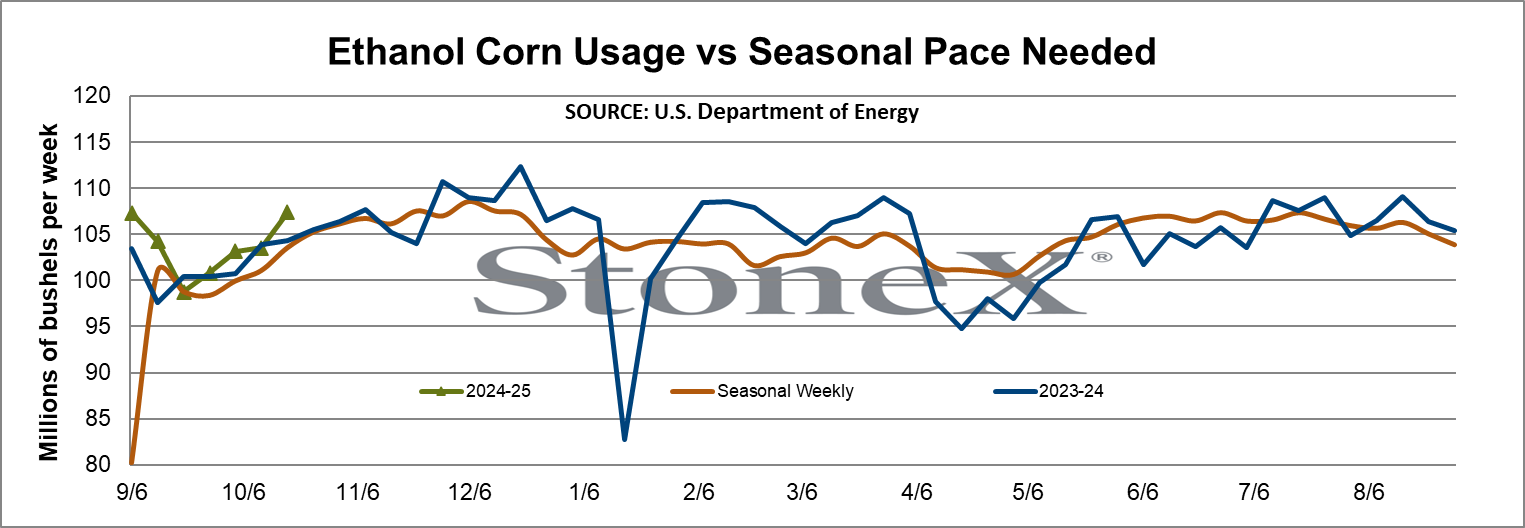
U.S. commercial crude oil inventories (excluding the Strategic Petroleum Reserve) rose by 5.5 million to 426 million barrels in the week ending October 18, putting them roughly 4% below the five-year average for mid-October. Gasoline stocks increased by 0.9 million barrels, leaving them 3% below levels typically seen in mid-October. Distillate stocks dropped by 1.1million barrels, leaving them 9% below seasonal levels. Ethanol stocks slipped to 22.2 million barrels in the week ending October 18, down from 22.3 million the previous week, but up from 21.4 million barrels in the same week last year. Ethanol production rose to 1,081K barrels per day last week, up from 1,042K bpd the previous week, and up from 1,040K bpd the previous year. The production of ethanol utilized an estimated 107.4 million bushels of corn in the week ending October 18, as shown below, up from 103.5 million the previous week, and up from 104.4 million bushels in the same week last year. That brings estimated marketing year to date corn use for ethanol production to 710 million bushels, which roughly matches the previous year's pace, but it remains a bit ahead of the seasonal pace needed to hit USDA's target for the year.