October 24 - Stocks remained mixed and choppy at midday as traders continue to digest earnings reports amid mixed economic data. This morning's weekly jobless claims and economic activity data raised flags with rising continuing claims, while PMI survey data and new home sales data was solid. The VIX inched upward closer to 20 during the morning, while the dollar index is currently trading near 104.2. Yields on 10-year Treasuries are trading near 4.20%, while yields on 2-year Treasuries are trading near 4.04%. Crude oil prices are now 1% weaker, after being higher earlier in the morning, while the grain and oilseed markets continue to be mixed, with corn and soybean prices hanging onto modest gains following strong export sales data, while wheat prices are mixed to weaker as they try to remain competitive.
The PMI composite flash index for October came in at 54.3, which was up modestly from 54.0 in September. A number above 50 indicates month-on-month expansion. However, a breakdown in the data finds that the above strength continues to largely be carried by the service sector, while the manufacturing sector remains in a recession. The manufacturing PMI index came in at 47.8, up from 47.3 the previous month, and above analyst expectations of 47.6. The services PMI index was 55.3 for October, up from 55.2 the previous month, and above analyst expectations of 55.0. In other words, there was little change in October data from the previous month, other than some slight improvement.
New home sales rose to an annualized rate of 738K in September, up from 709K in August, up from analyst expectations of 718K, and above the highest end of trade expectations. This is a better showing than this week's existing home sales data, and the highest in nearly a year and a half. The total was lifted by declining mortgage rates, with surging sales in the Northeast driving the move. The median price of a new home rose to $426,000 in September, up from $410,900 the previous month. The supply of new homes available fell 3.8% month-on-month in September.
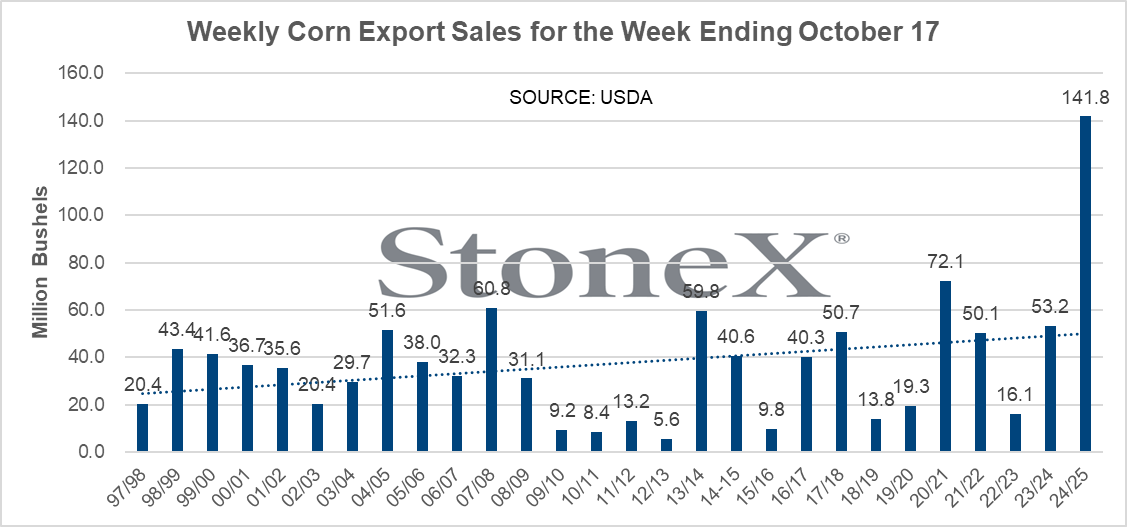
Exporters sold 141.8 million bushels of the current-year corn crop in the week ending October 17, which is second only to a massive sale of 292.8 million bushels that China compiled to announce the week of Joe Biden's inauguration in January 2021. This morning's USDA weekly export sales report also showed another 22.9 million bushels of next year's crop sold during the same week. Most of that was sold to Mexico, along with 66.1 million bushels of the current-year sales total. "Unknown destinations" also bought a net 45.4 million bushels of this year's corn crop in the week ending October 17. That may have been Mexico as well, or it might be a combination of various destinations, which we will learn when freight is arranged. Current marketing year to date corn export sales through October 17 total 924 million bushels, which exceeds the 10-year seasonal pace needed to hit USDA's target by 125 million bushels. There have been another 58.1 million bushels of known corn export sales over the past week that will show up in next week's report, along with other possible sales that did not show up in the daily flash reports.
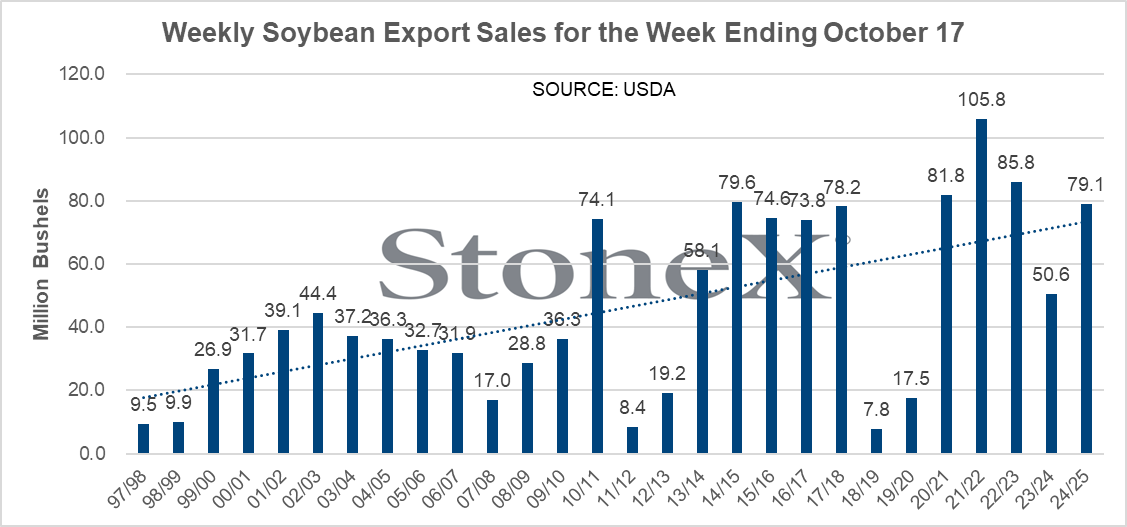
Exporters sold 79.1 million bushels of soybeans in the week ending October 17, which is also a new marketing year high. China was the featured buyer during the week at a net 47.4 million bushels, although 14.6 million bushels of that total were already on the books as previous sales to "unknown destinations." Marketing year to date soybean export sales total 882 million bushels. That still falls short of the 10-year seasonal pace needed to hit USDA's target by 100 million bushels, although the deficit is shrinking. Another 46.3 million bushels of sales have appeared in USDA's daily flash sale announcements over the past week that will show up in next Thursday's weekly report, along with other possible sales that were not previously reported. This morning's weekly report also included 19.6 million bushels of wheat sales and 2.8 million bushels of grain sorghum sales.