October 30 - Optimism reigns eternal on Wall Street ahead of Wednesday's policy statement from the Federal Reserve, leading to gains in stocks to start the week. Traders are optimistic that the Fed will have a positive message of a soft landing for the economy. Ironically, the next Fed statement comes before critical jobs data to be released on Friday. Nonetheless, Wall Street chooses to be upbeat. Even so, that optimism is somewhat contained by the headline risk coming from the war in the Middle East, where intense fighting continues to raise risks for the war to escalate into a broader regional conflict. The VIX is trading near 21 this morning, reflecting moderately escalated anxiety on Wall Street. The dollar index is trading near 106.3. Yields on 10-year Treasuries are trading near 4.90%, while yields on 2-year Treasuries are trading near 5.05%. Crude oil prices are more than 2% lower, while the grain and oilseed markets are mixed at mid-morning. Kansas City wheat prices posted a fresh two-year low overnight, before bargain buying lifted prices off their lows into positive territory this morning, providing support for the other two wheat markets as well. That helped corn prices to firm to mixed mid-morning. Soybean prices remained mostly in the red, but with good support thus far beneath them due to lingering dryness concerns in Center-West Brazil that is sending more export business our way. USDA is expected to release its first condition ratings for the winter wheat crop this afternoon, reflecting better conditions than we've seen in several years.
Soybean traders are increasingly focused on dry weather in Center-West Brazil, which is predominantly Mato Grosso and surrounding areas. This is the most productive area of Brazil from a total production standpoint, partially because Mato Grosso is 1.3 times the size of the state of Texas. The dryness thus far gives us about a 10-point delay in the planting progress, but that's not a big concern for total production. Farmers can plant late, and still produce a normal crop if sufficient rains fall. That's not a guarantee at this point, but the bigger risk comes down the road when the safrinha corn crop gets planted late due to a delayed soybean harvest.
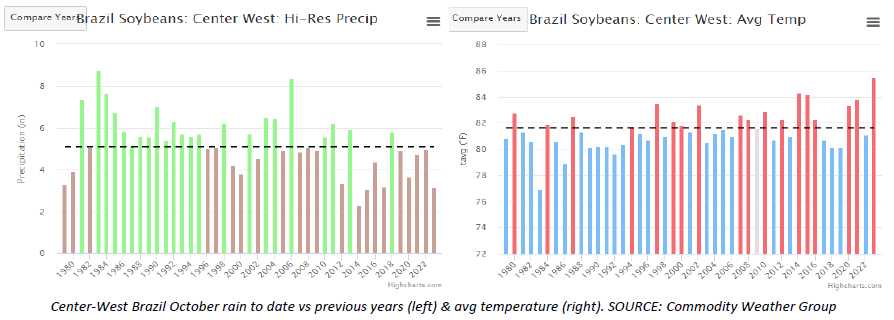
Normal rainfall for October is better than 5", with rains month-to-date down better than a third from normal. Rains were better in the first half of the month than they've been in the second half, which is contrary to normal. The region would typically get about 1.1" per week to start the month, with that rising to better than 1.6" per week to end the month. Some areas received more than 5" this month - mostly early in the month, while other areas have not yet received much more than a light shower or sprinkle. Thus, planting has been sporadic. Nonetheless, planting progress as of Friday was at 74% in Mato Grosso, down from 83% the previous year. Planting progress for all of Brazil was at 43%, down from the previous year's pace of 50%. The left graphic below shows rainfall for Center-West Brazil month-to-date versus the past four-plus decades on the left, with average temperatures for the region versus the same time period on the right. Note that it's been notably warmer than normal this month, with much of that dryness and heat focused on the past two weeks. Forecasts continue to keep the elusive rains a week out. The longer-term models remain optimistic, but we need to see those rains move forward in the forecast. Normal rainfall is near 7" for November and increases to more than 9" in December, but right now we simply need a good rain across the region to get the crop started. The crop will remain at risk until that happens.