September 10 - Stocks are mixed at midday as traders digest the latest inflation and interest rate cut projections, while also considering the potential implications of the presidential election ahead of tonight's debate between the candidates. That leaves a cautious tone spreading across Wall Street at midday. The VIX firmed to trade near 20, while the dollar index is trading near 101.6. Yields on 10-year Treasuries are trading near 3.66%, while yields on 2-year Treasuries are trading near 3.62%. Crude oil prices are more than 4% lower to fresh 16-month lows, while the grain and oilseed complex is mixed at midday.
Tropical Storm Francine is expected to strengthen to category 1 hurricane strength later today, amid expectations that it will make landfall on the Louisiana Coast tomorrow afternoon. Our StoneX energy analysts note that Louisiana has 2.97 million barrels per day of crude oil refining capacity, which amounts to 16% of U.S. total refining capacity. Some flash flooding is expected in the days ahead, which may interrupt operations. Oil and gas platforms in the Gulf in the path of Francine are already evacuating non-essential personnel. Crude oil and gas production is not expected to be dramatically impacted by the storm unless she strengthens much more than currently expected. Gulf waters are warm enough to support that, but Francine currently lacks the organization to strengthen beyond category 1 levels. Francine is currently expected to travel up the Mississippi River Valley to the boot hill of Missouri, bringing rains with it into the Ohio River Valley - covering many areas that desperately need the moisture. It will also help boost river levels on the Mississippi River ahead of harvest, although more rains in the basin will be needed in the weeks ahead. Cotton with open bolls (70 - 80% of the crop in the region) will be vulnerable to losses in the path of Francine, along with early soybeans if the rains linger, but the region should benefit overall from the rains.
Soybean prices plummeted by more than 20 cents per bushel at times today, with the November contract trading back below the psychological $10 per bushel level today. Modest losses were also seen in the corn market, although December corn continues to hold above the psychological $4 per bushel level. USDA's weekly crop progress and condition report Monday afternoon revealed stable crop ratings from the previous week at a time of year when the ratings typically are declining. That suggests that observers are still quite impressed with this year's crops, keeping ratings well above the long-term averages for early September, raising concerns that USDA might raise its yield estimates in its September WASDE crop report on Thursday. This will be the first report of the year in which corn and soybean production estimates will be based in part on actual field sampling, in addition to farmer surveys and satellite data. The estimates will go a long way in communicating whether this year's big crops are still getting bigger, or whether the market has sufficiently priced in the size of the crops. Yet, that still doesn't eliminate the risk of bushels moving onto the market due to storage shortages amid the anticipated rapid harvest of two record crops in the weeks ahead - another reason that the recent rally has stalled.
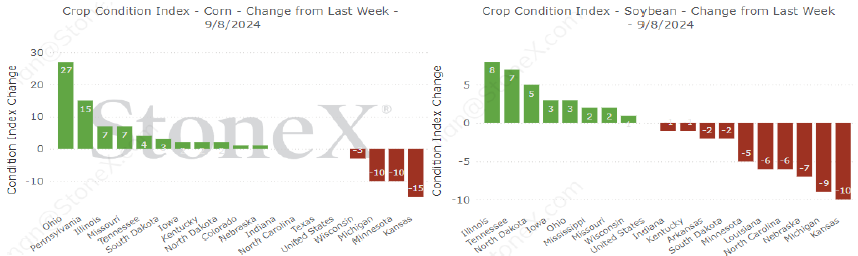
This week's changes in condition index scores for the corn and soybean crops by state are shown below. The U.S. numbers did not change this week, but most states did see changes in their condition index scores. The condition index score takes all five rating categories into account. Some states saw significant improvements over the past week, while other states saw significant declines, but the biggest differences overall were seen in the soybean crop. USDA continues to release these ratings until harvest progress exceeds 50% of the crop. As such, the ratings from mid-September on until they quit typically reflects more about what surveyors hear from farmers about whether their yields are coming in higher or lower than expected. Crop ratings tend to rise into October if yields are better than expected, while they tend to decline if yields are disappointing. That's because these ratings are subjective in nature, and they tend to be influenced by what those filling out the weekly surveys are hearing from farmers who they encounter each week.