September 23 - A risk-on sentiment spread across Wall Street to start trade this week, with generally upbeat economic data supporting optimism already in place falling the Federal Reserve's 50-basis point rate hike last week. The VIX is trading near 16 today, while the dollar index is trading near 100.8. Yields on 10-year Treasuries are trading near 3.74%, after making new 19-day highs, while yields on 2-year Treasuries are trading near 3.58%. Positive money flow supported both stocks and commodities to start trade today. Crude oil prices fell contrary to much of the rest of the markets, while the grain and oilseed markets - which had built the largest short positions this summer - are seeing the greatest strength. Traders pointed to dry weather in Brazil and in the Black Sea to provide fundamental support for what was really more about money flow than it was about the fundamentals of supply and demand this morning.
The Chicago Fed national activity index for August rose to 0.12, reflecting above-trend economic growth, although modestly so. That beats expectations of a 0.00 reading, and counters a downward revision of the July number to -0.42. That downward revision dropped the three-month moving average to -0.17, down from -0.13 originally. The flash composite PMI index for September came in stronger than expected at 54.4, down from an upwardly revised 54.6 final number for August, which was stronger than expected, but up from analyst expectations of 53.0. The manufacturing index continued to reflect contraction at 47.0, down from 47.9 the previous month and down from analyst expectations of 47.0. However, the services index was stronger at 55.4, down slightly from an upwardly revised 55.7 final number for August, but above analyst expectations of 55.2. It was interesting to note that prices charged for goods and services rose at their fastest pace in six months in today's data.
USDA inspected 43.4 million bushels of corn for export shipment in the week ending September 19, as shown below, along with 17.8 million bushels of soybeans, 3.1 million bushels of grain sorghum, and a two-year high 26.1 million bushels of wheat. The portion of the above that was inspected specifically for shipment to China included 6.3 million bushels of soybeans, along with very miniscule amounts of corn and wheat. The wheat inspections mentioned above for shipment bring marketing year to date inspections for shipment to all destinations to 282 million bushels, up 92 million bushels or 48% from the previous year's more than a quarter of the way through the new marketing year. That exceeds the seasonal pace needed to hit USDA's target by 18 million bushels, and the gap is growing.
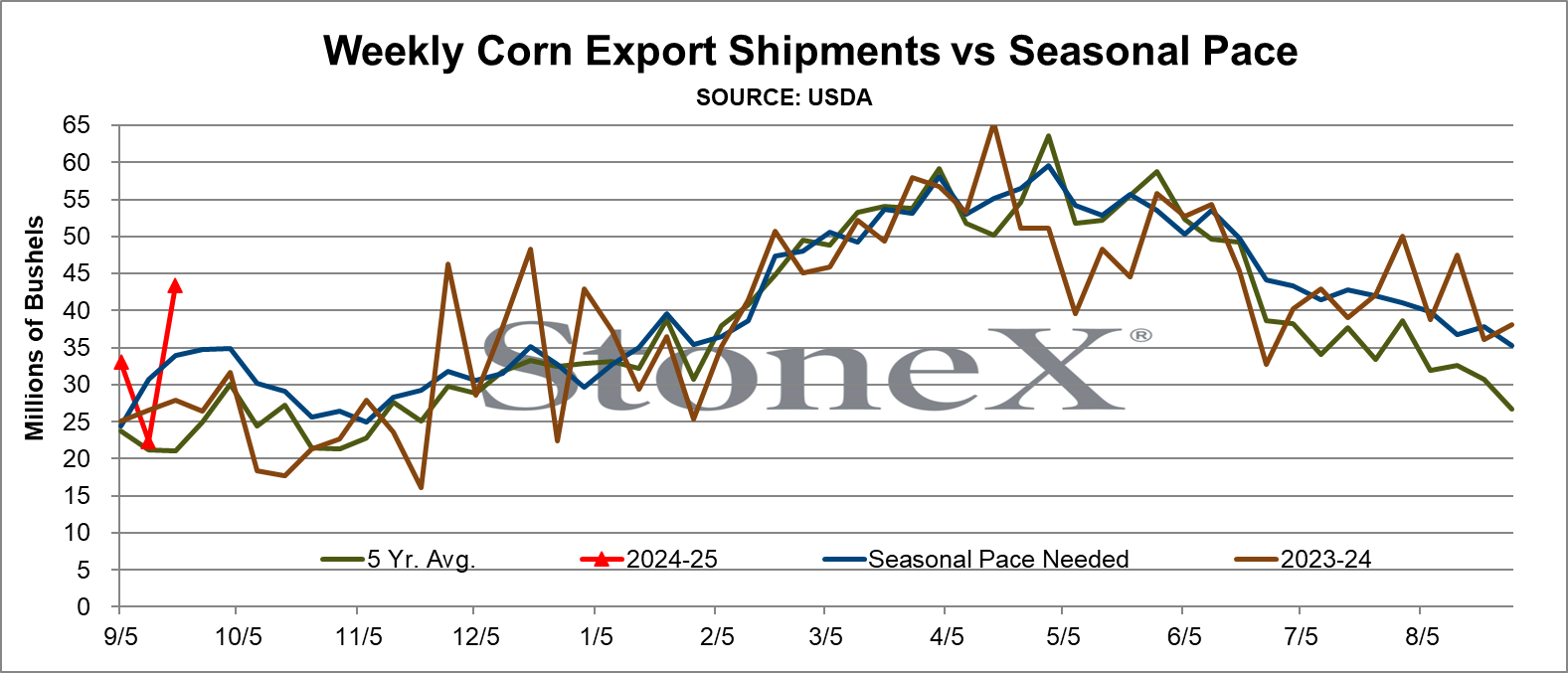
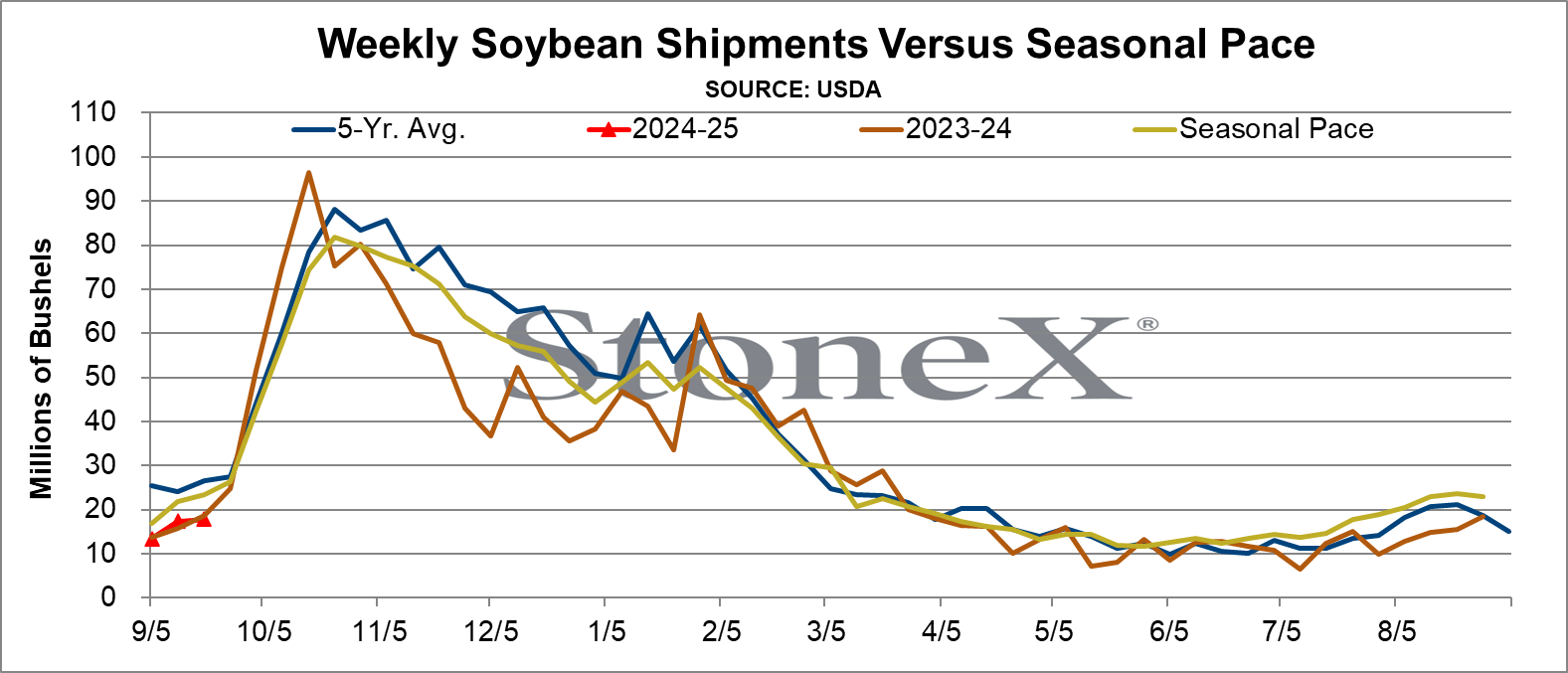
Marketing year to date corn export inspections total 84.4 million bushels through the first three weeks of the year, up from 79.6 million bushels the previous year. Corn export inspections have varied widely through the first three weeks, as shown below, with the latest weekly total being a five-week high. We can beat USDA's export target if we maintain a strong pace supported by smaller crops in the Black Sea and in South America, but that's probably more of a story for the last half of the marketing year. Marketing year to date soybean export inspections total just 45.3 million bushels, down from 48.2 million bushels at this point last year, and already 17 million bushels below the seasonal pace needed to hit USDA's aggressive target for the year. That's largely because USDA has thus far inspected just 11 million bushels for shipment to China in the new marketing year, which is its lowest total for this date since Hurricane Ida slowed things up in 2021. The pace needs to quickly pick up over the next couple of weeks to avoid developing a much larger deficit in soybean shipments.