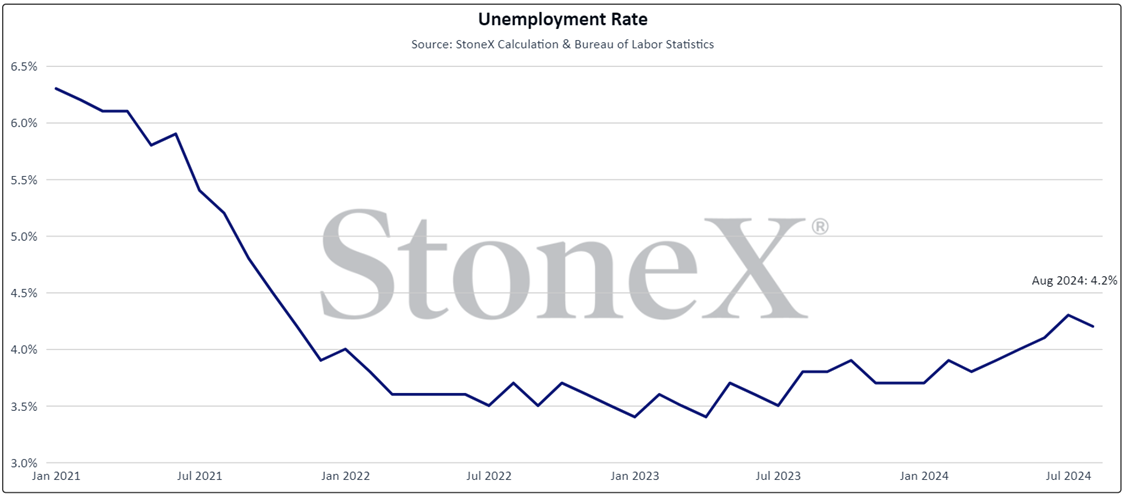
September 6 - Stocks slid lower on recession fears as we moved through the morning following the release of the latest monthly jobs report. The unemployment rate actually ticked lower this morning, as shown below, but traders focused on the slowdown in job creations. Two members of the Federal Open Market Committee made public appearances this morning, with both repeating the message from Fed Chair Jerome Powell at Jackson Hole, Wyoming last month - that the time for rate cuts has arrived. Fed Governor Christopher Waller indicated that he is open to larger cuts as well, indicating that he's been an advocate of front-loading cuts. That gave a brief surge in stocks, but then the selling returned once again as recession fears returned. That set a negative tone overall for the broader markets as we close out the week.
The major stock indices set fresh three-week lows this morning as those recession fears mounted once again. The VIX rose to trade near 23 late morning, while the dollar index traded near 101.0. Yields on 10-year Treasuries are trading near 3.69%, while yields on 2-year Treasuries are trading near 3.68%. Crude oil prices are trading 1.8% lower near $68 per barrel, while the grain and oilseed sector is weaker once again. Corn prices initially found support from strong weekly export sales, but gains quickly found fresh buyers as the recent solid rally begins to falter amid a flood of U.S. corn on the horizon, combined with big supplies in Brazil as well. Similar dynamics are at work in the soybean market as well. Wheat enjoyed a nice rally over the past couple of weeks, but Russian cash wheat prices remain weak.
Much of the recent price strength was money flow related, with the funds beginning to take profits on massive short positions as prices reached new multi-year lows. Upside risk for these fund managers becomes greater than downside risk at these low price levels, providing an incentive to claim a portion of their profits. That doesn't mean that we can't make new lows, but it does ease concerns of doing so in the near-term. Fundamentally, wheat traders point toward lingering drought hindering winter wheat planting in the Black Sea Region - especially in Russia. Dryness is also a factor in portions of the U.S. Southern Plains, Australia and Argentina, along with portions of Europe. That's probably more of a story later in the marketing year when we see Black Sea cash prices finally firm. Corn traders can also point toward a smaller crop in the Black Sea, and an expected smaller crop in Argentina due to a big shift toward soybeans in the upcoming growing season, but again that's more of a story for the second half of the marketing year. Both corn and soybean traders are keeping their eyes on dry soils in Brazil. That's not unusual for the dry season, but the question revolves around when will the seasonal monsoon rains return? The models currently suggest that the monsoon rains will return in early October. That's a bit late, but that's still soon enough to eliminate significant crop concerns, although confidence remains low this far out.
Meanwhile, the focus remains on the massive size of this year's U.S. corn and soybean crops. One can argue about the final yields, but there's growing consensus that they will be record large, with an overall dry pattern expected to facilitate rapid harvest. That will stretch storage capacity, pushing more bushels onto the market during the gut slot of harvest increasing pressure to both basis and futures. That may or may not produce new lows for futures, but the mere threat of what lies ahead is expected to cap rally potential until we get the bulk of this crop in the bin. The exception to that would be a bullish black swan event that is currently not on the radar.