May 13 – Traders got more good news to digest this morning in the form of better-than-expected U.S. inflation data, though stocks are off to a mixed open to start trade, with Nasdaq and S&P 500 in the green but the Dow Jones taking a slight breather after yesterday’s sharp gains. Optimism has certainly been bolstered by improvements in trade and geopolitical tensions, with Wall Street’s fear index putting in another low since late March below the 18 level to start the session. The dollar is also looking to take a breather to start the day after spiking to a month-plus high yesterday, though the current 101.4 level remains well above recent trade. Treasuries are relatively quiet after making sharp gains of their own yesterday, with 10-year yields near 4.45% and 2-year yields near 3.97%. Crude oil is adding to yesterday’s gains as demand expectations improve, with nearby WTI hovering around $62.50 this morning after breaking above $63.50 for the first time since late April yesterday. The ags are mixed, with the grains and oilseeds mostly lower but the livestock sector again pushing higher as both live and feeder cattle futures continue to make fresh all-time highs.
Headline CPI fell to 2.3% year-on-year in April, below market expectations of holding steady at March’s 2.4% and marking the lowest level seen since February 2021. In month-on-month terms, headline CPI rose 0.2%, up from the -0.1% decline seen in March but still below market expectations of a 0.3% rise. Much of the improvement came from a 3.7% decline in energy costs, largely driven by an 11.8% drop in gasoline, while food and transportation both saw improvements as well. Excluding the more volatile items like food and energy, core CPI rose 0.2% month-on-month, also below expectations of a 0.3% rise, while the 2.8% year-on-year increase matched analyst estimates and held steady with March. After all the doom and gloom hanging over the broader markets in the last few months, this is certainly welcome news. We’ll get another round of fresh inflation data at the producer level with April PPI due out on Thursday morning.
The U.S. is cutting the de minimis tariff for low-value items (up to $800) imported from China down to 54% from its previous 120% level, following up on the weekend’s move by both sides to reduce tariffs dramatically after their meeting in Switzerland. De minimis shipments have skyrocketed in the 2020’s era of online shopping, with more than 90% of packages to the U.S. coming via this channel, and around 60% of that volume coming from China. While we’re clearly still a very long way from the finish line when it comes to U.S. and China trade relations, the developments of the last few days are the most positivity we’ve seen in months and give both sides more time to negotiate a larger deal. It is worth pointing out, however, that even the now drastically lower tariffs on Chinese goods still represent significant increases and will continue to have a material impact on trade between the two countries, as well as implications for the prices of goods to the U.S. consumer down the road.
Elsewhere in the world of diplomacy, President Trump arrived in Saudi Arabia today to begin a four-day trip through the Middle East which will also include stops in Qatar and the United Arab Emirates. The focus of this trip is not on security ties in the region, however, but rather to discuss the potential growth of economic ties. Markets will be keeping a close eye on these meetings for announcements of deals, including potential steps toward materializing a previously mentioned sizable U.S. investment from the Saudis. Additionally, it’s been reported this morning that U.S. diplomats Steve Witkoff and Keith Kellogg will be traveling to Istanbul on Thursday to take part in peace talks between Russia and Ukraine. President Trump also floated the idea of attending the peace talks himself while he’s in the region, though it remains unclear whether or not that will happen.
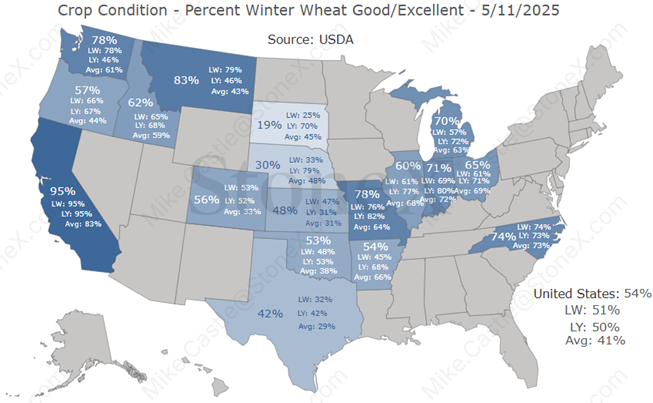
The grain markets have a plethora of data to digest following yesterday's first glimpse at USDA’s 2025/26 balance sheets in addition to their weekly Crop Progress report after the close. The May WASDE was certainly more bullish than expected (save for wheat), with both corn and soybean ending stocks being pegged at tight enough levels to keep an impactful weather scare in play, though the demand side of the equation may prove overly optimistic barring a trade deal with China that forces them to buy from the U.S. even if we are a significant premium to South America and other origins. Bearish pressure is being felt this morning from the better-than-expected progress for the spring season, however, as U.S. corn (62% complete), soybean (48%), and spring wheat (66%) planting all came in ahead of market expectations. Winter wheat conditions were also sharply ahead of expectations, rising 3% week-on-week to 54% good/excellent versus analyst estimates of holding steady at 51%. This is now the best national rating seen at this point of the season in six years, weighing on the wheat complex as July Chicago, KC, and Minneapolis wheat futures all grind out fresh contract lows this morning.