RECAP: Excessive Rainfall Threatens Colombia’s Main Harvest
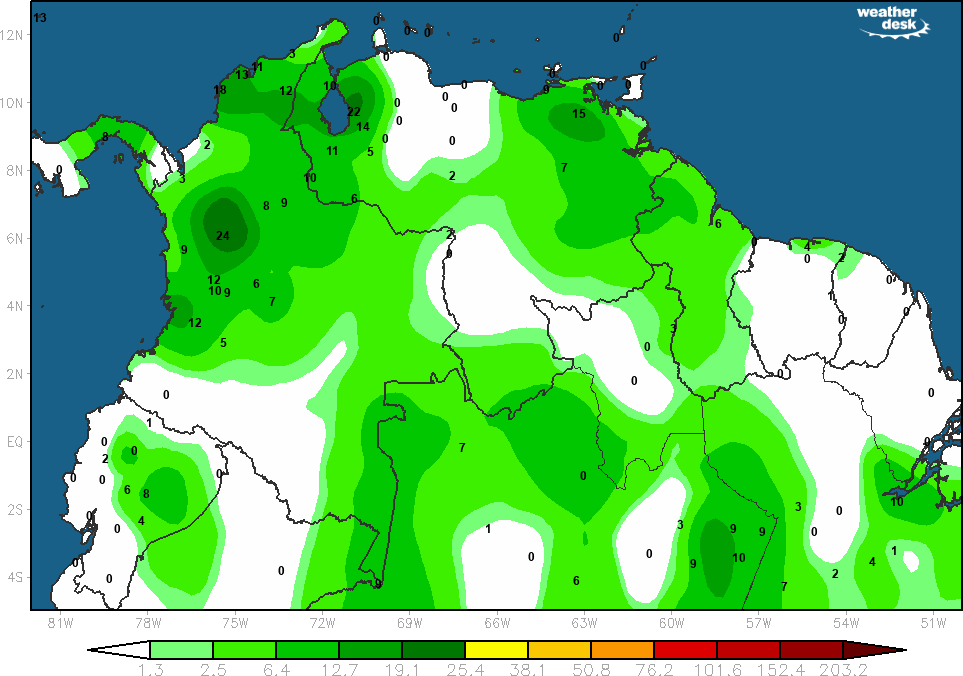
Bogotá (Coffee Network) - Excessive rains, lack of sunlight and torrential downpours have destroyed coffee roads in Colombia, where the main harvest is threatened by the country’s second’s rainy season that worsens with the potential La Niña arrival.
Rare events such as hailstorm were registered in the town of Curiti, in the eastern province of Santander. While tertiary roads in the central province of Caldas are making it more difficult to transport beans to coffee cooperatives.
Colombia, the world’s third largest coffee exporter, is expected to pick its main harvest during September-December with at least 7.5 million bags but the supply of high-quality Arabica beans may be at a stake because of abnormal rainfall.
Torrential rains associated with the country’s second rainy season, along with the potential arrival of La Niña, have exacerbated rainfall, which most likely could reduce Arabica supply in 2021 and 2022, analysts said.
A 69% probability of cooling of the waters of the tropical Pacific Ocean increases the possibility of the development of a La Niña phenomenon. In the coming months, this cooling will favor increased rainfall in much of the country, the Colombia’s weather office Ideam said.
According to the records of the National Unit for Disaster Risk Management (UNGRD), disasters have been registered in 161 municipalities, while 26 departments have registered some type of event associated with rainfall in August. Until now, August was a dry month.
In addition, more than 20,500 families are affected, seven people have lost their lives, eight have been injured and there is one missing person.
The departments with the greatest effects are: Norte de Santander, Cundinamarca, Antioquia, Córdoba, Sucre, Bolívar and Tolima.
In Caldas, the tertiary roads that connect Pensilvania-Puerto López-Puerto Arenas-Arboleda and Salamina-La Palma-La Quiebra-San Félix are closed because of landslides.
Marco Tulio Velez, the director for the coffee committee of Caldas- the country’s fifth-largest producer- said heavy machinery of the Government of Caldas works on different roads to reestablish the roads, which should not affect the transportation of beans.
The main harvest in Caldas, which weights 70% of the department’s total output, could grow to as much as 900,000 bags during this main harvest compared with the 770,000 bags that it collected in the same period last year. Their main harvest goes until the last week of November in Caldas.
Caldas began collecting beans in August, but the harvest will not be concentrated as in previous years because of the torrential rains. IN October, they expect two weeks of high coffee concentration for picking and the harvest will drag on until November.
“Rainfall have increased in a severe way in July and August,” he said. Caldas weights 8% of the country’s total output. Last year, it contributed with 1.08 million bags. The province has 66,000 hectares dedicated to coffee.
Around 12% of Caldas coffee plantations are vulnerable to a roya attack, and those plantations have seen an increase of roya incidence. Roya, which attacks coffee leaves, exacerbates during periods of high humidity.
In the northern Caribbean province of Magdalena, authorities have declared yellow alert amid a potential rise of rivers that run along the coffee-producing area of Sierra Nevada de Santa Marta. In Magdalena’s capital a downpour that lasted six hours created widespread destruction in the cities of Santa Marta and Taganga.
Colombia picks its main coffee harvest in the months of September, October, November and December in the central provinces of Caldas, Risaralda, Antioquia, North of El Valle del Cauca, and some areas of Huila, the country’s coffee-largest producer.
LOGISTIC BOTTLENECKS
Another event that could further hit global Arabica supply is the shortage of containerships, which are impacting Peruvian and Colombian coffee exports.
In Peru, the lack of cointainer ships failed to ship beans through the Callao port in a new incident that is affecting coffee exporters in the region as Colombian exporters have also been hurt by the logistics restriction. An international coffee trader, who preferred to remain anonymous, told Coffee Network, they have failed to ship beans to the US through the Peruvian Callao port because the shipping companies MSC, Hapag and CMA are not granting space for coffee shipments because they are running out of space as they only have one frequency each day.
The coffee exporter said they are willing to pay extra costs so long as shipping companies take their coffee “because we have commitments that we must fulfill,” he said. Exporters are asking the Peruvian government-controlled promotion office Promperu to start mediating to find a solution.
The Peruvian coffee and cocoa association have acknowledged that shortage of containers are hitting Peruvian coffee exports.
Disruption of shipping containers are once again preventing Colombian coffee to reach its destination since two weeks ago because some shipping companies are not docking on Colombian Pacific ports, prompting a delay of coffee exports, sources told Coffee Network.
The disruption begun on August 20 when the shipping agency Hamburg Sud declined to dock on the Pacific port of TcBuen, one of the four terminals that host the city of Buenaventura. Another shipping companies including MSC are not docking in Sociedad Portuaria de Buenaventura, people familiar with the situation including three exporters told Coffee Network.
Disruption of shipping containers in which shipping carriers have concentrated their vessels on their most popular routes — those linking North America and Europe to Asia and leaving behind those from South and Central America, created problems for coffee exports earlier this year in Guatemala and Colombia.
But the situation worsened after road blockades in May and June forced to shut down Colombian Pacific ports, which run out of space to receive import and export cargo. The situation prompted shipping agencies to do not stop on Colombian Pacific ports, and the disruption has dragged on until now, hitting coffee exports, the commercial director of the Colombian coffee growers federation told Coffee Network last week.
With the lack of containerships, coffee growers and exporters have had to resort to shipments through the Caribbean port of Cartagena, incurring in additional expenses.
According to Gustavo Gomez, director Asoexport, the Colombian private exporters association, trucking costs to move coffee from some regions of Colombia to the Caribbean port could increase freight costs between 30%-70% depending on when the coffee is being produced. For instance, coffee growers located in the southeastern province of Huila, which are almost two days away from Cartagena most likely pay 70% in extra shipping costs.
By Diana Delgado
This material should be construed as market commentary and represents the opinions and viewpoints of the author, and does not reflect tailored advice associated with any specific account.
The views are current only through the date stated and are subject to change at any time based upon market or other conditions, and StoneX Group Inc. (“SGI”) disclaims any responsibility to update such views. Actual results, performance, or achievements may differ materially from those expressed or implied. Information is based on data gathered from what we believe are reliable sources. Past performance does not guarantee future results.
The StoneX Group Inc. group of companies provides financial services worldwide through its subsidiaries, including physical commodities, securities, exchange-traded and over-the-counter derivatives, risk management, global payments and foreign exchange products in accordance with applicable law in the jurisdictions where services are provided.
References to certain OTC products or swaps are made on behalf of StoneX Markets, LLC (SXM), a member of the National Futures Association (NFA) and provisionally registered with the U.S. Commodity Futures Trading Commission (CFTC) as a swap dealer. SXM’s products are designed only for individuals or firms who qualify under CFTC rules as an ‘Eligible Contract Participant’ and who have been accepted as customers of SXM.
StoneX Financial Inc. (SFI) is a member of FINRA/NFA/SIPC and registered with the MSRB. SFI is registered with the U.S. Securities and Exchange Commission (SEC) as a Broker-Dealer and with the CFTC as a Futures Commission Merchant and Commodity Trading Advisor. StoneX Financial (Canada) Inc. (SFCI) is registered in Canada and is a member of CIRO and CIPF. References to certain securities trading are made on behalf of the BD Division of SFI and are intended only for an audience of institutional clients as defined by FINRA Rule 4512(c). References to certain exchange-traded futures and options are made on behalf of the FCM Division of SFI. Wealth Management is offered through SA Stone Wealth Management Inc., member FINRA/SIPC, and SA Stone Investment Advisors Inc., an SEC-registered investment advisor, both wholly owned subsidiaries of SGI.
R.J. O’Brien & Associates, LLC (RJO) is registered with the CFTC as a Futures Commission Merchant and is a member of NFA.
StoneX Financial Ltd (SFL) is registered in England and Wales, company no. 5616586. SFL is authorized and regulated by the Financial Conduct Authority (FCA) (registration number FRN:446717) to provide services to professional and eligible customers including: arrangement, execution and, where required, clearing derivative transactions in exchange traded futures and options. SFL is also authorized to engage in the arrangement and execution of transactions in certain OTC products, certain securities trading, precious metals trading and payment services to eligible customers. SFL is authorized and regulated by the FCA under the Payment Services Regulations 2017 for the provision of payment services. SFL is a category 1 ring-dealing member of the London Metal Exchange. In addition SFL also engages in other physically delivered commodities business and other general business activities which are unregulated and not required to be authorized by the FCA.
This communication is issued in the European Economic Area by StoneX Financial Europe GmbH (SFEG). StoneX is the trade name used by STONEX GROUP INC. and all its associated entities and subsidiaries. StoneX Financial Europe GmbH (“SFEG”) is a securities trading firm registered in Germany under Company No. HRB 80844.
StoneX APAC Pte. Ltd. (“SAP”) (Co. Reg. No 200616676W) is regulated as a Dealer (PS20190001002) under the Precious Stones and Precious Metals (Prevention of Money Laundering and Terrorism Financing) Act 2019 for purposes of anti-money laundering and countering the financing of terrorism. SAP is an “Approved International Trading Company” authorized to act as a “Spot Commodity Broker” under the Commodity Trading Act.
StoneX Financial Pte Ltd (Co. Reg. No 201130598R) (“SFP”) is regulated by the Monetary Authority of Singapore and is a Capital Markets Service Licence holder (for dealing in capital market products), an Exempt Financial Adviser (for advising on investment products and issuing or promulgating analyses/ reports on investment products) and a Major Payment Institution (for domestic and cross-border money transfer services).
SFP may distribute analysis/report produced by its respective foreign affiliates within the StoneX Group of companies pursuant to an arrangement under Regulation 32C of the Financial Advisers Regulations Recipients should contact SFP at (65) 6309 1000 for any matters arising from, or in connection with, this webinar.
StoneX APAC Pte. Ltd. (“SAP”) (Co. Reg. No 200616676W) is regulated as a Dealer (PS20190001002) under the Precious Stones and Precious Metals (Prevention of Money Laundering and Terrorism Financing) Act 2019 for purposes of anti-money laundering and countering the financing of terrorism.
StoneX Financial (HK) Limited (CE No.: BCQ152) (“SHK”) is regulated by the Hong Kong Securities and Futures Commission for Dealing in Securities and Dealing in Futures Contracts.
StoneX Financial Pty Ltd (ACN 141 774 727) holds an Australian Financial Service License (AFSL: 345646) for Dealing in Securities, Exchange-Traded Derivatives Contracts, OTC Derivatives Contracts and Foreign Exchange Contracts, and is regulated by the Australian Securities and Investments Commission.
StoneX Securities Co., Ltd. (“SSJ”) (Co. Reg. No 010401047199) is regulated by the Japanese Financial Services Agency as a Type-I Financial Instruments Business Operator (Kanto Local Finance Bureau (FIBO)No.291’), is a member of the Financial Futures Association of Japan for dealing and broking FX and FX Option transactions, and is a member of the Japan Securities Dealers Association for dealing and broking stock indices and option transactions.
Trading swaps and over-the-counter derivatives, exchange-traded derivatives and options and securities involves substantial risk and is not suitable for all investors. Past performance of any futures or option is not indicative of future success. Indicators are not a trading system and are not published as a specific trade recommendation. The information herein is not a recommendation to trade nor investment research or an offer to buy or sell any derivative or security. It does not take into account your particular investment objectives, financial situation or needs and does not create a binding obligation on any of the StoneX group of companies to enter into any transaction with you. You are advised to perform an independent investigation of any transaction to determine whether any transaction is suitable for you. No part of this material may be copied, photocopied or duplicated in any form by any means or redistributed without the prior written consent of StoneX Group Inc.
The report/analysis herein is not directed to, or intended for distribution to or use by, any person or entity who is a citizen or resident of or located in any locality, state, country or other jurisdiction where such distribution, publication, availability or use would be contrary to law or regulation.
© 2026 StoneX Group Inc. All Rights Reserved.